
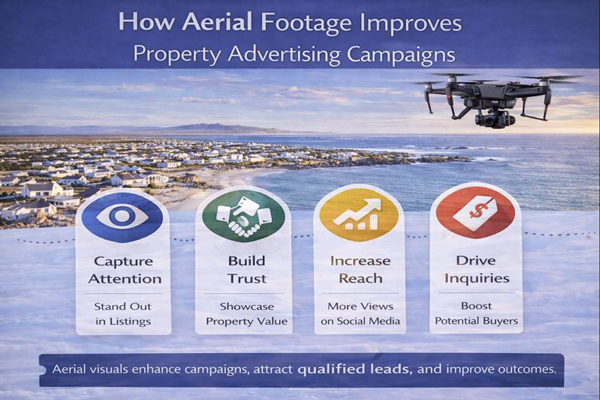
How Aerial Footage Improves Property Advertising Campaigns
Property advertising has changed fundamentally over the last decade. Buyers no longer encounter properties in a single place or format. They move across platforms, devices, and attention spans, often interacting with the same listing multiple times in different contexts before making a decision.
In this environment, advertising performance is not driven by exposure alone. It is driven by how well a property holds attention, communicates value, and builds confidence across every touchpoint. Aerial footage has become one of the most effective tools for achieving this, not because it looks impressive, but because it solves several structural problems in modern property advertising.
This article analyses how aerial footage improves property advertising campaigns by supporting multi-platform delivery, increasing attention retention, reinforcing premium brand perception, and improving performance across websites, portals, and social media. The focus is on campaign effectiveness rather than visual novelty.
The Core Challenge in Modern Property Advertising
Property advertising no longer operates in a linear funnel.
Buyers do not simply see an advert, click through, and book a viewing. Instead, they encounter fragments of information across different channels. A social media clip. A listing portal thumbnail. A website hero video. A follow-up remarketing ad.
Each exposure is brief, often unplanned, and judged in isolation.
The challenge for property advertising is therefore not just to inform, but to re-engage. A campaign must repeatedly earn attention and reinforce perception across multiple platforms without feeling repetitive or disconnected.
Aerial footage plays a unique role in solving this challenge because it works across formats while retaining meaning.
Why Multi-Platform Advertising Demands Versatile Visuals
Modern property campaigns span several platforms simultaneously.
Property portals prioritise thumbnails and short clips.
Websites rely on hero visuals and background video.
Social media favours short-form, scroll-stopping content.
Paid advertising requires adaptable assets for multiple placements.
Each platform has different technical and behavioural constraints, but they share one requirement: visuals must communicate quickly.
Aerial footage performs well across these contexts because it delivers information at a glance. It shows location, scale, and surroundings immediately, without requiring explanation.
This versatility makes aerial footage an efficient core asset within a broader campaign rather than a one-off enhancement.
Aerial Footage as a Campaign Anchor
Effective campaigns are anchored by a small number of strong visual assets that can be repurposed.
Aerial footage often serves as that anchor because it establishes context that all other media can build upon. Interior photography shows what the property is like inside. Aerial footage shows where it exists and how it relates to its environment.
Once this context is established, other visuals make more sense.
In West Coast campaigns, particularly around Saldanha Bay, this anchoring effect is critical. Buyers often care deeply about proximity, openness, and surroundings. Aerial footage answers those questions early, allowing subsequent advertising to reinforce rather than explain.
Attention Retention Starts With Immediate Orientation
Attention in advertising is fragile.
Buyers scrolling through feeds or portals decide within seconds whether to engage further. Visuals that require interpretation lose attention quickly. Visuals that orient the viewer immediately retain it.
Aerial footage excels at orientation.
From a single frame or short clip, viewers can understand:
– The position of the property
– Its relationship to neighbouring homes
– The character of the surrounding area
– The sense of space or openness
This rapid orientation reduces cognitive load. Viewers do not have to work to understand what they are seeing. As a result, they are more likely to keep watching.
Retention improves not because the footage is dramatic, but because it is efficient.
Why Attention Retention Matters More Than Reach
Reach without retention is wasted spend.
Many property advertising campaigns achieve broad exposure but fail to convert interest because viewers disengage too quickly. They may recognise the advert but never develop enough understanding or confidence to act.
Aerial footage improves retention by providing meaningful information early. Viewers who understand context are more likely to watch longer, click through, or revisit the listing later.
In advertising terms, this increases the quality of impressions rather than just their quantity.
Reducing Scroll Fatigue in Social Media Advertising
Social media environments are hostile to traditional property advertising.
Users are not actively searching for property. They are scrolling quickly, filtering aggressively, and reacting emotionally rather than logically.
In this context, interior photos often fail. They look similar to countless other images and require context that social feeds do not provide.
Aerial footage interrupts this pattern.
The unfamiliar perspective draws attention. The sense of scale and location provides instant interest. Even users not actively looking for property may pause to watch.
This pause is valuable. It creates brand awareness and familiarity that can influence later decisions when the buyer enters an active search phase.
Aerial Footage and Brand Perception
Advertising does not only promote a property. It also communicates brand standards.
The quality of visuals reflects the perceived quality of the agent, developer, or seller. Poor visuals suggest low effort. Strong visuals suggest professionalism and confidence.
Aerial footage contributes significantly to premium brand perception when used correctly.
It signals investment. It suggests that the property has been marketed intentionally rather than casually. It implies that the advertiser understands modern marketing expectations.
In coastal markets like the West Coast, where lifestyle and aspiration are central, these signals matter.
Premium Perception Without Overstatement
Premium perception does not come from exaggeration.
Buyers are wary of overproduced content that feels misleading. The strength of aerial footage lies in its clarity rather than its drama.
By showing real surroundings from a neutral perspective, aerial footage feels transparent. Transparency builds trust. Trust supports premium perception without triggering scepticism.
This balance is particularly important in Saldanha Bay advertising, where buyers may be sensitive to over-marketing due to varied neighbourhood character.
Aerial Footage as Proof Rather Than Promise
Effective advertising reduces reliance on claims.
Rather than stating that a property is well positioned, aerial footage shows it. Rather than describing openness or spacing, it demonstrates it visually.
This shift from promise to proof improves advertising credibility.
Buyers are more likely to accept messages that are supported visually. They do not feel sold to. They feel informed.
In advertising campaigns, this reduces resistance and increases receptiveness.
Improving Campaign Consistency Across Touchpoints
One of the most common weaknesses in property advertising campaigns is inconsistency.
Different visuals are used on different platforms. Messaging feels fragmented. Buyers struggle to connect what they see on social media with what they later see on portals or websites.
Aerial footage helps unify campaigns by providing a consistent visual reference point.
The same aerial clip can appear in social media ads, website headers, and listing videos. This repetition builds recognition without redundancy.
Consistency improves recall, which is essential in longer buyer journeys.
Website Performance and Aerial Video
Property websites and landing pages rely heavily on first impressions.
Hero visuals determine whether visitors stay or leave. Aerial footage performs well in this role because it establishes context immediately.
Visitors understand where the property is before they scroll. This reduces bounce rates and increases engagement with supporting content.
In West Coast campaigns, where websites often serve as credibility anchors rather than primary lead sources, this improved engagement supports overall campaign performance.
Supporting Interior Media Rather Than Competing With It
Aerial footage does not replace interior photography or video. It enhances their effectiveness.
When buyers understand context, interior visuals feel grounded. Rooms are no longer abstract spaces. They are parts of a larger environment.
This grounding improves interpretation. Buyers are better able to imagine how the property fits into their lifestyle.
From an advertising perspective, this means that every piece of media performs better when supported by aerial context.
The Role of Aerial Footage in Remarketing
Remarketing relies on familiarity.
Buyers who have seen a property before are more likely to engage again if the visual cue triggers recognition. Aerial footage is particularly effective for this because it is distinctive.
An overhead or oblique aerial shot is easier to recognise than a generic interior image. When used in remarketing ads, it can quickly re-anchor the property in the viewer’s memory.
This improves click-through and reinforces perceived importance.
Campaign Performance Beyond Clicks
While clicks and views are measurable, many benefits of aerial footage are indirect.
It improves the quality of enquiries.
It shortens the decision cycle.
It reduces misunderstandings before viewings.
It supports price confidence.
These outcomes may not be attributed directly to a single advert, but they affect overall campaign success.
Aerial footage contributes to these outcomes by reducing uncertainty and building confidence early.
Why Aerial Footage Matters More in Competitive Markets
In markets with high inventory, buyers have more choice and less patience.
Advertising must work harder to differentiate listings and retain attention. Generic visuals are penalised through disengagement.
Aerial footage offers differentiation without relying on gimmicks. It provides information competitors may not show or may show poorly.
In West Coast markets, where many properties share similar interior styling, this differentiation can be decisive.
Cost Efficiency at Campaign Level
While aerial footage has an upfront cost, its campaign-level efficiency is often overlooked.
One aerial shoot can produce assets for multiple platforms, formats, and timeframes. These assets can be reused, repurposed, and integrated into future campaigns.
Compared to producing multiple platform-specific visuals from scratch, aerial footage often delivers a strong return on investment.
Efficiency improves when assets are versatile and durable.
Avoiding the Pitfall of Decorative Aerials
Aerial footage is only effective when used strategically.
Random flyovers or purely decorative shots add little value. They may look impressive but fail to communicate useful information.
Effective aerial footage is purposeful. It shows boundaries, spacing, orientation, and relationship to surroundings.
In advertising campaigns, purpose-driven aerials perform better than visually dramatic but informationally empty ones.
Aerial Footage as Part of a System
The strongest property advertising campaigns are systems, not collections of assets.
Aerial footage works best when integrated with photography, copy, targeting, and timing. It should support the campaign objective rather than exist independently.
When treated as part of a system, aerial footage amplifies the effectiveness of every other element.
Measuring Success Through Behavioural Signals
While exact attribution can be difficult, behavioural signals often reveal the impact of aerial footage.
Longer video watch times
Higher engagement on ads
Improved enquiry quality
Reduced basic clarification questions
These signals indicate that buyers are better informed and more confident.
Campaigns that generate these signals consistently outperform those that rely on generic visuals.
Closing Perspective
Property advertising performance is shaped by how quickly and clearly a campaign communicates value across platforms.
Aerial footage improves this performance by providing immediate context, retaining attention, reinforcing premium perception, and supporting consistency across advertising touchpoints.
In West Coast and Saldanha Bay campaigns, where location and surroundings are central to buyer decisions, aerial footage is not a visual extra. It is a structural advantage.
When used strategically, it reduces friction, improves engagement quality, and strengthens the overall effectiveness of property advertising campaigns.
If you are planning a property advertising campaign and want visuals that support performance rather than simply adding decoration, aerial footage should be considered a core asset. Used correctly, it does not just enhance advertising. It makes it work harder and more efficiently across every platform.


