
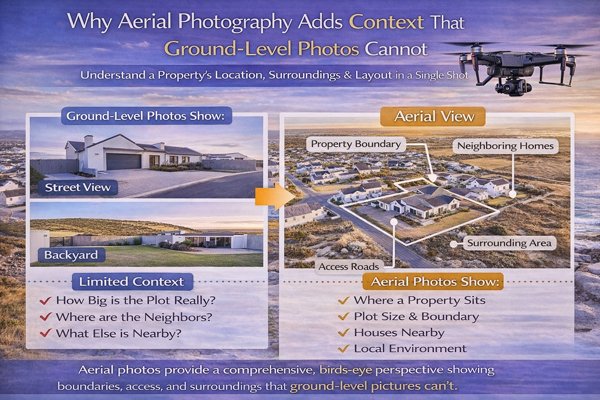
Why Aerial Photography Adds Context That Ground-Level Photos Cannot
Property buyers do not struggle to see what a house looks like. They struggle to understand where it sits, how it relates to its surroundings, and whether it makes sense as a place to live. This gap between appearance and understanding is one of the biggest weaknesses in traditional property marketing.
In Vredenburg and across the West Coast, this gap shows up repeatedly. Listings rely heavily on ground-level photos that show rooms, facades, and finishes, yet buyers still arrive at viewings uncertain. They ask basic questions that should already have been answered. They feel disoriented. They need time to mentally place the property before they can even begin evaluating it properly.
Aerial photography exists to solve this exact problem. It does not replace ground-level photos. It completes them. It adds context that ground-level images simply cannot provide, no matter how well they are shot.
Understanding why this matters requires looking closely at how buyers interpret photos, where confusion enters the process, and how aerial perspective changes buyer confidence long before a viewing takes place.
Why Buyers Struggle to Understand Properties From Photos Alone
Most buyers believe they are good at reading listings. In reality, they are piecing together fragments.
Ground-level photos show isolated moments. A living room from one corner. A kitchen from another. An exterior shot taken from the street. Each image may be clear on its own, but together they do not always form a coherent whole.
Buyers are left trying to answer bigger questions on their own. How large is the plot really. Where does the house sit on it. How close are neighbouring buildings. What lies behind the property or just out of frame.
In Vredenburg, where neighbourhood layouts, plot shapes, and surrounding land use can vary significantly from street to street, this lack of clarity is especially noticeable. Buyers often arrive at viewings needing time to orient themselves before they can even assess the home.
That initial confusion weakens confidence.
The Limits of Ground-Level Perspective
Ground-level photography is inherently limited by walls, fences, and angles.
From eye level, it is difficult to show boundaries clearly. It is hard to communicate depth and spacing. Surroundings are often cropped out, either unintentionally or because they do not fit neatly into the frame.
Even excellent ground-level photos cannot show how a property sits within its broader environment. They can suggest space, but they cannot define it. They can hint at views, but they cannot map relationships.
As a result, buyers often misinterpret scale and position. They may assume more privacy than exists, or less. They may imagine open land where there are neighbouring homes, or vice versa.
These misunderstandings are not minor. They shape how buyers feel about the property before they ever arrive.
How Aerial Photography Changes Spatial Understanding
Aerial photography changes the point of view entirely.
By lifting the camera above the property, buyers are given a complete spatial overview. They can see boundaries, plot shape, access points, and the relationship between the property and its surroundings in a single image.
This perspective answers questions buyers often do not know how to ask.
How much space is actually around the house.
How close are the neighbours.
Where does the road run in relation to the property.
What sits beyond the back fence.
In West Coast towns like Vredenburg, where properties can sit next to open land, commercial zones, or dense residential areas, this information is critical. Aerial photography provides it instantly and intuitively.
Boundary, Position, and Surroundings Become Clear
One of the most valuable contributions of aerial photography is boundary clarity.
Buyers want to know what they are buying, not just inside the walls but around them. Ground-level photos often hide boundaries unintentionally, especially where fencing, hedges, or elevation changes exist.
From the air, boundaries become visible. Buyers can see where the property begins and ends, how it is positioned on the plot, and how neighbouring properties relate to it.
This visibility reduces assumption. Buyers no longer need to imagine worst-case scenarios. They can assess reality for themselves.
Position is equally important. Whether a property sits centrally on a plot, closer to one boundary, or aligned in a particular way affects privacy, light, and usability. Aerial images make this obvious.
How Surroundings Influence Perception
Surroundings are not neutral. They influence how a property is experienced every day.
Buyers care about what is nearby, even if they do not articulate it clearly. Busy roads, open fields, neighbouring buildings, and access routes all affect perceived value.
Ground-level photos often avoid showing surroundings because they are difficult to frame attractively. This avoidance, intentional or not, increases buyer suspicion.
Aerial photography removes the need for avoidance.
By showing surroundings openly, it communicates transparency. Buyers feel that nothing is being hidden. This openness builds trust and allows buyers to evaluate suitability honestly.
In Vredenburg, where land use can vary and future development may be a concern, this transparency is particularly valuable.
How Aerial Images Reduce Uncertainty
Uncertainty is one of the biggest barriers to buyer confidence.
When buyers are unsure about layout, position, or surroundings, they become cautious. They scrutinise more. They question more. They look for problems rather than possibilities.
Aerial photography reduces this uncertainty by replacing guesswork with clarity.
Instead of imagining how a property sits, buyers see it. Instead of wondering about spacing, they understand it. Instead of worrying about what lies beyond the frame, they know.
This reduction in uncertainty changes buyer behaviour. Buyers feel calmer and more open. They engage with listings for longer and arrive at viewings better prepared.
Why Reduced Uncertainty Leads to Stronger Confidence
Confidence grows when expectations match reality.
Aerial photography helps align buyer expectations before a viewing takes place. When buyers arrive and recognise what they saw online, trust is reinforced.
There are fewer surprises. Less time spent orienting. More time spent evaluating how the property feels and whether it fits their needs.
In West Coast markets like Vredenburg, where buyers may travel specifically for viewings, this alignment is crucial. Confident buyers are more receptive, more positive, and more decisive.
Context Changes How Buyers Compare Properties
Buyers rarely evaluate properties in isolation. They compare.
Without aerial context, comparisons often focus on interiors and finishes. Properties begin to blur together. Decisions become price-driven.
Aerial photography shifts comparison to more meaningful factors. Plot size, spacing, surroundings, and position become visible and comparable.
This helps buyers understand why one property may be better suited to them than another, even if interiors are similar.
Context-driven comparison leads to better decisions and fewer regrets.
Why Context Matters More Than Detail Early On
Detail matters, but timing matters more.
Buyers need context before they can appreciate detail. Without understanding where a property sits and how it relates to its surroundings, interior details feel abstract.
Aerial photography provides that foundation.
Once context is established, buyers can interpret ground-level photos more accurately. Rooms make sense in relation to the plot. Outdoor spaces feel grounded rather than imagined.
This sequencing improves comprehension and confidence.
Aerial Photography as a Trust Signal
Buyers associate openness with honesty.
Listings that include aerial imagery feel more transparent. Buyers sense that they are being shown the full picture rather than a carefully cropped version.
This perception builds trust before any conversation with an agent takes place.
Trust, in turn, affects how buyers approach price, negotiation, and commitment.
Why Ground-Level Photos Alone Can Feel Incomplete
Ground-level photos are essential, but alone they often feel unfinished.
Buyers may not consciously notice what is missing, but they feel it. Something does not quite add up. They cannot fully picture the property in their mind.
Aerial photography fills that gap.
It turns a collection of images into a complete story. Buyers move from seeing rooms to understanding a place.
The Role of Aerials in Modern Property Marketing
Modern buyers expect more clarity than ever.
They are used to maps, satellite views, and spatial tools in everyday life. When property listings fail to provide similar context, they feel outdated.
Aerial photography aligns property marketing with how buyers already consume information. It feels intuitive rather than impressive.
This alignment improves engagement and confidence.
Why Aerial Context Matters in Vredenburg and the West Coast
In Vredenburg and across the West Coast, properties often derive value from their relationship to land, space, and surroundings.
Whether it is proximity to open areas, separation from neighbours, or the nature of nearby development, context shapes desirability.
Aerial photography communicates this context efficiently and honestly.
Aerial Photography Is About Clarity, Not Promotion
There is a misconception that aerial photography is about making properties look more impressive.
In reality, its greatest strength is clarity.
It shows what exists. It reduces ambiguity. It aligns expectation with reality.
Buyers respond positively to this clarity because it allows them to make informed decisions.
How Context Improves Buyer Confidence Before Viewings
By the time a buyer books a viewing, their confidence is already influenced by what they have seen.
Aerial photography helps ensure that confidence is based on understanding rather than assumption.
Confident buyers arrive ready to engage, not to investigate. They ask better questions and move more decisively.
Closing Perspective
Ground-level photos show what a property looks like. Aerial photography shows where it belongs.
In Vredenburg and across the West Coast, aerial imagery adds essential context that ground-level photos cannot provide. It clarifies layout, reveals boundaries and surroundings, reduces uncertainty, and builds buyer confidence long before a viewing takes place.
If you are considering how to improve the clarity and effectiveness of your property marketing, aerial photography is one of the most powerful tools available. If you would like advice or a quote on aerial photography or a broader property marketing approach, you are welcome to get in touch to discuss what would best suit your property.


