
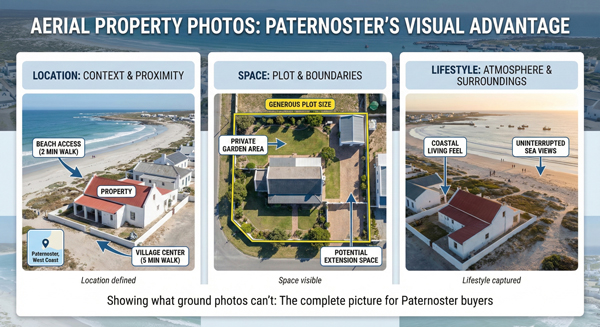
Aerial Property Photos: Showing Location, Space, and Lifestyle in Paternoster
Property marketing succeeds when buyers understand where a home is, how it sits in its environment, and what kind of life it supports. In coastal towns like Paternoster, these factors often matter more than square metres or finishes alone.
Buyers drawn to Paternoster are not only comparing houses. They are comparing settings, atmosphere, and long-term lifestyle fit. Aerial property photos play a central role in that comparison because they reveal information that ground-level photography simply cannot show with clarity.
This article explores how location-driven buyer decisions work, why proximity to the coastline and amenities shapes demand, how space and layout influence perceived value, and how aerial imagery enables lifestyle storytelling that resonates with buyers in Paternoster and across the West Coast.
The Core Problem: Buyers Cannot Visualise the Bigger Picture
Most property listings are built from the inside out. They prioritise interior rooms, finishes, and details, then move outward to show a façade or street view. While this approach is familiar, it leaves buyers with a fragmented understanding of the property.
Buyers often struggle to answer fundamental questions:
• How close is the home to the coastline
• How open or dense is the surrounding area
• How much space exists between neighbouring properties
• How the plot relates to roads, footpaths, or amenities
• What kind of daily lifestyle the location supports
When buyers cannot visualise these elements clearly, they hesitate. Hesitation reduces engagement and weakens perceived value.
Aerial property photos exist to close this gap.
Location-Driven Buyer Decisions in Coastal Markets
In coastal towns, location is not a secondary consideration. It is the primary driver of demand.
Buyers choosing Paternoster are often motivated by:
• Proximity to the sea
• Walkability and access to amenities
• Openness and views
• Neighbourhood character
• Long-term lifestyle suitability
Interior quality matters, but it rarely outweighs location. Buyers are willing to compromise on finishes more readily than on setting.
Aerial imagery places location at the centre of the conversation.
Why Buyers Need to See Location, Not Just Read About It
Descriptions can state that a property is “close to the beach” or “well positioned,” but buyers rarely trust words alone.
They want visual confirmation.
Aerial photos provide that confirmation by showing:
• Distance to the coastline
• Orientation of the home relative to the sea
• Relationship between the property and surrounding streets
• The broader layout of the neighbourhood
Seeing these elements removes doubt and replaces assumption with understanding.
Proximity to the Coastline as a Visual Signal
In Paternoster, proximity to the coastline is one of the strongest value drivers.
Aerial photos allow buyers to judge this proximity visually rather than relying on maps or descriptions.
Buyers can see:
• How many rows from the sea the property sits
• Whether views are open or partially obstructed
• How the coastline curves relative to the home
• Whether access feels direct or indirect
This visual clarity helps buyers decide quickly whether the property aligns with their expectations.
Amenities and Everyday Convenience
Lifestyle buyers care deeply about convenience, even in relaxed coastal towns.
They want to understand:
• Distance to shops and restaurants
• Access routes to the beach
• Walkability of the area
• How integrated the home is within the village
Aerial photos show how amenities relate spatially to the property. This helps buyers imagine daily routines rather than just occasional visits.
Space Is Felt, Not Measured
Space is one of the most misunderstood concepts in property marketing.
Listings often rely on measurements, but buyers respond emotionally to how space feels.
Aerial imagery communicates space through visual relationships:
• Plot size relative to neighbours
• Breathing room between homes
• Balance between built and open areas
• Overall density of the neighbourhood
This visual information is processed intuitively. Buyers do not calculate. They sense.
Plot Size and Layout From Above
From ground level, plot size can be difficult to judge accurately.
Aerial photos reveal:
• True boundaries
• Shape and orientation of the plot
• Usable outdoor areas
• Relationship between buildings and open space
This clarity is particularly important in Paternoster, where plots may vary significantly in shape and positioning.
Why Boundaries Matter to Buyers
Unclear boundaries create uncertainty.
Buyers worry about privacy, noise, and future development when they cannot see where a property begins and ends.
Aerial photos clarify boundaries visually, reducing the need for assumptions.
Clear boundaries build confidence early in the decision process.
Understanding Layout Beyond the Floor Plan
Floor plans explain internal layout. They do not explain external relationships.
Aerial photos show how the building sits within the plot and how outdoor spaces connect to the home.
This helps buyers understand:
• How private outdoor areas are
• Where sunlight enters the property
• How indoor and outdoor living spaces relate
This understanding supports stronger emotional connection.
Lifestyle Is More Than Architecture
Lifestyle in Paternoster is defined by more than the home itself.
It includes:
• Proximity to nature
• Sense of openness
• Community layout
• Visual calm
Aerial imagery captures these elements in a single frame.
This is why aerial photos resonate so strongly with lifestyle-driven buyers.
Lifestyle Storytelling Through Drone Photography
Aerial photos do not tell stories through drama. They tell stories through context.
By showing location, space, and surroundings together, they allow buyers to imagine how they would live in that environment.
This imagination is powerful.
When buyers can see themselves in a place, they engage more deeply.
Why Lifestyle Imagery Improves Engagement
Listings that communicate lifestyle hold attention longer.
Buyers pause on aerial photos because they offer information that interior images cannot.
This increased engagement often leads to:
• Longer time spent on listings
• More thoughtful enquiries
• Better-aligned viewings
Lifestyle clarity filters interest effectively.
Aerial Photos Reduce Buyer Guesswork
Guesswork introduces friction.
When buyers are forced to guess about location, space, or surroundings, they hedge emotionally. They become cautious.
Aerial photos remove the need to guess.
When information is clear, buyers feel safer moving forward.
Transparency Builds Trust
Aerial photography signals transparency.
It shows what cannot easily be hidden: neighbours, roads, density, and context.
Buyers interpret this openness as honesty.
Honesty builds trust, even when a property is modest rather than luxurious.
Why Calm Aerial Images Work Best
Effective aerial property photos are calm and balanced.
They avoid exaggerated angles or dramatic perspectives. They focus on clarity.
Calm imagery aligns with how buyers want to make decisions.
Trust grows in calm environments.
Differentiation in Coastal Listings
Many coastal homes share similar interiors.
What differentiates them is setting.
Aerial photos highlight these differences clearly, allowing buyers to compare meaningfully.
This differentiation improves listing memorability.
Out-of-Town Buyers Rely on Aerial Context
Many Paternoster buyers are not local.
They rely heavily on visuals to decide whether to travel for a viewing.
Aerial photos provide reassurance by showing the environment honestly.
This leads to higher-quality enquiries from serious buyers.
Aerial Photos as a Filtering Tool
Context does not always increase enquiry volume. It improves enquiry quality.
Buyers who dislike the setting disengage early. Buyers who value it engage more deeply.
This filtering saves time and improves conversion efficiency.
The Role of Aerial Photos Across Platforms
Aerial images perform well across property portals, agency websites, and social media.
They work as:
• Thumbnail attention-grabbers
• Gallery context providers
• Supporting visuals for marketing campaigns
Their versatility increases overall marketing effectiveness.
Why Omitting Aerial Photos Creates a Disadvantage
Listings without aerial context rely on buyers to imagine the surroundings.
Imagination introduces error. Error creates doubt.
In competitive coastal markets, doubt often pushes buyers toward clearer alternatives.
Reframing Aerial Photography as Information
Aerial photography is often viewed as an upgrade.
In reality, it is an information layer.
It provides clarity that buyers actively seek but rarely articulate.
When framed this way, its strategic value becomes obvious.
Buyer Confidence Comes From Clarity
Confidence grows when uncertainty disappears.
Aerial photos remove uncertainty by showing location, space, and lifestyle together.
Confident buyers engage longer and decide faster.
The West Coast Buyer Expectation
Across the West Coast, buyers increasingly expect aerial context for lifestyle properties.
Listings without it feel incomplete.
Meeting this expectation protects perceived value.
Practical Guidance for Sellers and Agents
When reviewing aerial property photos, look for:
• Clear visibility of surroundings
• Honest representation of spacing and density
• Balanced, neutral perspective
• Emphasis on location and layout
These qualities indicate that the images are serving buyer understanding.
Practical Guidance for Marketers
Plan aerial photography around buyer questions.
Ask what a buyer cannot understand from ground-level images alone.
Answering that question should guide every aerial capture.
Closing Perspective
Aerial property photos matter in Paternoster because they communicate what buyers care about most: location, space, and lifestyle. They show how a home fits into its environment, how much breathing room it offers, and what kind of daily life it supports.
By reducing uncertainty, highlighting proximity to the coastline and amenities, and enabling lifestyle storytelling, aerial imagery improves engagement and builds buyer confidence.
In Paternoster and across the West Coast, buyers are not just choosing properties. They are choosing places to live.
Aerial photography makes those places clear.


