
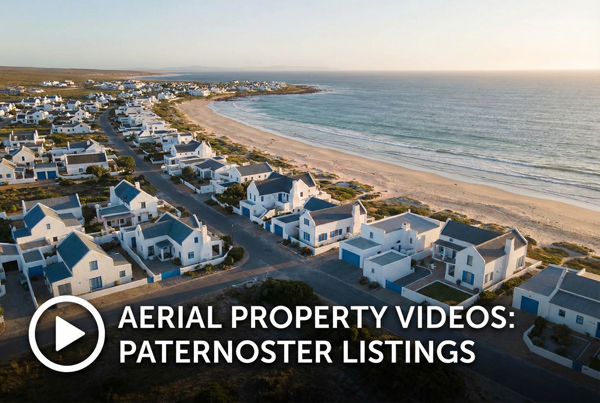
aerial-property-videos-location-lifestyle-paternoster
Property marketing in coastal towns succeeds or fails on context. Buyers are not only choosing a structure. They are choosing a setting, a pace of life, and a daily experience. In places like Paternoster, where the village, coastline, and community atmosphere are as important as the home itself, static imagery often falls short.
Aerial property videos address this limitation directly. They do not simply show a house from above. They explain where the property sits, how it relates to its surroundings, and what kind of lifestyle it supports. Movement adds meaning. Context becomes intuitive rather than abstract.
This article explores why buyers need geographic context, how aerial video showcases coastline and amenities, why plot size and surroundings matter, and how lifestyle storytelling through motion improves engagement and buyer confidence in Paternoster listings and across the West Coast.
The Core Problem: Buyers Cannot Place Themselves in the Setting
Most property listings still rely heavily on interior photography. Kitchens, living areas, bedrooms, and bathrooms dominate the visual narrative. While these spaces matter, they rarely answer the buyer’s most important lifestyle questions.
Buyers want to know:
• Where exactly is this home in relation to the coastline
• What surrounds it beyond the boundary walls
• How integrated it is within the village
• Whether the area feels open, quiet, or busy
• What daily life might look like here
When these questions are unanswered, buyers struggle to connect emotionally. They may like the house, but they cannot imagine living there.
Aerial property videos exist to solve this problem.
Why Buyers Need Geographic Context Early
Geographic context is not a detail. It is a decision filter.
In coastal markets, buyers often eliminate properties based on location before considering interior quality. They want to understand orientation, access, proximity, and atmosphere early in the browsing process.
Aerial video provides this context immediately.
Instead of relying on maps, descriptions, or assumptions, buyers can see how the property fits into the broader environment.
This clarity allows faster and more confident decisions.
How Buyers Interpret Location Visually
Buyers do not think in coordinates or measurements. They think in relationships.
They want to understand:
• How close the home is to the sea
• How the street connects to the village
• How neighbouring properties are positioned
• How open or enclosed the area feels
Aerial video shows these relationships in one continuous sequence. Buyers do not need to piece together information from multiple sources.
They simply understand.
Why Still Images Struggle to Communicate Context
Still images fragment information.
Each photo shows a moment, but buyers must mentally stitch those moments together. This takes effort, and effort introduces friction.
Aerial video removes that friction by presenting information as a flow.
Movement reveals how spaces relate, how distances change, and how the property connects to its surroundings.
This makes context effortless to absorb.
Showcasing the Coastline as a Value Anchor
In Paternoster, the coastline is not a background feature. It is a value anchor.
Buyers are drawn by:
• Proximity to the sea
• Coastal atmosphere
• Walkability to beaches
• Visual openness
Aerial video allows buyers to see how close the property is to the coastline, how directly it connects, and whether views or access are obstructed.
This visual confirmation is far more persuasive than written claims.
Why Proximity Feels Different When Seen From Above
Maps can show distance, but they cannot show experience.
Aerial movement shows:
• How many rows separate the property from the water
• Whether access feels direct or indirect
• How the coastline curves relative to the home
• How integrated the property is within the coastal fabric
This transforms proximity from an abstract concept into a lived experience.
Amenities and Daily Life Matter More Than Buyers Admit
Lifestyle buyers care deeply about convenience, even in relaxed coastal towns.
They want to know:
• Where shops and restaurants are
• How far the beach is from the front door
• Whether walking is practical
• How the village flows
Aerial video shows amenities in context rather than listing them as bullet points.
Seeing where things are relative to the home helps buyers imagine daily routines.
Plot Size Is Understood Through Movement
Plot size is difficult to judge from interior or street-level photos.
Aerial video communicates plot size through comparison and movement.
As the camera moves, buyers can see:
• The true shape of the plot
• How much space exists around the home
• How it compares to neighbouring properties
• Where outdoor areas are positioned
This creates an intuitive sense of space that numbers alone cannot provide.
Surroundings Shape Perceived Quality
Buyers evaluate a property as part of its environment.
A well-presented home surrounded by cramped or chaotic surroundings feels less valuable than a modest home in an open, coherent setting.
Aerial video reveals these surroundings honestly.
This honesty builds trust and helps buyers assess suitability accurately.
Boundaries and Privacy as Visual Signals
Privacy is a major concern for buyers, even when they do not articulate it directly.
Aerial video clarifies:
• Boundary lines
• Spacing between properties
• Overlooking risks
• Buffer zones
When buyers can see boundaries clearly, they feel safer evaluating the property.
Uncertainty around boundaries often leads to hesitation and discounting.
Lifestyle Storytelling Through Motion
Lifestyle is not communicated through single images. It is communicated through sequence.
Aerial motion allows marketers to guide buyers through the environment in a way that mirrors how they would experience it in real life.
Movement can show:
• Arrival routes
• Transition from village to home
• Connection between house and landscape
• Rhythm of the surrounding area
This creates a subtle but powerful lifestyle narrative.
Why Motion Feels More Trustworthy Than Static Claims
Motion reduces suspicion.
Static images can be selective. Movement feels more transparent.
When buyers see a continuous aerial sequence, they assume fewer things are being hidden.
This perception of openness builds trust.
Buyer Engagement Increases With Movement
Video naturally holds attention longer than photos.
Aerial video adds an additional layer of engagement because buyers expect information to unfold as the camera moves.
This expectation keeps them watching longer, absorbing more context.
Longer engagement correlates with stronger intent.
Time Spent Watching Reflects Buyer Interest
Buyers who watch aerial videos are often more serious.
They invest time because they are evaluating suitability, not just aesthetics.
This makes aerial video a strong indicator of enquiry quality.
Differentiation in Paternoster Listings
Many Paternoster homes share similar architectural styles and interior finishes.
What differentiates them is location and setting.
Aerial video highlights these differences clearly, allowing buyers to compare meaningfully.
This differentiation helps listings stand out without exaggeration.
Out-of-Town Buyers Depend on Aerial Context
A large portion of coastal buyers are not local.
They rely on online media to decide whether a viewing is worth the trip.
Aerial video often serves as a substitute for a first visit.
When context is clear, buyers feel more confident committing time and travel.
Aerial Video as a Buyer Filter
Not all engagement is good engagement.
Aerial video helps buyers self-select.
Those who dislike the setting disengage early. Those who appreciate it engage more deeply.
This filtering improves enquiry quality and saves time.
Why Calm Aerial Videos Perform Best
Effective aerial property videos are calm and measured.
They avoid dramatic movements or fast cuts. They prioritise clarity over excitement.
Calm motion aligns with how buyers want to evaluate property.
Trust grows in calm environments.
Overly Cinematic Videos Can Undermine Credibility
While cinematic techniques have their place, they can backfire in property marketing.
Fast, dramatic aerial moves may impress creatively but reduce informational clarity.
Buyers may feel manipulated rather than informed.
Professional aerial video balances aesthetics with accuracy.
Integrating Aerial Video With Other Media
Aerial video works best as part of a complete marketing system.
It complements:
• Interior photography
• Floor plans
• Ground-level video
• Written descriptions
By providing context early, it enhances how all other information is interpreted.
Platform Performance and Accessibility
Aerial videos perform well across:
• Property portals
• Agency websites
• Social media platforms
They are especially effective as hero content that draws buyers into the listing.
Why Omitting Aerial Video Creates a Gap
Listings without aerial video rely on buyers to imagine the setting.
Imagination introduces error.
Error creates doubt.
In competitive coastal markets, doubt pushes buyers toward clearer alternatives.
Reframing Aerial Video as Clarity, Not Luxury
Aerial video is often perceived as a premium add-on.
In reality, it is a clarity tool.
It answers questions buyers care about but may not ask directly.
When framed this way, its value becomes practical rather than promotional.
Buyer Confidence Comes From Understanding
Confidence is not created by hype.
It is created by understanding.
Aerial video builds understanding by showing location, space, and surroundings honestly.
Confident buyers move forward faster and negotiate less defensively.
The West Coast Buyer Expectation
Across the West Coast, buyer expectations have evolved.
For lifestyle properties, aerial video is increasingly expected.
Listings without it feel incomplete.
Meeting this expectation protects perceived value.
Practical Guidance for Sellers and Agents
When evaluating aerial property videos, look for:
• Clear explanation of location
• Honest representation of surroundings
• Smooth, controlled movement
• Logical sequencing
These qualities indicate that the video serves buyer understanding.
Practical Guidance for Marketers
Plan aerial videos around buyer questions.
Ask what a buyer would want to know before visiting in person.
Design movement to answer those questions visually.
Closing Perspective
Aerial property videos matter in Paternoster because they communicate what buyers value most: location, space, and lifestyle. They show how a home fits into its environment, how close it is to the coastline and amenities, and what daily life might feel like.
By providing geographic context, revealing surroundings, and telling a lifestyle story through motion, aerial video improves engagement and builds buyer confidence.
In Paternoster and across the West Coast, buyers are not only choosing properties. They are choosing places to live.
Aerial property videos make those places understandable.
And when understanding is clear, confident decisions follow.


