
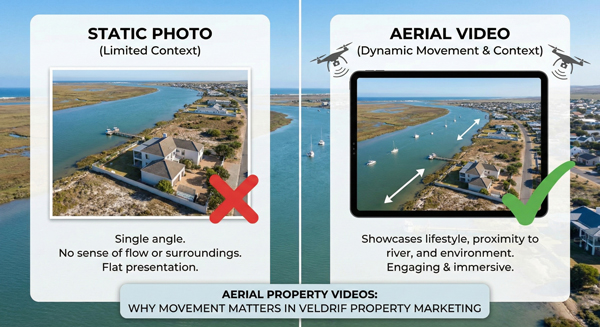
Aerial Property Videos: Why Movement Matters in Velddrif Property Marketing
Property marketing has always relied on visuals, but not all visuals communicate in the same way. Still images are excellent at showing detail and composition, yet they struggle to convey how a property exists in space. This limitation becomes especially apparent in coastal towns, where location, proximity, and flow play a decisive role in buyer decision-making. In Velddrif, aerial property videos have become one of the most effective ways to bridge this gap.
The reason is simple. Movement communicates information that static images cannot. It reveals scale, orientation, and relationships between spaces in a way that feels natural to how humans understand environments. This article explores why movement matters in aerial property videos, how it improves spatial understanding, why it keeps buyers engaged longer, and how controlled flow directly supports buyer confidence in Velddrif property marketing.
The Core Problem: Static Images Struggle With Spatial Context
Most buyers begin their property search online. They scroll quickly, compare multiple listings, and form impressions before ever reading descriptions or booking viewings. Still photography plays a crucial role at this stage, but it has inherent limits.
A static aerial image can show location. It cannot explain it.
Buyers often struggle to understand:
• How close the property is to key features
• How the plot sits within its surroundings
• How the home relates to neighbouring properties
• How outdoor and indoor spaces connect
Without movement, buyers are forced to infer these relationships. Inference creates uncertainty. Uncertainty slows decisions.
Why Human Perception Is Movement-Based
Humans understand space through movement. We walk through environments, turn our heads, and adjust our position to make sense of scale and layout. This is how spatial awareness develops.
Aerial video mirrors this process. By moving smoothly through space, it allows buyers to orient themselves intuitively rather than analytically.
This intuitive understanding reduces mental effort and increases engagement.
Motion as a Cognitive Shortcut
Movement acts as a cognitive shortcut.
Instead of analysing multiple images and mentally stitching them together, buyers receive information in a continuous sequence. Relationships between elements become obvious without explanation.
This is particularly valuable in Velddrif, where buyers are often assessing lifestyle factors such as river proximity, neighbourhood layout, and openness rather than just interior features.
How Aerial Motion Improves Spatial Understanding
Aerial video clarifies spatial relationships in ways still images cannot.
As the camera moves, buyers can see:
• Distances between the home and surrounding features
• Orientation relative to water, roads, or open land
• The true scale of the plot
• How spaces transition from public to private
This understanding forms quickly and intuitively.
When buyers understand space clearly, they feel more confident evaluating whether a property suits their needs.
Scale Is Easier to Feel Than Measure
Scale is one of the hardest concepts to communicate through still photography.
Aerial video communicates scale by showing how elements change relative to one another during movement. A house grows larger as the camera approaches. Boundaries become clearer as perspective shifts.
This dynamic information helps buyers feel the size of a property rather than guess it.
Feeling scale builds confidence. Guessing scale creates doubt.
Layout Becomes Obvious Through Flow
Layout is not just about floor plans. It is about how spaces relate to one another across the site.
Aerial video reveals:
• Entry points
• Outdoor circulation
• Garden flow
• Relationship between structures
By following a logical movement path, buyers can understand layout without instruction.
This clarity reduces the risk of misinterpretation.
Why Movement Keeps Viewers Engaged Longer
Engagement is not just about interest. It is about attention retention.
Movement naturally holds attention because the brain expects continuity. When the camera moves smoothly, viewers stay engaged to see what comes next.
Still images invite quick judgement. Video invites exploration.
This difference has measurable implications for how long buyers spend with a listing.
The Role of Anticipation in Video Engagement
Aerial video creates anticipation.
As the camera moves, buyers anticipate new information. This anticipation keeps them watching.
Well-paced movement encourages viewers to stay until the end, increasing exposure to the property’s full context.
Longer engagement correlates with stronger recall and higher enquiry intent.
Smooth Motion vs Distracting Motion
Not all movement is beneficial.
Erratic, fast, or overly dramatic movement overwhelms viewers and reduces clarity. Professional aerial property videos use slow, controlled motion to guide attention rather than excite it.
Smooth movement feels intentional. Intentional movement builds trust.
Flow as a Trust Signal
Flow is more than visual smoothness. It is psychological reassurance.
When a video flows logically, buyers assume that the property has nothing to hide. The camera does not jump erratically or avoid certain angles.
This openness signals transparency.
Transparency is a cornerstone of buyer confidence.
Movement Reduces Perceived Risk
One of the main barriers to buyer action is perceived risk.
Aerial video reduces this risk by showing:
• Boundaries clearly
• Neighbouring properties honestly
• Surroundings without cropping or distortion
Movement makes concealment difficult. Buyers interpret this as honesty.
When risk perception drops, enquiry likelihood rises.
The Velddrif Context: Lifestyle and Location
Velddrif buyers are often motivated by lifestyle rather than pure square metre comparisons.
They care about:
• Proximity to water
• Neighbourhood character
• Openness and space
• Relationship to the environment
Aerial video communicates these elements far more effectively than static imagery.
Movement allows buyers to experience the location, not just view it.
Out-of-Town Buyers Rely on Motion
Many buyers interested in Velddrif properties are not local. They rely heavily on visuals to decide whether a viewing is worth the journey.
Aerial video provides reassurance by offering a more complete understanding of the property’s setting.
This reduces wasted viewings and increases enquiry quality.
Video as a Confidence Filter
Aerial video acts as a filter.
Buyers who engage fully with a video arrive at viewings with clearer expectations. Those who decide the property is not for them self-select out earlier.
This filtering benefits sellers and agents by focusing attention on genuinely interested buyers.
How Flow Influences Emotional Response
Emotion plays a role even in rational decisions.
Smooth aerial movement creates a calm emotional tone. Calmness signals safety and control.
Buyers who feel calm are more receptive to information and less defensive.
Flow, therefore, influences not just understanding, but emotional readiness.
Movement vs Still Images: Complementary Roles
Aerial video does not replace photography. It complements it.
Still images capture detail. Video explains context.
Together, they provide a complete narrative.
Listings that rely on one without the other often feel incomplete.
The Risk of Overusing Aerial Video
While movement is powerful, overuse can dilute its impact.
Aerial video should be purposeful, not decorative.
Each movement should answer a question or clarify a relationship.
When video is used strategically, it enhances marketing. When used gratuitously, it distracts.
Professional Control Is the Difference
The effectiveness of aerial movement depends on control.
Professional aerial property videos prioritise:
• Stable flight paths
• Consistent speed
• Predictable camera angles
• Logical sequencing
This control transforms movement from spectacle into information.
Buyer Confidence Comes From Clarity
Confidence is built when buyers feel informed.
Aerial video builds confidence by:
• Reducing ambiguity
• Showing scale honestly
• Explaining layout intuitively
When buyers understand what they are seeing, they are more willing to take the next step.
Why Flow Matters More Than Length
A short, well-flowing aerial video often outperforms a longer, poorly structured one.
Flow ensures that every second adds value.
Buyers remember clarity, not duration.
The West Coast Buyer Expectation
Across the West Coast, buyers are increasingly accustomed to aerial media.
This has raised expectations.
Listings without movement now feel incomplete, especially in lifestyle-driven markets.
Meeting expectations is part of maintaining perceived value.
Movement as a Modern Marketing Standard
Aerial video is no longer a novelty. It is a standard in competitive property marketing.
What differentiates listings is not whether video is used, but how well it is executed.
Movement quality is now a key differentiator.
The Cost of Static-Only Marketing
Listings that rely solely on still imagery often struggle to communicate context.
Buyers may misinterpret location, scale, or surroundings.
This leads to:
• Lower engagement
• Weaker enquiries
• More objections during viewings
Aerial video addresses these issues proactively.
How Movement Supports Pricing Confidence
When buyers understand a property’s context clearly, they are less likely to challenge pricing based on uncertainty.
Aerial video protects perceived value by aligning expectations with reality.
This alignment supports firmer negotiations.
Reframing Aerial Video as Information, Not Hype
Aerial video works best when framed as information delivery, not visual hype.
Movement should explain, not impress.
This approach builds trust rather than scepticism.
Practical Implications for Sellers and Agents
When evaluating aerial videos, look for:
• Smooth, controlled motion
• Logical sequencing
• Clear spatial explanation
• Calm pacing
These qualities indicate that movement is being used strategically.
Practical Implications for Marketers
For property marketers, movement should be planned, not improvised.
Each flight path should serve a purpose.
Intentional movement produces consistent results.
Buyer Psychology and the Power of Flow
Flow reduces mental resistance.
When information flows naturally, buyers move with it.
This psychological ease translates into action.
Closing Perspective
Aerial property videos matter in Velddrif property marketing because movement communicates what still images cannot. It improves spatial understanding, clarifies scale and layout, keeps buyers engaged longer, and builds confidence through transparency and flow.
In lifestyle-driven markets like Velddrif, buyers are not just choosing a house. They are choosing a setting.
Movement allows them to experience that setting before they arrive.
When aerial video is executed with control and intention, it becomes one of the most effective tools for reducing uncertainty and increasing buyer confidence.
Flow is not decoration. It is communication.
And in property marketing, clear communication is what moves buyers forward.


