
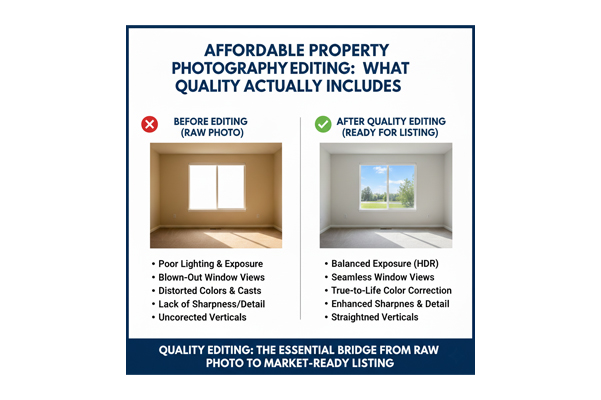
Affordable Property Photography Editing: What Quality Editing Actually Includes
Property photography editing is one of the most misunderstood parts of real estate marketing. It is often treated as a minor afterthought, bundled into a price without explanation, or reduced to a vague idea of “making photos brighter.” When editing is labelled as affordable, it is frequently assumed to be basic, rushed, or low quality. In reality, affordability and quality are not opposites. They are the result of an efficient, disciplined workflow.
Quality property photo editing is not about dramatic transformation. It is about technical accuracy, visual consistency, and trust. Buyers do not reward flashy edits. They reward images that feel clear, calm, and believable. This article breaks down what affordable property photography editing actually includes, why cheap editing is often misunderstood, how professional editors structure their workflow, and why editing should be seen as an investment in marketing quality rather than a cost to be minimised.
The Core Problem: Editing Is Invisible Until It Is Done Poorly
Good editing is invisible. Poor editing is obvious.
This is the central challenge of property photography editing. When editing is done well, buyers rarely notice it. They simply feel that the property looks clean, balanced, and professionally presented. When editing is done poorly, buyers may not articulate the issue, but they sense something is wrong. Colours feel off. Light feels artificial. Rooms feel inconsistent. Trust erodes.
Because buyers do not consciously register good editing, sellers and agents often underestimate its importance. This leads to unrealistic expectations around cost, time, and effort.
Misconceptions Around “Cheap Editing”
One of the most common misconceptions is that affordable editing means pressing a preset and exporting files.
In reality, genuinely cheap editing often includes:
Over aggressive presets applied blindly
Inconsistent colour from image to image
Clipped highlights and crushed shadows
Poor vertical correction
No attention to detail areas
No quality control
This type of editing is fast, but it is not affordable in the long term. It damages listings, reduces buyer confidence, and often leads to re shoots or prolonged time on market.
Affordable quality editing is not about doing less. It is about doing the right things efficiently.
Why Editing Exists in Property Photography
Editing exists because cameras do not see the way humans do.
Cameras struggle with dynamic range, mixed lighting, and colour accuracy. Editing bridges the gap between raw capture and human perception.
In property marketing, the goal of editing is not to enhance reality. It is to translate it accurately.
Quality editing ensures that images reflect how spaces actually feel when viewed in person.
Editing Is a Structured Workflow, Not a Single Action
Professional property photography editing follows a structured sequence. Each stage solves a specific problem.
Skipping stages creates visible issues later. Rushing stages compounds errors.
Affordable quality editing works because the workflow is repeatable and disciplined.
Stage One: Image Selection and Quality Control
Editing begins before any adjustments are made.
At this stage, images are reviewed for:
Sharpness
Composition accuracy
Exposure suitability
Consistency with the set
Images that cannot be corrected cleanly are removed. This prevents time being wasted on files that will never meet standard.
This stage alone separates professional workflows from cheap batch processing.
Stage Two: Lens Corrections and Geometry
Before colour or brightness adjustments, technical corrections are applied.
This includes:
Lens distortion correction
Perspective correction
Vertical line alignment
Horizon levelling
These adjustments ensure that walls are straight, proportions are realistic, and rooms feel stable.
Poor geometry undermines buyer trust immediately. Correct geometry makes spaces feel solid and credible.
This stage is essential and non negotiable.
Stage Three: Global Exposure and White Balance
Once geometry is correct, global exposure is adjusted.
This involves balancing highlights, midtones, and shadows so that the image feels natural.
White balance is corrected to ensure that whites look neutral and colours feel believable.
At this stage, the image should already feel calm and readable before any fine tuning occurs.
Cheap editing often skips careful white balance, leading to yellow, blue, or green colour casts that buyers subconsciously dislike.
Stage Four: Dynamic Range Management
Property images frequently contain bright windows and darker interiors.
Quality editing manages this range carefully, whether through exposure blending, HDR processing, or manual adjustments.
The goal is to retain detail without flattening contrast.
Affordable quality editing achieves this by applying restrained, consistent techniques rather than extreme processing.
This stage directly affects buyer confidence because it determines how honest the image feels.
Stage Five: Colour Correction and Consistency
Colour consistency across a listing is critical.
This stage ensures that:
Wall colours match from room to room
Wood tones feel natural
Tiles and finishes look accurate
Exterior and interior images belong to the same visual set
This is where experience matters. Over correction creates artificial colour. Under correction leaves images dull or mismatched.
Buyers respond positively to listings that feel cohesive.
Stage Six: Local Adjustments and Detail Refinement
After global adjustments, attention turns to local details.
This may include:
Lifting dark corners slightly
Reducing hotspots or glare
Enhancing texture subtly
Balancing window views
These adjustments are targeted and restrained. They are never applied uniformly.
This is also where bathrooms, kitchens, and detail shots receive extra attention.
Cheap editing rarely includes this stage due to time constraints.
Stage Seven: Spot Removal and Cleanup
Small imperfections can have an outsized psychological impact.
This stage involves removing:
Sensor dust spots
Minor distractions
Temporary blemishes
Small inconsistencies
This is not about altering the property. It is about removing visual noise that distracts from the space.
Affordable quality editing includes this because it improves perceived care.
Stage Eight: Final Consistency Check
Before export, images are reviewed as a complete set.
Editors check for:
Exposure consistency
Colour continuity
Perspective uniformity
Overall balance
This final check ensures that the listing feels intentional rather than pieced together.
Skipping this stage leads to uneven listings that feel amateur.
Lightroom vs Photoshop: Different Roles, Same Goal
Lightroom and Photoshop are often misunderstood as interchangeable tools. They are not.
Lightroom is used for:
Batch consistency
Global adjustments
Colour management
Workflow efficiency
Photoshop is used for:
Advanced retouching
Complex blending
Precision corrections
Problem solving
Affordable quality editing relies primarily on Lightroom for efficiency, with Photoshop used selectively where necessary.
Cheap editing avoids Photoshop entirely. Overpriced editing may overuse it unnecessarily.
The balance matters.
Time and Skill: The Hidden Cost Factors
Editing time is not linear.
Some images take seconds. Others take minutes. Some require problem solving that only experience provides.
Affordable editing works when the editor knows exactly what to adjust and what to leave alone.
Inexperienced editors take longer and produce worse results. Automated workflows are fast but unreliable.
Skill reduces time without reducing quality.
Why Good Editing Feels Simple but Is Not Easy
When editing is done well, the image feels effortless.
This illusion hides the complexity behind the scenes.
Balanced exposure, natural colour, and clean geometry require judgement, not presets.
Affordable quality editing is possible because experienced editors make fewer mistakes and corrections.
Editing as a Value Multiplier
Editing multiplies the value of photography.
A well captured image can be undermined by poor editing. A moderately captured image can be elevated by good editing.
In property marketing, editing often has a greater impact on buyer perception than the camera used.
This is why editing should be seen as an investment, not an add on.
How Editing Influences Buyer Behaviour
Buyers do not analyse editing. They react to it emotionally.
Good editing creates:
Calm images
Clear spaces
Trustworthy presentation
Reduced uncertainty
These reactions lead to longer engagement, better enquiries, and smoother viewings.
Poor editing creates doubt before the property is even considered seriously.
Affordable Does Not Mean Generic
Affordable quality editing does not mean one size fits all.
Different properties require different levels of attention.
The affordability comes from process efficiency, not from ignoring context.
Professional editors adjust their workflow based on property type, light conditions, and intended market.
The Risk of Cutting Editing Costs
Cutting editing costs often leads to hidden expenses.
These include:
Lower enquiry quality
Longer time on market
Re shoots
Price pressure during negotiation
The apparent savings disappear quickly.
Editing and Brand Perception
For agents and photographers, editing quality reflects brand standards.
Consistent, clean editing builds recognition and trust over time.
Inconsistent or sloppy editing damages credibility, even if individual properties are strong.
Why Buyers Trust Balanced Images
Balanced images feel honest.
They do not shout. They do not exaggerate. They do not hide.
This honesty is what buyers reward.
Affordable quality editing focuses on balance because balance builds trust.
Reframing “Affordable” in Property Editing
Affordable should not mean cheap.
Affordable should mean efficient, repeatable, and reliable.
It should mean that quality is delivered consistently without unnecessary cost.
What to Look For in Affordable Editing
When evaluating editing quality, look for:
Straight verticals
Natural colour
Consistent exposure
Clean details
Cohesive listings
These qualities indicate a disciplined workflow.
Editing Is Part of the Marketing System
Photography, editing, and presentation are not separate steps. They are one system.
Weak editing breaks the system.
Strong editing supports everything else.
Why Editing Quietly Protects Value
Good editing does not attract attention. It removes friction.
Buyers move forward without hesitation.
That is its value.
Closing Perspective
Affordable property photography editing is not about doing less. It is about doing what matters, consistently and well.
Quality editing includes structured stages, technical precision, colour accuracy, and thoughtful restraint. It relies on skill and experience to work efficiently without sacrificing standards.
When editing is treated as an investment in clarity and trust, it pays for itself quietly through better engagement, stronger enquiries, and smoother transactions.
Buyers may never notice good editing, but they always notice when it is missing.
If the goal of property marketing is to remove uncertainty and build confidence, then affordable quality editing is not a compromise. It is the foundation.


