
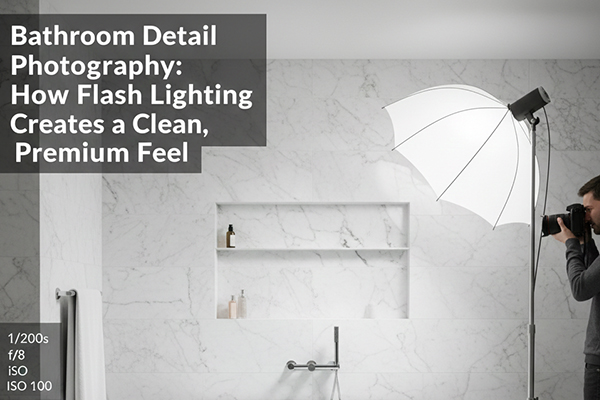
Bathroom Detail Photography: How Flash Lighting Creates a Clean, Premium Feel
Bathrooms occupy a unique psychological position in property marketing. Buyers may forgive dated kitchens or compact bedrooms, but they are far less tolerant when bathrooms feel unclear, dark, or questionable. In listing photography, bathrooms are where buyers look for reassurance. They scan for cleanliness, condition, and signs of ongoing care. Small visual cues carry disproportionate weight.
In coastal markets such as Jacobsbaai and across the West Coast, this sensitivity is amplified. Moisture, salt air, and humidity are part of daily life. Buyers are acutely aware of how these factors can affect finishes, fixtures, and maintenance over time. Bathroom photography, particularly close-up detail images, plays a decisive role in shaping trust.
This article explains why buyers are so sensitive to bathroom presentation, why reflective surfaces make bathrooms technically challenging to photograph, and how controlled flash lighting creates the clean, premium feel that supports buyer confidence rather than undermining it.
The Core Problem: Bathrooms Trigger Buyer Doubt Faster Than Any Other Room
Bathrooms are intimate, functional spaces. Buyers mentally project themselves into using them daily. Any hint of grime, poor lighting, or visual ambiguity triggers concern.
Common buyer reactions include:
• Is this bathroom well maintained
• Are there hidden moisture problems
• Do these finishes age well
• Is this space hygienic
Unlike living areas, bathrooms are not judged on atmosphere or warmth. They are judged on clarity, cleanliness, and precision.
Photography that fails to show bathrooms clearly does not simply undersell the space. It introduces doubt.
Why Buyer Sensitivity Is Highest in Bathrooms
From a buyer psychology perspective, bathrooms combine three risk factors.
First, they involve hygiene. Buyers are instinctively cautious about spaces associated with cleanliness.
Second, bathrooms are expensive to renovate. Uncertainty here carries financial implications.
Third, bathrooms contain materials that reveal wear quickly: grout, chrome, glass, sealant, and tiles.
As a result, buyers scrutinise bathroom images more closely than almost any other room.
The Limits of Natural Light in Bathrooms
Many bathrooms have limited natural light or no windows at all. Even when windows are present, light often enters from a single direction, creating harsh contrast and deep shadows.
Relying solely on ambient light produces images that feel:
• Dim
• Uneven
• Flat
• Unreliable
Dark corners, shadowed grout lines, and dull fixtures raise red flags, even if the bathroom is spotless in reality.
Flash lighting exists to solve this problem, not to dramatise it.
Reflective Surfaces Are the Technical Challenge
Bathrooms are dominated by reflective materials.
Typical surfaces include:
• Mirrors
• Glass shower panels
• Chrome taps and fittings
• Gloss tiles
• Polished stone
These surfaces behave unpredictably under uncontrolled light. Harsh reflections, blown highlights, and distracting glare are common problems when lighting is not managed deliberately.
Poorly handled reflections make bathrooms feel chaotic rather than clean.
Why Flash Is Essential for Bathroom Detail Photography
Flash lighting allows photographers to take control of the scene.
Unlike ambient light, flash is directional, adjustable, and repeatable. It can be shaped to fill shadows, reveal texture, and balance reflections.
In bathroom detail photography, flash is not used to overpower the space. It is used to clarify it.
Clarity is what buyers interpret as cleanliness.
Flash as a Precision Tool, Not a Blunt Instrument
There is a misconception that flash produces harsh, artificial images. This is only true when flash is used without diffusion or intention.
Professional bathroom photography uses flash carefully, often in combination with softboxes or diffusers, to create even, natural-looking light.
The goal is not brightness. The goal is balance.
Softboxes and Diffusion: Creating a Premium Look
Softboxes transform flash from a harsh point source into a broad, gentle light.
This matters in bathrooms because soft light:
• Reduces harsh reflections
• Smooths tonal transitions
• Reveals surface texture without exaggeration
• Creates an even, hygienic appearance
Harsh light emphasises flaws. Soft light suggests care and quality.
Balancing Flash With Ambient Light
Effective bathroom photography rarely relies on flash alone.
Flash is balanced with existing ambient light to maintain a natural feel. This balance prevents the image from looking clinical or artificial.
When flash and ambient light are combined correctly, the bathroom feels bright but believable.
Buyers respond to this balance instinctively.
Why Detail Shots Matter More Than Wide Shots in Bathrooms
Wide bathroom shots show layout, but they often hide what buyers care about most.
Detail shots reveal:
• Tap finishes
• Tile condition
• Grout cleanliness
• Shower fittings
• Mirror edges
• Sealant lines
These details are where buyers look for proof of maintenance.
Detail photography supported by proper lighting reassures buyers that nothing is being concealed.
Detail Images as Proof of Care
Buyers interpret detail images as evidence.
When a listing includes well-lit, close-up bathroom details, buyers assume:
• The bathroom has been maintained carefully
• The seller is confident in the condition
• There are no obvious issues to hide
This assumption extends beyond the bathroom to the property as a whole.
Care shown in small things implies care in larger ones.
Flash Lighting and Perceived Cleanliness
Cleanliness in photography is not just about cleanliness in reality. It is about visibility.
Flash lighting improves visibility by:
• Eliminating shadowed corners
• Revealing true surface colour
• Highlighting clean lines and edges
When everything is visible, buyers feel reassured.
When areas disappear into shadow, buyers imagine problems.
Controlling Reflections Without Hiding Them
One of the most important skills in bathroom photography is reflection control.
The aim is not to eliminate reflections completely, but to make them predictable and unobtrusive.
Flash placement and diffusion allow reflections to be:
• Soft
• Controlled
• Directional
Uncontrolled reflections feel messy. Controlled reflections feel intentional.
Intentionality is interpreted as professionalism.
Mirrors and Buyer Trust
Mirrors are a psychological focal point.
A poorly lit mirror with glare or shadow creates discomfort. A clean, evenly lit mirror reinforces the sense of hygiene and order.
Flash lighting allows mirrors to be lit without distracting hotspots, preserving clarity.
This clarity reduces subconscious buyer anxiety.
The West Coast Context: Moisture and Maintenance Awareness
Buyers in West Coast towns are acutely aware of moisture-related risks.
They look for signs of:
• Rust
• Staining
• Mould
• Sealant wear
Flash-lit detail photography exposes these areas honestly. When no issues are visible, trust increases.
When images are dark or vague, suspicion increases.
Why Buyers Distrust Dark Bathroom Photos
Dark bathroom photos are often interpreted as evasive.
Buyers may assume:
• Poor lighting is hiding flaws
• The bathroom is dated or worn
• Maintenance issues exist
Even if none of this is true, perception drives behaviour.
Flash lighting removes ambiguity.
Bathroom Details and Perceived Value
Bathrooms contribute significantly to perceived property value.
A clean, well-presented bathroom suggests that the property is move-in ready. A questionable bathroom suggests immediate expense.
Detail images supported by proper lighting reinforce the idea that the bathroom adds value rather than risk.
This perception influences how buyers approach pricing and negotiation.
Reducing Buyer Doubt Before Viewings
Many objections arise before buyers ever visit a property.
Bathroom photography plays a major role in this pre-viewing filtering process.
Clear, detailed, well-lit images reduce the number of doubts buyers carry into a viewing.
Fewer doubts mean more focused, confident viewings.
Flash Lighting as a Consistency Tool
Consistency matters across a listing.
Bathrooms often vary in size and light availability. Flash lighting allows each bathroom to be presented to the same standard, regardless of natural light conditions.
This consistency makes the property feel professionally marketed rather than uneven.
Uneven presentation raises questions.
Detail Photography vs Overexposure
There is a difference between bright and overexposed.
Professional flash lighting preserves texture and depth while increasing brightness.
Overexposed images flatten surfaces and remove detail, making spaces feel cheap rather than premium.
The distinction is subtle, but buyers sense it.
Clean Does Not Mean Clinical
One risk in bathroom photography is making the space feel sterile.
Soft flash lighting avoids this by preserving warmth and material character while maintaining cleanliness.
The goal is premium, not hospital.
Detail Photography as a Strategic Choice
Bathroom detail photography is not decorative. It is strategic.
It answers buyer questions proactively. It reduces uncertainty. It supports trust.
Flash lighting enables this strategy by making details visible and credible.
The Cost of Getting Bathroom Photography Wrong
Poor bathroom photography has real consequences.
It can lead to:
• Fewer enquiries
• Lower buyer confidence
• More objections during viewings
• Increased negotiation pressure
These costs often outweigh the effort required to photograph bathrooms properly.
Why Professional Bathroom Photography Pays Off Quietly
Well-executed bathroom photography does not draw attention to itself.
Buyers rarely comment on it directly. Instead, they feel reassured and move on.
This quiet effectiveness is a sign of success.
Reframing Flash Lighting in Property Marketing
Flash should not be seen as an aggressive tool.
In bathroom detail photography, flash is about control, not intensity.
It replaces uncertainty with clarity.
Practical Implications for Sellers and Agents
When reviewing bathroom photos, look for:
• Even lighting across surfaces
• Clear detail without glare
• Natural colour and texture
• Clean, visible edges and lines
These qualities indicate thoughtful flash use.
Practical Implications for Photographers
For photographers, bathroom detail work demands discipline.
Flash placement, diffusion, and balance must be consistent. Shortcuts show immediately in reflective spaces.
Mastery here elevates the entire listing.
Buyer Psychology and the Illusion of Effortlessness
Buyers associate effortlessness with quality.
When bathroom photos feel calm and clean, buyers assume the same care exists behind the scenes.
Flash lighting helps create this illusion of effortlessness through technical control.
Closing Perspective
Bathroom detail photography carries more psychological weight than many sellers realise. Buyers use these images to assess cleanliness, maintenance, and risk. In coastal markets like Jacobsbaai and across the West Coast, this assessment is particularly sharp.
Flash lighting, when used with restraint and precision, transforms bathroom photography. It controls reflections, reveals detail, and creates a clean, premium feel that supports buyer confidence rather than undermining it.
Detail images lit properly reduce doubt before it forms. They allow buyers to focus on the property as a whole rather than worrying about hidden issues.
If the goal of property marketing is to remove uncertainty and build trust, then bathroom detail photography supported by controlled flash lighting is not an extra. It is essential.
Clarity is what sells confidence.


