
Bracketing and HDR: Why Technical Accuracy Matters in Property Marketing
Property photography sits at the intersection of technical discipline and buyer psychology. While composition, styling, and timing all play a role, there is a less visible factor that consistently separates credible listings from forgettable ones: technical accuracy. In residential markets such as Velddrif and across the broader West Coast this accuracy is most clearly expressed through how exposure is handled.
Bracketing and HDR are often misunderstood. To some, they are seen as shortcuts or gimmicks. To others, they are associated with overprocessed images that look unnatural and artificial. In professional property marketing, however, bracketing and HDR are neither shortcuts nor stylistic effects. They are tools for precision.
This article explains why bracketing and HDR matter, how they address the real technical challenges of property photography, and why accurate exposure directly supports buyer confidence, trust, and engagement.
The Core Problem: Properties Exceed Camera Limitations
The fundamental challenge in property photography is not creativity. It is physics.
Most residential interiors contain a wider range of light than a camera can capture in a single exposure. Bright windows, reflective surfaces, shaded corners, and mixed lighting conditions all coexist within the same frame.
The human eye handles this effortlessly. Cameras do not.
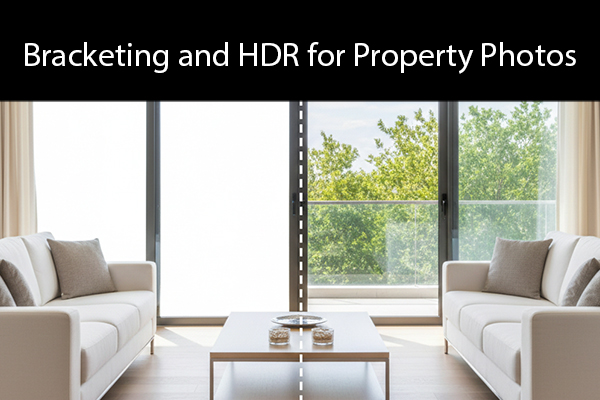
When photographers rely on a single exposure, they are forced to compromise. Either the windows are blown out, or the interior is underexposed. Either highlights are lost, or shadows collapse.
Bracketing exists because reality routinely exceeds what a single frame can record.
Why Dynamic Range Matters in Property Marketing
Dynamic range describes the span between the brightest and darkest details a camera can capture at once.
In property marketing, dynamic range matters because buyers expect clarity everywhere in the image. They want to see both the room and what lies beyond the windows. They want to understand finishes, textures, and spatial relationships without distraction.
Images with crushed shadows or blown highlights do not feel natural. They feel incomplete.
Incomplete images introduce uncertainty, and uncertainty is one of the biggest obstacles to buyer confidence.
Interior Spaces Are the Hardest Test
Interiors are the most demanding environments for exposure accuracy.
Typical challenges include:
• Bright coastal daylight outside
• Darker interior finishes
• Mixed artificial lighting
• Reflections from floors and windows
In places like Velddrif, where white exteriors and bright skies are common, this contrast becomes extreme.
Single-exposure photography almost always fails under these conditions unless heavy compromises are made.
The Consequences of Poor Exposure
When exposure is poorly handled, the consequences extend beyond aesthetics.
Buyers may perceive:
• Poor maintenance due to dark or muddy areas
• Smaller spaces due to shadow collapse
• Misrepresentation when windows are blown out
• Amateur marketing due to inconsistent lighting
These perceptions affect engagement long before a viewing is booked.
Exposure Bracketing Explained Simply
Exposure bracketing is the practice of capturing multiple images of the same scene at different exposure levels.
Typically, this includes:
• One exposure for highlights
• One exposure for midtones
• One exposure for shadows
These images are then combined to create a final image that reflects the full range of light present in the scene.
The goal is not drama. The goal is accuracy.
Why Bracketing Is Not Optional in Many Interiors
In many property interiors, bracketing is not a creative choice. It is a technical necessity.
Without bracketing, photographers must choose which parts of the scene to sacrifice. With bracketing, they can preserve information across the entire frame.
This preservation allows buyers to see the space as it exists, not as the camera struggled to record it.
HDR as a Tool, Not a Look
HDR has developed a poor reputation due to overuse and misuse.
Overprocessed HDR images often feature:
• Unrealistic contrast
• Halos around windows
• Flat, textureless surfaces
• Colours that feel artificial
These images damage trust because they feel manipulated.
Professional HDR is different.
Realistic HDR vs Overprocessing
Realistic HDR aims to recreate human visual perception.
It prioritises:
• Natural contrast
• Accurate colour
• Subtle transitions
• Consistent lighting
Overprocessed HDR prioritises impact at the expense of realism.
In property marketing, realism always performs better than spectacle.
Why Buyers React Negatively to Overprocessed Images
Buyers are sensitive to visual manipulation, even if they cannot articulate why.
Overprocessed HDR images trigger scepticism because they break visual expectations. Walls look unnatural. Light feels fake. Depth disappears.
When buyers feel something is visually wrong, they question everything else.
Trust erodes quickly.
Technical Accuracy as a Trust Signal
Technical accuracy is a form of honesty.
When exposure feels balanced and natural, buyers assume the photographer is showing the property as it is. This assumption carries over into perceptions of the seller and agent.
Accurate exposure signals:
• Care in presentation
• Respect for the buyer
• Confidence in the property
• Professional marketing standards
These signals matter more than stylistic flair.
How Bracketing Supports Buyer Confidence
Buyer confidence is built on clarity.
When buyers can see:
• Interior details clearly
• Exterior views without blowout
• Consistent light across rooms
They feel informed rather than persuaded.
Informed buyers ask better questions, book viewings with clearer expectations, and engage more seriously.
The Role of HDR in Reducing Hesitation
One of the main reasons buyers hesitate is uncertainty.
Poorly exposed images create unanswered questions:
Is that room dark or just poorly photographed
What does the view actually look like
Are those finishes worn or just shadowed
Bracketing and realistic HDR answer these questions visually, reducing friction in the decision-making process.
Technical Precision vs Artistic Interpretation
Property photography is not fine art.
While aesthetics matter, accuracy matters more.
Artistic interpretation that distorts reality may look impressive, but it often undermines marketing goals. Technical precision ensures that images function as reliable information tools.
In property marketing, credibility outperforms creativity.
Consistency Across a Listing
Bracketing also supports consistency.
Different rooms have different light levels. Without bracketing, exposures may vary dramatically from room to room, creating a disjointed visual experience.
Consistent exposure across a listing makes the property feel cohesive and professionally marketed.
Consistency reassures buyers.
The West Coast Context
Across the West Coast, properties often feature strong natural light and outdoor connections.
This makes exposure accuracy even more important.
Buyers want to understand how interior spaces relate to outdoor areas, views, and light. Bracketing allows these relationships to be shown clearly rather than guessed.
Bracketing vs Flash: Complementary Tools
Bracketing is often used alongside flash, not instead of it.
Flash can lift interior light levels and control shadows. Bracketing preserves dynamic range.
Together, they allow photographers to create images that feel natural while remaining technically accurate.
Relying on either tool alone often produces compromises.
Workflow Discipline Matters
Bracketing is only effective when applied consistently and processed carefully.
Poor alignment, inconsistent colour balancing, or aggressive tone mapping can undo the benefits.
Professional workflows treat bracketing as part of a system, not a one-off technique.
Why Buyers Never Ask About HDR, But Feel Its Impact
Buyers never ask whether images are bracketed or HDR.
They simply respond to how images feel.
Balanced exposure feels calm. Calm images build confidence. Confidence drives action.
The absence of technical problems is itself a positive signal.
Exposure Accuracy and Negotiation Dynamics
When buyers arrive at a viewing and the property matches the photos, negotiation dynamics improve.
There is less disappointment, fewer objections, and more focus on fit rather than flaws.
Technically accurate photography protects perceived value during negotiation.
The Cost of Inaccuracy
Inaccurate exposure has real costs:
• Longer time on market
• Lower enquiry quality
• Increased price pressure
• Reduced trust in marketing
These costs often exceed the investment required for professional bracketing and HDR workflows.
Why Precision Is a Marketing Advantage
In competitive markets, small advantages matter.
Listings that feel clear and honest stand out quietly but effectively.
Technical precision is not flashy, but it is persuasive.
Reframing HDR in Property Marketing
HDR should not be framed as a style.
It should be framed as a technical solution to a real problem.
When used correctly, it disappears into the image. When used poorly, it dominates it.
The best HDR is invisible.
Practical Implications for Sellers and Agents
For sellers and agents, the takeaway is simple.
Judge photography by how accurately it represents light, space, and detail.
Avoid images that feel dramatic but unnatural. Prioritise images that feel calm and believable.
Practical Implications for Photographers
For photographers, bracketing is not an optional extra. It is a core competency.
Understanding when to bracket, how much to bracket, and how to process realistically is essential for professional results.
Buyer Psychology and Technical Precision
Buyer psychology favours clarity over persuasion.
Technical precision supports clarity by removing visual obstacles to understanding.
The more accurately a property is shown, the easier it is for buyers to say yes.
Closing Perspective
Bracketing and HDR are not about making property photos look impressive. They are about making them accurate.
In Velddrif and across the West Coast, where light conditions are demanding and buyers are visually attentive, technical accuracy matters.
Exposure bracketing solves real dynamic range problems. Realistic HDR aligns images with human vision. Together, they create photographs that feel honest, calm, and trustworthy.
Buyers may never notice the technique, but they respond to its effects. They feel more confident, ask better questions, and engage more seriously.
In property marketing, technical accuracy is not a luxury. It is a foundation.
When photography reflects reality clearly, it supports trust. And trust is what turns interest into action.


