
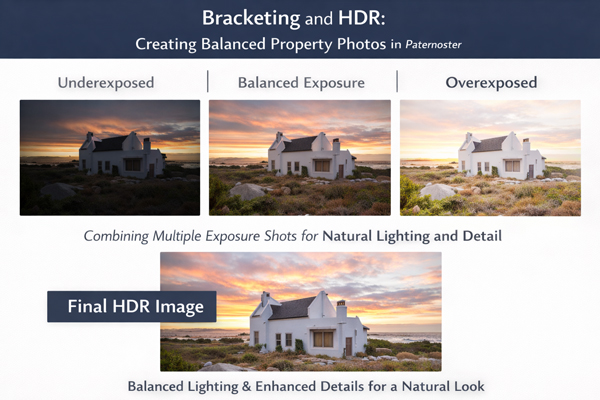
Bracketing and HDR: Creating Balanced Property Photos in Paternoster
Property photography is judged less by how striking an image looks and more by how believable it feels. Buyers are not searching for dramatic imagery. They are trying to understand space, light, and condition as accurately as possible before committing time, travel, or money. In a coastal town like Paternoster, where bright exteriors and darker interiors often coexist within the same frame, achieving that accuracy is technically demanding.
This is where bracketing and HDR become essential. Not as visual effects, and not as stylistic choices, but as precision tools that allow property photos to reflect what the human eye actually sees. When used correctly, they disappear into the image. When used poorly, they destroy trust.
This article explains why bracketing and HDR matter in Paternoster property photography, how they solve real exposure problems, and why balanced images consistently outperform dramatic ones in property marketing.
The Core Problem: Interior Light Exceeds Camera Limits
The fundamental challenge in property photography is dynamic range.
Most residential interiors contain a greater range of light than a camera can capture in a single exposure. Bright windows, reflective white walls, shaded corners, and mixed artificial lighting all exist at the same time. The human eye adapts instantly. Cameras do not.
In Paternoster homes, this challenge is amplified by:
• Bright coastal daylight
• Whitewashed architecture
• Strong contrast between indoor and outdoor light
• Smaller rooms with limited natural light
When a single exposure is used, something has to give. Either the windows blow out, or the interior collapses into shadow.
Neither outcome reflects reality.
Why Dynamic Range Accuracy Matters in Property Marketing
Buyers rely on photography as their primary source of information.
If areas of a room are too dark to see clearly, buyers assume uncertainty. If windows are blown out, buyers question what is being hidden. These reactions happen subconsciously, but they affect confidence.
Balanced exposure allows buyers to:
• Understand room proportions
• See finishes and materials clearly
• Evaluate views realistically
• Feel oriented within the space
This clarity reduces hesitation and improves enquiry quality.
Why Single-Exposure Photos Often Fail
Single-exposure photography forces compromise.
To expose for the interior, windows are often overexposed and lose all detail. To preserve window detail, interiors become dark and uninviting. Heavy post-processing can lift shadows, but this introduces noise, colour shifts, and unnatural contrast.
Buyers may not know why the image feels wrong, but they feel that something is off.
Bracketing exists to avoid this compromise entirely.
What Exposure Bracketing Actually Is
Exposure bracketing involves capturing multiple images of the same composition at different exposure levels.
A typical bracketed set includes:
• One exposure for highlights
• One exposure for midtones
• One exposure for shadows
These exposures preserve detail across the full range of light in the scene. They are not intended to be shown individually. They are raw data.
The final image is created by blending this data carefully to reflect how the space appears in real life.
Bracketing as a Workflow, Not a Shortcut
Professional bracketing is not a quick fix. It is a disciplined workflow.
It requires:
• A tripod for perfect alignment
• Consistent camera settings
• Thoughtful exposure spacing
• Careful blending in post-production
Rushed bracketing or sloppy blending creates halos, flat textures, and unnatural light. Proper bracketing produces images that feel calm and believable.
Why Bracketing Is Essential in Paternoster Interiors
Paternoster interiors often feature design elements that increase contrast.
Dark timber floors, shaded ceilings, and small window openings are common. At the same time, exterior light is intense and reflective.
Without bracketing, photographers must either sacrifice interior detail or exterior realism. With bracketing, both can be preserved.
This allows buyers to understand how interior spaces relate to the outdoor environment, which is a key lifestyle factor in coastal property decisions.
HDR: A Tool With a Bad Reputation
HDR has gained a negative reputation in property photography, largely due to misuse.
Overprocessed HDR images are easy to spot. They feature:
• Flat, textureless surfaces
• Heavy halos around windows
• Unrealistic colours
• Artificial contrast
These images look manipulated, and manipulation erodes trust.
However, this is not a flaw in HDR itself. It is a flaw in how it is applied.
Natural-Looking HDR Is the Goal
Professional HDR is not about impact. It is about balance.
Natural-looking HDR aims to:
• Preserve realistic contrast
• Maintain natural colour
• Avoid visible blending artefacts
• Match human visual perception
When done correctly, buyers should not notice HDR at all. They should simply feel that the image looks right.
HDR as a Realism Enhancer, Not an Effect
HDR should enhance realism, not replace it.
The best HDR images do not look edited. They look observed. Light transitions feel smooth. Shadows retain depth. Highlights retain detail without drawing attention to themselves.
This subtlety is what builds trust.
Why Buyers React Better to Balanced Images
Balanced images reduce cognitive effort.
Buyers do not have to work to understand the space. They do not have to imagine what is hidden in shadows or guess what lies beyond blown-out windows.
This ease of understanding creates comfort, and comfort leads to confidence.
Confident buyers are more likely to enquire, view, and proceed.
How Bracketing Supports Consistency Across Listings
One of the biggest benefits of bracketing is consistency.
Different rooms have different light conditions. Without bracketing, exposures may vary dramatically from room to room. With bracketing, each space can be balanced to the same visual standard.
Consistency across a listing makes the property feel cohesive and professionally marketed.
Inconsistent exposure feels careless.
HDR and Colour Accuracy
Exposure and colour are closely linked.
Poor exposure often leads to colour shifts, especially when shadows are lifted aggressively from a single exposure. Bracketing reduces the need for extreme adjustments, preserving more natural colour information.
In Paternoster homes, where neutral palettes and coastal tones dominate, colour accuracy plays a major role in perceived quality.
Reducing Buyer Uncertainty Through Exposure Accuracy
Many buyer objections begin with uncertainty.
Is the room actually dark
Is the view really that good
Are those finishes worn or just poorly lit
Balanced HDR images answer these questions visually, before they are asked.
When uncertainty is reduced, buyers arrive at viewings with clearer expectations and fewer objections.
HDR vs Flash: Complementary, Not Competing
HDR and flash are often misunderstood as alternatives.
In reality, they are complementary tools.
Flash can lift interior light levels and shape shadows. Bracketing preserves dynamic range. Used together, they produce images that feel natural and dimensional.
Relying on HDR alone can result in flat images. Relying on flash alone can result in harsh light and blown highlights. Balance comes from combining techniques intelligently.
Technical Accuracy as a Trust Signal
Technical accuracy sends a subtle but powerful signal.
It tells buyers that:
• The property is being presented honestly
• Care has been taken in marketing
• The seller and agent are confident in the property
These signals influence how buyers perceive value and credibility.
The West Coast Buyer Context
Across the West Coast, many buyers are out of town or viewing remotely.
For these buyers, photography is not supplementary. It is foundational.
Balanced, accurate images help remote buyers build a reliable mental model of the property. Poor exposure breaks that model.
The Cost of Getting Exposure Wrong
Poor exposure has measurable consequences.
It can lead to:
• Lower engagement on listings
• Fewer serious enquiries
• Longer time on market
• Increased price pressure during negotiation
These costs often outweigh the investment required for proper bracketing and HDR workflows.
Why Balanced Photos Support Pricing Confidence
When a property is presented clearly and accurately, buyers focus on fit rather than flaws.
They are less likely to question value based on perceived issues caused by poor photography. This supports firmer pricing conversations and smoother negotiations.
Balanced photos protect perceived value.
HDR as Part of a Professional System
HDR is not a one-click solution.
In professional property photography, it sits within a broader system that includes:
• Stable capture
• Controlled composition
• Colour management
• Consistent post-production standards
When HDR is treated as part of this system, results feel reliable rather than experimental.
What Buyers Never See, But Always Feel
Buyers never ask whether images are bracketed or HDR.
They simply feel whether images are calm, clear, and believable.
When technical accuracy is present, it goes unnoticed. When it is absent, it becomes the story.
Reframing HDR in Property Marketing
HDR should not be framed as a feature or upgrade.
It should be framed as a technical requirement for accurate representation under challenging light conditions.
In Paternoster, those conditions are the norm, not the exception.
Practical Implications for Sellers and Agents
When reviewing property photos, look for:
• Detail visible both inside and outside
• Natural contrast without harsh shadows
• Consistent exposure across rooms
• Colours that feel believable
These qualities indicate proper bracketing and restrained HDR.
Practical Implications for Photographers
For photographers, mastering bracketing and natural HDR is non-negotiable in coastal markets.
The goal is not to impress, but to inform.
Restraint, accuracy, and consistency matter more than dramatic results.
Closing Perspective
Bracketing and HDR are not about making property photos look better. They are about making them truer.
In Paternoster, where bright coastal light and intimate interiors coexist, balanced exposure is essential for honest representation. Bracketing captures the full range of light. Natural HDR blends that information into images that reflect how spaces are actually experienced.
Buyers may never notice the technique, but they respond to its effects. They feel more confident, more informed, and more willing to engage.
In property marketing, technical accuracy is not optional. It is the foundation on which trust, clarity, and perceived value are built.
When images feel real, buyers believe them.


