
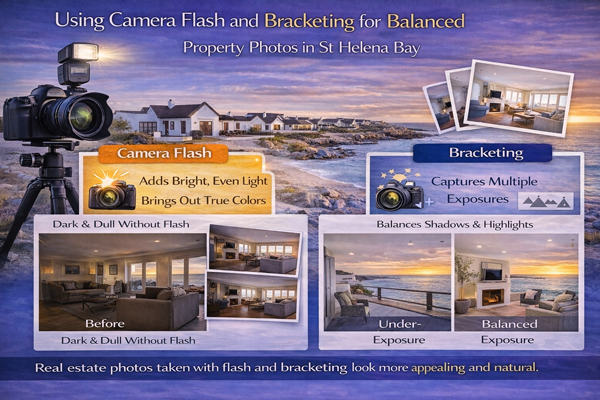
Using Camera Flash and Bracketing for Balanced Property Photos in St Helena Bay
Property photography in St Helena Bay presents a very specific visual challenge. Homes are often designed to maximise views, light, and openness, with large windows, open-plan layouts, and strong contrast between interior spaces and the coastal environment outside. To the human eye, these spaces feel balanced and calm. To a camera, they are anything but.
This is where many property photos fail. Not because the homes are lacking, but because the technical limits of a single exposure cannot cope with the dynamic range found in coastal interiors. Camera flash and exposure bracketing are not stylistic extras in this context. They are control tools, used to represent spaces accurately and consistently.
In St Helena Bay and across the West Coast, understanding how flash and bracketing work together is one of the key differences between average property photos and images that genuinely support buyer confidence and perceived value.
The Dynamic Range Problem Inside Coastal Homes
Dynamic range refers to the difference between the brightest and darkest parts of a scene.
Interior property spaces, especially in coastal homes, often contain extreme dynamic range. Bright daylight pours in through windows and doors, while interior corners, ceilings, and adjacent rooms sit in relative shadow. The human eye handles this effortlessly. A camera does not.
With a single exposure, the camera must choose what to prioritise. If it exposes for the interior, the exterior view becomes a bright white shape with no detail. If it exposes for the exterior, the interior becomes dark and uninviting.
In St Helena Bay, where outdoor context and views form part of the lifestyle appeal, losing either side of this balance misrepresents the property. Buyers are left with incomplete information and increased uncertainty.
Flash and bracketing exist to solve this exact problem.
Why Single-Exposure Photography Falls Short
Single-exposure photography relies on one frame to capture all the information in a scene. In controlled environments, this can work well. In high-contrast interiors, it almost always fails.
When single exposures are used in property photography, compromises are unavoidable. Either the photo favours atmosphere and sacrifices clarity, or it preserves detail and sacrifices warmth.
Buyers may not understand the technical reason for this, but they feel the result. Rooms appear smaller than they are. Windows feel evasive. Dark corners raise questions.
These impressions shape buyer perception long before a viewing is booked.
What Exposure Bracketing Actually Does
Exposure bracketing involves capturing multiple images of the same scene at different exposure levels.
One image preserves highlight detail, such as the view outside the windows. Another captures midtones, representing the general interior. A third reveals shadow detail in darker areas.
These images are later combined or selectively used to create a final photograph that reflects what the human eye experiences naturally.
In property photography, bracketing is not about creating dramatic HDR effects. It is about restoring balance and information.
When used correctly, buyers do not notice bracketing. They simply see a room that feels clear and believable.
Bracketing Versus HDR Misconceptions
Bracketing is often associated with heavy-handed HDR processing. This association has given the technique a bad reputation among buyers and agents alike.
Poor HDR exaggerates contrast, flattens textures, and creates an artificial look. Professional bracketing avoids this entirely.
The goal is subtlety. Bracketing is used to gently extend dynamic range so that nothing important is lost. Highlights remain controlled. Shadows retain depth. Colours stay natural.
In St Helena Bay homes, where buyers expect calm, coastal realism rather than visual drama, subtle bracketing is essential.
Why Bracketing Alone Is Not Always Enough
While bracketing solves many dynamic range problems, it does not address everything.
Bracketing captures available light more completely, but it cannot change the quality or direction of that light. Deep shadows may still exist. Colour casts from mixed lighting may remain. Some rooms may still feel flat.
This is where flash becomes important.
Flash allows the photographer to shape light, not just capture it. Used alongside bracketing, it produces images that are both balanced and natural.
Flash as a Tool for Natural-Looking Results
Flash in property photography is often misunderstood as a way to make rooms look brighter or more impressive. In professional use, it serves a different purpose.
Flash is used to lift shadow detail, control contrast, and neutralise colour issues. It helps the camera see the room the way the human eye does.
In St Helena Bay properties, flash is rarely used directly. It is bounced, diffused, or positioned off-camera to create soft, even illumination that blends seamlessly with ambient light.
When flash is used correctly, buyers do not notice it. They simply feel that the room looks right.
Balancing Flash With Bracketing
The most effective property photography combines flash and bracketing rather than choosing one over the other.
Bracketing ensures that highlight and shadow detail is preserved across the scene. Flash ensures that the interior light feels even, calm, and realistic.
Together, they solve the full range of problems found in coastal interiors. Bright windows remain detailed. Interior spaces feel open rather than gloomy. Colour stays consistent.
This combination is especially valuable in St Helena Bay, where open-plan layouts and strong exterior light are common.
Controlling Shadows Without Flattening the Room
One of the risks in property photography is flattening space.
If shadows are removed entirely, rooms can look lifeless and two-dimensional. If shadows are too strong, rooms feel smaller and more uncertain.
Flash allows shadows to be controlled rather than eliminated. By gently filling darker areas, it preserves depth while removing harsh contrast.
Bracketing ensures that shadow detail is captured accurately, so the final image does not rely on aggressive processing.
The result is a room that feels spacious, calm, and believable.
Managing Highlights and Exterior Views
Exterior views are a major value component in coastal markets.
In St Helena Bay, buyers often care deeply about what lies beyond the windows. Open land, sea air, and neighbourhood context all influence desirability.
Bracketing preserves highlight detail so that exterior views remain visible. Flash raises interior exposure so that those views can be included without sacrificing room brightness.
This balance allows buyers to understand the relationship between interior and exterior, which is critical for lifestyle-driven decisions.
Consistency Across Rooms Builds Confidence
One of the most important benefits of using flash and bracketing together is consistency.
Natural light varies from room to room. Window direction, room size, and time of day all influence exposure and colour. Without control, a property listing can feel visually fragmented.
Flash and bracketing allow each room to be balanced independently while maintaining a consistent overall look. Exposure, colour temperature, and brightness can be aligned across the entire property.
In St Helena Bay homes, where open-plan designs visually connect multiple spaces, this consistency is essential. Buyers experience the home as a single environment rather than a series of unrelated images.
Why Consistency Improves Perceived Quality
Buyers associate consistency with care.
When lighting and exposure feel even across a listing, buyers infer that the property has been presented thoughtfully. They feel that nothing is being hidden or neglected.
Inconsistent images create doubt. Buyers may assume that some areas are darker, smaller, or less appealing in reality.
Flash and bracketing protect perceived quality by removing these inconsistencies.
Colour Accuracy and Mixed Light Sources
Homes often contain multiple light sources. Daylight from windows, warm bulbs, cool LEDs, and decorative lighting all mix together.
Cameras struggle to interpret this mixture accurately. Colours can shift, whites can look yellow or blue, and natural materials can appear artificial.
Flash provides a neutral reference light that helps unify colour across the scene. Bracketing ensures that colour information is preserved across exposure levels.
In St Helena Bay properties, where neutral palettes and natural textures are common, accurate colour representation is critical to buyer trust.
Buyer Psychology and Balanced Exposure
Buyers may not understand exposure or lighting techniques, but they respond to the outcome emotionally.
Balanced photos feel calm. Unbalanced photos feel uneasy.
When buyers see balanced images, they feel more confident that the property is being represented honestly. They are more willing to engage, enquire, and book viewings.
This psychological effect is one of the most important reasons flash and bracketing matter in property marketing.
Reducing Buyer Anxiety Before Viewings
Many buyer objections are rooted in uncertainty.
Will the room be darker than the photos
Will the view be blocked or disappointing
Is the space smaller than it looks
Flash and bracketing reduce these concerns by aligning expectation with reality. Buyers arrive at viewings prepared to confirm what they have seen rather than to investigate potential problems.
This shift in mindset leads to smoother viewings and more productive conversations.
Why Flash and Bracketing Matter More in Coastal Markets
Coastal environments exaggerate every lighting challenge.
Bright skies, reflective surfaces, and open layouts push camera sensors to their limits. Techniques that may work inland often fail near the coast.
In St Helena Bay and across the West Coast, flash and bracketing are not optional enhancements. They are practical necessities for accurate representation.
Lighting Control as a Signal of Professionalism
Presentation sends signals.
Listings with balanced exposure, clear window detail, and consistent interiors signal professionalism. Buyers infer that effort has been invested and that the property has been positioned carefully.
Poor exposure suggests rushed marketing and invites scepticism.
Flash and bracketing are part of that professional signal, even when buyers do not consciously notice them.
Flash and Bracketing as Tools for Honesty
There is a misconception that advanced lighting techniques are used to make properties look better than they are.
In reality, the opposite is true.
Flash and bracketing reduce distortion. They narrow the gap between what the camera captures and what the human eye experiences. They remove misleading extremes rather than adding enhancement.
Buyers respond positively to this honesty because it builds trust.
How Balanced Images Support Pricing Confidence
Buyers often infer pricing intent from presentation.
Balanced, well-controlled images suggest that the property has been positioned carefully. Buyers are less likely to assume that the asking price is inflated.
Poorly exposed images invite doubt and aggressive negotiation.
In St Helena Bay’s competitive market, lighting quality quietly influences how buyers approach value.
Flash and Bracketing Are Part of a System
Neither flash nor bracketing works in isolation.
They are part of a system that includes camera settings, composition, timing, and post-processing. Each element supports the others to create a natural, cohesive result.
This system approach is what separates professional property photography from casual attempts.
Closing Perspective
Balanced property photos do not happen by accident.
They are the result of understanding dynamic range, using exposure bracketing intelligently, and applying flash in a subtle, controlled way. In St Helena Bay and across the West Coast, these techniques are essential for representing coastal homes accurately.
Flash and bracketing work together to preserve detail, control contrast, and create consistency across rooms. The result is photography that buyers trust.
If you are marketing a property in St Helena Bay and want photos that reflect the space honestly and confidently, professional use of flash and bracketing is essential. If you would like advice or a quote on property photography that applies these techniques correctly, you are welcome to get in touch to discuss the best approach for your listing.


