
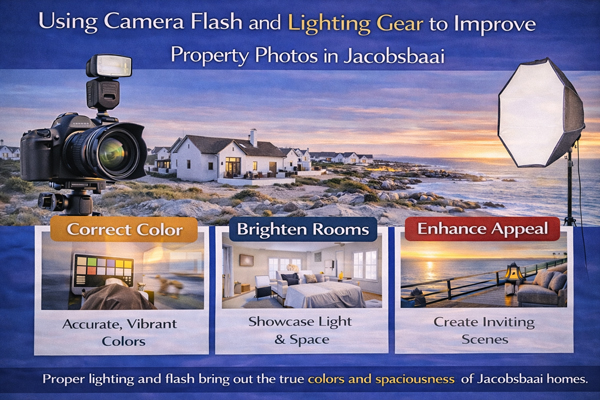
Using Camera Flash and Lighting Gear to Improve Property Photos in Jacobsbaai
Property photography in Jacobsbaai presents a very specific set of challenges. The homes are often bright, open, and exposed to strong coastal light. Interiors frequently feature white walls, reflective surfaces, and large openings to the outside. To the human eye, these spaces feel balanced and inviting. To a camera relying only on natural light, they are anything but.
This is why camera flash and professional lighting gear are not optional tools in Jacobsbaai property photography. They are not used to make properties look better than they are. They are used to make them look the way they actually feel when you stand inside them.
Understanding why lighting control matters requires looking at the limits of natural light, how buyers interpret images, and how controlled lighting directly influences perceived quality and trust.
Why Natural Light Alone Is Unreliable in Coastal Homes
Natural light is often described as the ideal light source for property photography. In theory, it sounds perfect. In practice, it is unpredictable and inconsistent, especially in coastal environments.
In Jacobsbaai, light changes rapidly throughout the day. Bright sun, passing clouds, reflective sand, and open skies create extreme contrasts between interior and exterior spaces. What looks balanced to the eye becomes a technical problem for the camera.
Relying on natural light alone usually forces a compromise. Either the interior is exposed correctly and windows are blown out, or the exterior view is preserved and the interior becomes dark and flat. Neither result reflects reality.
Natural light is also directional. It pours in from one side of a room, leaving corners, ceilings, and adjacent spaces underexposed. These darker areas may feel fine in person, but in photos they can look neglected or smaller than they are.
For buyers browsing listings, these inconsistencies quietly undermine confidence.
The Human Eye Versus the Camera Sensor
One of the biggest misunderstandings in property photography is assuming the camera sees the way people do.
Human vision constantly adapts. We can look at a bright window and then at a darker corner and still perceive balance. Cameras cannot do this without assistance. They record light literally, not perceptually.
In a Jacobsbaai home with open-plan spaces and strong daylight, this limitation becomes obvious. The camera exaggerates contrast, deepens shadows, and clips highlights.
Flash and lighting gear exist to bridge this gap. They help the camera approximate what the eye naturally perceives.
Flash Is Not the Opposite of Natural Light
A common mistake is treating flash as a replacement for natural light. In professional property photography, flash is used to support ambient light, not overpower it.
Natural light sets the mood. Flash provides control.
By introducing controlled artificial light into the scene, the photographer can lift shadows, reduce contrast, and balance the interior with the exterior. The goal is not to make rooms brighter than they are, but to stabilise lighting so it feels even and believable.
In Jacobsbaai properties, where coastal light can be harsh and uneven, this balance is essential. Flash allows the photographer to work with the available light rather than fighting against it.
Flash Balancing With Ambient Light
Balancing flash with ambient light is one of the most important skills in professional property photography.
If flash is used too strongly, images look artificial and flat. If it is used too weakly, it fails to solve the underlying exposure problems.
The correct approach is subtle. Flash is introduced gradually, often bounced or diffused, to raise the darker areas of a room until they match the brightness of the naturally lit areas. This creates an image where no single element dominates the viewer’s attention.
In Jacobsbaai homes with large windows or sliding doors, this balance allows interior details to remain visible while preserving outdoor views. Buyers can see both at once, just as they would in person.
Why Buyers Respond to Balanced Lighting
Buyers rarely comment on lighting directly, but they react to it instinctively.
Balanced lighting makes spaces feel calm and open. It allows the eye to move comfortably through an image. There are no harsh shadows to raise questions and no blown highlights to suggest exaggeration.
When lighting feels balanced, buyers trust what they are seeing. When it feels uneven, they become cautious, even if they cannot explain why.
In West Coast markets like Jacobsbaai, where buyers may already be cautious about coastal exposure and maintenance, this trust is particularly important.
Controlling Shadows to Avoid Negative Assumptions
Shadows are one of the most common sources of misinterpretation in property photos.
Deep shadows can make corners look dirty, ceilings look lower, and rooms look smaller. Buyers may subconsciously assume that areas in shadow are less important or less well maintained.
In reality, those shadows are often just the result of directional natural light.
Flash allows photographers to control shadows rather than eliminate them completely. By filling in darker areas gently, flash preserves depth while removing harsh contrasts that distort perception.
This controlled approach ensures that every part of the room feels intentional and usable.
Highlight Control and Window Detail
Highlights are the other side of the problem.
In Jacobsbaai properties, windows often frame important lifestyle elements. Courtyards, ocean air, outdoor living spaces, or neighbouring open areas all contribute to value. When windows are blown out in photos, that context is lost.
Flash helps control highlights by raising interior brightness so the camera can expose the exterior correctly at the same time. This technique allows both spaces to coexist naturally in one image.
Buyers benefit from this clarity. They understand how the interior connects to the outside, which is a major selling point in coastal homes.
Why Inconsistent Lighting Breaks the Sense of Flow
One of the quickest ways to undermine a property listing is inconsistent lighting between rooms.
If one room looks bright and airy while the next looks dark and cold, buyers feel a disconnect. The home no longer feels like a single environment. It feels fragmented.
This fragmentation creates doubt. Buyers may assume some areas are less appealing in reality, even if that is not the case.
Lighting gear allows photographers to maintain consistent exposure and colour across all rooms, regardless of window direction or time of day. This consistency is especially important in open-plan Jacobsbaai homes, where spaces visually connect.
Consistency Supports Perceived Quality
Buyers associate consistency with care.
When lighting feels even throughout a property, buyers infer that the home is well maintained and thoughtfully presented. They do not consciously analyse lighting, but they register the cohesion.
Inconsistent lighting introduces uncertainty. Buyers may question whether some areas receive less natural light or whether the home feels uneven in daily use.
Professional lighting removes this doubt.
Softening Light for Realism
Direct flash, if used incorrectly, can be harsh and unflattering. Professional property photography avoids this through light modification.
Lighting gear such as diffusers, bounce techniques, and off-camera flash placement are used to soften light and spread it evenly. The aim is to mimic how daylight wraps around a space, not to create dramatic shadows or hotspots.
In Jacobsbaai interiors, where white walls and reflective finishes are common, soft light is essential. It prevents glare, reduces shine, and preserves texture.
Softened flash feels invisible to the viewer. Buyers do not notice the lighting technique. They simply experience clarity.
Colour Accuracy and Buyer Trust
Colour accuracy plays a major role in buyer confidence.
Homes often contain mixed light sources. Daylight from windows, warm bulbs, cool LEDs. Cameras struggle to interpret these mixtures accurately, leading to colour shifts that make whites look yellow or grey and natural materials look artificial.
Flash provides a neutral light source that helps unify colour across a room. When combined with correct camera settings, it ensures that finishes appear as they do in real life.
In Jacobsbaai properties, where neutral palettes and natural materials are common, colour accuracy prevents disappointment during viewings.
How Lighting Influences Perceived Quality
Perceived quality is rarely based on a single feature. It is built from small signals.
Even lighting suggests order. Controlled highlights suggest care. Accurate colour suggests honesty.
When buyers see well-lit images, they assume the property has been presented thoughtfully. This assumption extends to how the home has been maintained.
Poor lighting undermines this perception. Buyers may assume that corners have been cut, even if that is not true.
Lighting does not create quality, but it allows quality to be seen clearly.
Lighting and Buyer Confidence Before Viewings
Most buyer anxiety comes from uncertainty.
Will the rooms feel darker in person
Will finishes look different than in the photos
Is something being hidden
Good lighting reduces these concerns.
When photos are clear and balanced, buyers arrive at viewings prepared to confirm rather than investigate. They are more open and less defensive.
This change in mindset affects the entire viewing experience.
Flash as a Professional Signal
Presentation communicates intent.
Listings with evenly lit interiors signal professionalism. Buyers interpret this as a sign that the seller and agent take the process seriously.
In Jacobsbaai and across the West Coast, where buyers may be weighing lifestyle changes rather than purely practical moves, this signal matters.
Flash is part of that signal, even when it goes unnoticed.
Why Flash Matters More in Coastal Markets
Coastal environments amplify lighting challenges.
Strong daylight, reflective surfaces, and open layouts make ambient-only photography unreliable. What works inland often fails near the coast.
In Jacobsbaai, flash is not a stylistic choice. It is a practical requirement for accurate representation.
Without it, even high-quality homes can appear flat, harsh, or unbalanced.
Lighting as a Tool for Honesty
There is a misconception that flash makes properties look better than they are. In reality, poor lighting is what misrepresents properties.
Flash, when used correctly, narrows the gap between what the camera sees and what the eye experiences. It removes distortions rather than creating illusions.
Buyers respond positively to this honesty because it builds trust.
Lighting and Pricing Confidence
Buyers infer pricing intent from presentation.
Well-lit images suggest a considered listing. Buyers are less likely to assume there is room for aggressive negotiation. Poor lighting suggests a lack of investment and invites doubt.
In Jacobsbaai’s competitive market, lighting quality quietly influences how buyers approach value.
Lighting Is Part of a System
Flash works best as part of a complete lighting system.
It is combined with ambient light, camera settings, composition, and post-processing to create a cohesive result. Each element supports the others.
This system approach is what separates professional property photography from casual attempts.
Closing Perspective
Camera flash and lighting gear are not used in property photography to impress. They are used to clarify.
In Jacobsbaai and across the West Coast, controlled lighting solves the challenges created by coastal light, reflective interiors, and strong contrasts. It balances ambient light, controls shadows and highlights, and creates consistency that buyers trust.
When lighting is done properly, buyers see properties as they truly are. They arrive at viewings confident rather than cautious and evaluate homes on their real merits.
If you are marketing a property in Jacobsbaai and want photography that accurately reflects the space and supports buyer confidence, professional lighting control is essential. If you would like advice or a quote on property photography that uses flash and lighting correctly for coastal homes, you are welcome to get in touch to discuss the best approach for your listing.


