
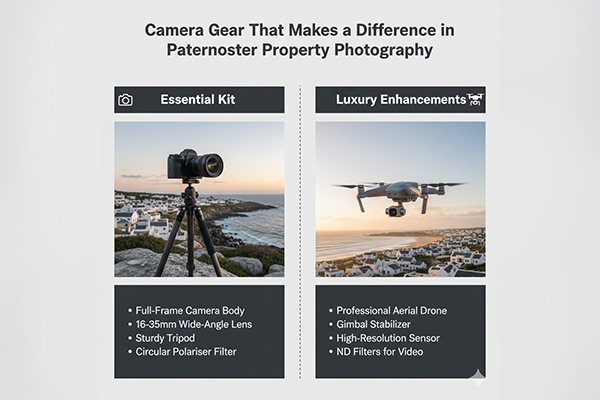
Camera Gear That Makes a Difference in Paternoster Property Photography
Property photography is often discussed in terms of style, editing, or creative flair, but long before any of those elements come into play, outcomes are shaped by something more fundamental: the camera gear being used and how reliably it performs under real-world conditions. In a coastal market like Paternoster, where light conditions change rapidly and buyers are highly sensitive to visual quality, gear choice has a direct impact on how properties are perceived.
This does not mean that expensive equipment automatically produces better results. It means that the right equipment, chosen for the specific demands of property photography, enables consistency, accuracy, and professionalism. Buyers may never ask what camera was used, but they respond clearly to the outcomes that gear makes possible.
This article explores which camera gear actually makes a difference in Paternoster property photography, why those choices matter, and how they support both image quality and marketing performance.
The Core Problem: Inconsistent Results Undermine Trust
Property photography is not judged on a single strong image. It is judged on a set of images that must work together.
When buyers browse listings, they expect visual consistency across rooms, lighting conditions, and viewpoints. Inconsistent sharpness, colour shifts, exposure problems, or perspective errors signal unreliability. Even if the property itself is appealing, these inconsistencies introduce doubt.
Camera gear plays a critical role in preventing these problems, not because it creates quality on its own, but because it allows quality to be produced reliably.
Why Gear Choice Affects Image Quality in Property Photography
Image quality in property photography is not about artistic interpretation. It is about clarity, balance, and realism.
The gear used influences:
• How well interiors and exteriors are balanced
• How accurately colours are reproduced
• How much detail is retained in highlights and shadows
• How straight and stable images appear
• How consistently results can be repeated
In Paternoster, where homes often combine bright coastal exteriors with darker interiors, these factors become especially important.
The Coastal Challenge in Paternoster
Paternoster’s coastal environment presents unique challenges for photographers.
Bright white architecture, reflective surfaces, strong sunlight, and expansive skies create high-contrast scenes. Interiors often include darker finishes designed to stay cool, increasing the exposure gap between inside and outside.
Camera gear that struggles with dynamic range, colour accuracy, or stability will expose these challenges quickly.
Professional-grade gear does not remove these challenges, but it provides the headroom needed to manage them without compromising realism.
Full-Frame vs Crop Sensors: What Actually Matters
Sensor size is one of the most debated topics in photography, and property photography is no exception.
Full-frame and crop-sensor cameras can both produce usable results, but they behave differently in ways that matter for property work.
Dynamic Range and Interior Photography
Dynamic range refers to how much detail a camera can capture between the darkest shadows and brightest highlights.
In property photography, this matters because rooms often contain bright windows and dark corners in the same frame.
Full-frame sensors typically offer greater dynamic range, allowing more detail to be preserved without aggressive editing. This results in images that feel closer to what the human eye experiences.
Crop sensors can still perform well, but they often require more careful exposure management and post-processing to avoid clipped highlights or muddy shadows.
Noise Performance and Detail Retention
Interior property photography frequently requires lower shutter speeds or higher ISO settings, especially when natural light is limited.
Full-frame sensors generally handle noise more gracefully, preserving texture and detail without introducing distracting artefacts.
Buyers may not consciously notice noise, but they do notice when images feel flat, gritty, or overly processed.
Clean detail contributes to a perception of quality and care.
Field of View and Lens Behaviour
Sensor size also affects how lenses behave.
On crop sensors, wide-angle lenses become less wide, which can limit flexibility in tight spaces. This often leads photographers to use extremely wide lenses to compensate, increasing the risk of distortion.
Full-frame systems allow moderate wide-angle lenses to show space clearly without exaggeration, supporting more realistic representation.
In Paternoster homes, where accurate proportions matter, this balance is valuable.
Reliability: The Most Underrated Gear Advantage
Reliability is rarely discussed in marketing materials, but it is one of the most important factors in professional property photography.
Reliable gear:
• Focuses accurately
• Produces consistent colour
• Handles repeated use without failure
• Performs predictably in changing light
When gear behaves inconsistently, results suffer even if technique is sound.
Why Reliability Matters for Listings
Property shoots often involve time constraints, limited access windows, and coordination with agents and sellers.
Gear failures or unpredictable behaviour lead to rushed decisions, compromised compositions, or missed shots.
Reliable equipment reduces cognitive load, allowing the photographer to focus on presentation rather than troubleshooting.
This reliability directly affects the quality of the final listing.
Consistency Across Multiple Properties
Estate agents rely on photographers who can deliver consistent results across multiple listings.
Gear that produces variable colour profiles, inconsistent autofocus, or unreliable exposure creates uneven portfolios.
Consistency builds trust not only with buyers, but also with agents who need predictable outcomes.
Professional gear supports this consistency through stable performance rather than novelty features.
Lenses That Make a Practical Difference
While camera bodies receive much attention, lenses often have a greater impact on property photography outcomes.
The most effective property lenses prioritise:
• Optical clarity
• Minimal distortion
• Reliable sharpness across the frame
• Predictable colour rendering
Exotic or ultra-fast lenses offer little benefit in property photography compared to well-corrected wide-angle and standard zoom lenses.
Avoiding Distortion as a Trust Issue
Lens distortion is not just a technical flaw. It is a trust issue.
Overly distorted images make rooms feel misleading, even if unintentionally. Buyers may not articulate the problem, but they sense exaggeration.
Lenses that maintain straight lines and realistic proportions support honest representation, which in turn supports buyer confidence.
Tripods and Stability: Non-Negotiable Tools
One of the most impactful pieces of property photography gear is also one of the least glamorous: the tripod.
A solid tripod enables:
• Precise framing
• Level horizons
• Consistent camera height
• Low ISO shooting for cleaner images
Handheld property photography introduces variability that undermines consistency.
In professional listings, stability signals care and intention.
Camera Height and Buyer Comfort
Tripods allow the photographer to maintain consistent camera height across rooms.
This consistency helps buyers orient themselves and mentally map the space. Inconsistent camera height creates subtle discomfort and confusion.
Gear that supports repeatable positioning improves the viewer’s experience.
Colour Accuracy as a Professional Signal
Colour accuracy is one of the first things buyers notice, even if subconsciously.
Gear that produces reliable colour profiles reduces the need for aggressive correction and helps maintain natural tones.
In Paternoster, where white walls, timber finishes, and coastal blues dominate, inaccurate colour reproduction quickly looks unnatural.
Natural colour supports trust.
Gear and Workflow Integration
Professional gear is designed to integrate smoothly into established workflows.
This includes:
• File formats that support editing
• Consistent white balance behaviour
• Compatibility with lighting equipment
• Predictable response to exposure adjustments
When gear integrates well, post-production becomes about refinement rather than rescue.
This efficiency improves turnaround time without sacrificing quality.
Gear as a Professionalism Signal
While buyers do not ask about equipment, estate agents and sellers do notice professionalism in setup and process.
Professional gear communicates:
• Preparedness
• Seriousness
• Investment in quality
• Respect for the property
This perception influences trust long before images are delivered.
Why Professionalism Extends Beyond the Camera
Gear alone does not create professionalism, but inappropriate gear undermines it.
For example:
• Using consumer-grade equipment that struggles with interior light
• Relying on handheld shooting for entire properties
• Producing inconsistent results across rooms
These issues signal inexperience, regardless of intent.
Appropriate gear supports professional standards.
The West Coast Buyer Context
Across the West Coast, buyers often view properties remotely before travelling to view them.
This makes photography the primary source of truth.
When images feel accurate and consistent, buyers arrive informed and confident. When images feel uneven or misleading, buyers arrive sceptical.
Gear that supports accuracy protects this first impression.
Gear Does Not Replace Technique
It is important to be clear: gear does not replace skill.
A skilled photographer can produce strong results with modest equipment. An unskilled photographer will produce weak results with premium gear.
However, when technique is solid, the right gear amplifies its effectiveness and reduces friction.
When Gear Upgrades Make Sense
Gear upgrades make sense when they:
• Improve consistency
• Expand dynamic range
• Reduce noise and artefacts
• Support reliable workflow
Upgrading for prestige or novelty rarely improves outcomes.
The question is always whether the gear improves the buyer’s experience of the images.
Long-Term Value of Appropriate Gear
Appropriate gear reduces re-shoots, shortens editing time, and protects brand perception.
From a business perspective, this reliability compounds over time.
From a marketing perspective, it supports listings that feel calm, credible, and trustworthy.
Buyers Experience Results, Not Equipment
Ultimately, buyers experience outcomes.
They respond to:
• Balanced light
• Straight lines
• Clean detail
• Consistent presentation
These qualities emerge when gear supports technique effectively.
Reframing the Gear Conversation
The most useful question is not “What camera is best?”
It is “What gear allows consistent, accurate representation of property under real conditions?”
In Paternoster, those conditions include coastal light, reflective surfaces, and discerning buyers.
Practical Takeaways for Sellers and Agents
For sellers and estate agents, evaluating photography should focus on results rather than gear lists.
Look for:
• Consistency across listings
• Natural light balance
• Accurate proportions
• Calm, professional presentation
These outcomes indicate appropriate gear used well.
Practical Takeaways for Photographers
For photographers, investing in gear should be driven by reliability and repeatability.
The goal is not to impress peers, but to support clear communication between property and buyer.
Gear that disappears into the workflow is often the most valuable.
Closing Perspective
Camera gear makes a difference in Paternoster property photography, but not because it creates quality on its own. It makes a difference because it enables consistency, accuracy, and professionalism under demanding conditions.
Full-frame sensors offer greater flexibility in challenging light. Reliable lenses preserve proportions and trust. Tripods and stable systems support clarity. Together, these tools reduce variability and support honest representation.
Buyers may never ask what camera was used, but they respond clearly to the results it makes possible.
If the aim is to present property in a way that builds confidence, aligns expectations, and protects perceived value, then camera gear should be chosen not for status, but for its ability to deliver dependable, realistic outcomes every time.
That reliability is what truly makes a difference.


