Camera Gear for Property Video & Aerial Footage: What Separates Professional Results
Property video and aerial footage have become core components of modern real estate marketing, particularly in lifestyle-driven coastal areas. Yet while many listings now include video or drone clips, only a small percentage feel genuinely professional. The difference is rarely about ambition or effort. It comes down to production standards and how camera gear supports consistency, control, and clarity.
In areas such as Calypso Beach, Shark Bay, and Country Estate, buyers are visually literate. They compare listings quickly, often on mobile devices, and they form strong opinions about credibility long before booking a viewing. In this environment, camera gear does not create quality on its own, but it does set the boundaries within which quality can be achieved.
This article examines what separates professional property video and aerial footage from casual results, focusing on stabilisation, sensor performance, colour depth, drone limitations, and how the right gear enables smooth, trustworthy storytelling rather than visual spectacle.
The Core Problem: Video Quality Is Judged Instantly
Property video is unforgiving.
Buyers make judgements within seconds. Shaky movement, uneven exposure, clipped highlights, or inconsistent colour immediately signal amateur production. Even if the property itself is strong, poor video quality introduces doubt.
Unlike photography, video demands sustained attention. Any technical weakness compounds over time.
Professional results depend on whether camera gear supports stability, consistency, and realism across an entire sequence, not just a single frame.
Stabilisation Matters More Than Resolution
One of the most common misconceptions in property video is that higher resolution equals better quality.
In practice, stabilisation matters far more.
Smooth movement is the foundation of professional-looking property video. Buyers expect calm, controlled motion that mirrors how they would naturally move through a space.
Unstable footage, even at high resolution, feels careless.
Why Stabilisation Shapes Buyer Perception
Stabilisation affects perception at a psychological level.
Smooth footage communicates:
• Control
• Intentional movement
• Professional planning
• Calm confidence
Shaky footage communicates the opposite.
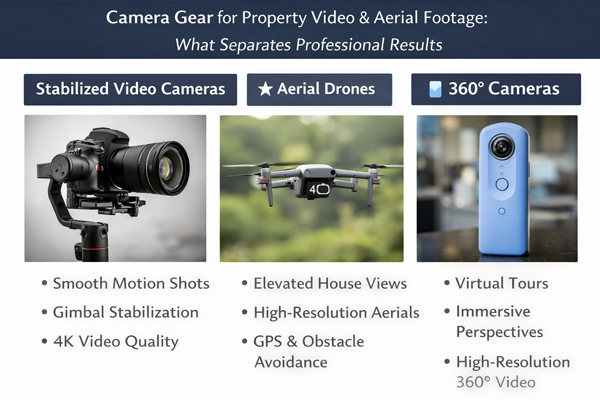
Camera gear that supports stabilisation, such as gimbals, in-body stabilisation, and balanced drone platforms, directly influences how trustworthy the video feels.
Buyers rarely forgive instability, but they often overlook modest resolution differences.
Gimbals and Movement Discipline
For interior walkthroughs, a dedicated gimbal is often the single most important piece of gear.
It allows:
• Level horizons
• Consistent walking pace
• Predictable framing
• Reduced micro-jitter
Without proper stabilisation, footage feels rushed and unpolished, regardless of camera quality.
Professional gear supports disciplined movement. Casual setups rely on luck.
Resolution as a Secondary Factor
Resolution matters, but only once stability is achieved.
Higher resolution allows for:
• Cleaner downscaling
• Minor reframing in post
• Better detail retention
However, buyers rarely benefit from native resolution if the footage itself is uncomfortable to watch.
A stable 4K clip almost always outperforms unstable 6K or 8K footage in perceived quality.
Sensor Size and Colour Depth: Why They Matter in Video
Sensor size and colour depth influence how footage handles light, contrast, and colour transitions.
Property video often includes:
• Bright exteriors
• Dark interiors
• Mixed colour temperatures
• Rapid exposure changes
Smaller sensors and limited colour depth struggle in these conditions.
How Larger Sensors Improve Property Video
Larger sensors generally offer:
• Better dynamic range
• Smoother highlight roll-off
• Cleaner shadows
• More natural colour transitions
These qualities reduce harsh contrast and help footage feel closer to what the human eye experiences.
In coastal environments, where light can be intense and reflective, this advantage becomes significant.
Colour Depth and Editing Flexibility
Colour depth affects how much footage can be adjusted without breaking.
Higher colour depth allows editors to:
• Balance interior and exterior light
• Match drone and ground footage
• Maintain natural skin tones and materials
• Avoid banding in skies and walls
Lower colour depth footage often looks acceptable straight out of camera but falls apart during correction.
Professional results depend on footage that tolerates refinement.
Drone Camera Limitations: Understanding the Ceiling
Drone footage adds context and orientation, but drone cameras have inherent limitations.
Most drones use small sensors to maintain flight efficiency. This affects:
• Dynamic range
• Low-light performance
• Colour flexibility
Professional drone results are achieved not by ignoring these limits, but by working within them.
Why Drone Footage Looks Amateur When Misused
Drone footage often looks amateur when:
• It is flown too fast
• It is shot in harsh midday light
• It relies on dramatic angles rather than clarity
• It is not colour-matched to ground footage
No amount of camera gear can fix poor flight discipline or poor timing.
Professional drone gear separates results by offering stability and predictable control, but technique remains critical.
The Role of Stabilised Drone Platforms
Modern drones with advanced stabilisation produce smoother footage that feels anchored rather than floaty.
This stability is essential for property marketing, where buyers want orientation, not spectacle.
Smooth lateral movement, gentle elevation changes, and controlled pacing feel informative rather than cinematic.
Professional gear enables this restraint.
Cinematic vs Casual Footage: The Wrong Comparison
Property video is often described as cinematic or casual, but this framing is misleading.
The real distinction is between controlled and uncontrolled footage.
Cinematic does not mean dramatic. It means intentional.
Casual footage lacks intention. It feels reactive and inconsistent.
Professional gear supports intentionality by offering predictable results.
Why Over-Cinematic Footage Can Backfire
Highly cinematic footage with aggressive motion, heavy grading, or dramatic music can undermine trust.
Buyers may feel that visuals are being used to distract rather than inform.
Professional property video prioritises clarity over spectacle.
Calm, accurate footage converts better than impressive but disorienting visuals.
Gear as a Support System, Not a Star
Professional camera gear works best when it disappears.
The viewer should not notice the camera, the drone, or the stabilisation. They should notice the space.
This invisibility is achieved through:
• Reliable stabilisation
• Consistent exposure
• Predictable colour response
• Clean audio integration
Gear that constantly draws attention to itself has failed its purpose.
How Gear Enables Smooth Storytelling
Property video is a form of storytelling, but the story is simple.
It is about:
• Arrival
• Flow
• Space
• Context
Camera gear supports this by allowing smooth transitions between scenes.
Stable footage, consistent colour, and predictable exposure make edits feel seamless.
When gear introduces variability, storytelling becomes fragmented.
Interior and Exterior Consistency
One of the clearest markers of professional production is consistency between interior and exterior footage.
This consistency is supported by gear that handles:
• Exposure transitions
• White balance accuracy
• Matching profiles across devices
When interiors and drone shots feel like they belong to the same story, buyers feel oriented.
When they clash, buyers feel unsettled.
Drone and Ground Footage Matching
Matching drone and ground footage is challenging.
Different sensors, lenses, and colour science must be reconciled.
Professional workflows rely on gear that produces footage flexible enough to be matched convincingly.
Cheap or limited cameras restrict this ability, resulting in visible seams.
The Coastal Context
In coastal areas like Calypso Beach, Shark Bay, and Country Estate, light conditions are demanding.
Bright reflections, wide skies, and strong contrasts expose the limits of casual gear quickly.
Professional gear provides the headroom needed to handle these conditions without compromising realism.
Casual Gear vs Professional Gear: Practical Differences
Casual setups often struggle with:
• Rolling shutter wobble
• Inconsistent autofocus
• Limited dynamic range
• Weak stabilisation
Professional setups reduce these issues, not because they are flawless, but because they are predictable.
Predictability is the foundation of consistency.
Consistency as the Defining Standard
Consistency is what separates professional results.
Buyers trust listings where:
• Every clip feels intentional
• Motion is calm throughout
• Colour is coherent
• Quality does not fluctuate
Camera gear enables this consistency by reducing variables.
Technique applies it.
Why Buyers Experience Results, Not Specs
Buyers never ask about sensor size or codecs.
They experience:
• Smoothness
• Calmness
• Clarity
• Realism
Gear matters only insofar as it supports these qualities.
Professional gear matters because it makes consistency repeatable.
When Gear Investment Makes Sense
Gear investment makes sense when:
• Video is a core marketing tool
• Properties rely on lifestyle appeal
• Aerial context influences value
• Results must be repeatable
In these cases, gear is not an upgrade. It is infrastructure.
When Gear Is Overkill
Gear becomes overkill when:
• Technique is underdeveloped
• Lighting discipline is weak
• Storytelling is unclear
• Movement lacks intention
Without technique, expensive gear simply produces expensive mistakes.
Professional Standards Are About Systems
Professional property video is not about owning specific tools.
It is about systems:
• Stable capture
• Controlled movement
• Consistent colour
• Integrated aerial and ground footage
• Predictable editing outcomes
Camera gear supports these systems.
It does not replace them.
Long-Term Value of the Right Gear Choices
The right gear reduces friction over time.
It lowers re-shoot rates, shortens editing cycles, and increases reliability.
From a business perspective, this consistency protects brand perception and client trust.
The Buyer Confidence Link
Buyers respond to confidence.
Smooth, consistent video creates confidence by reducing uncertainty.
When buyers feel confident, enquiries improve and negotiations soften.
Gear supports this indirectly, but meaningfully.
Reframing the Question
The question is not which camera is best.
The question is which gear allows the most consistent, calm, and accurate representation of property.
Professional results come from choosing gear that serves that goal.
Closing Perspective
Camera gear for property video and aerial footage matters, but not in the way it is often discussed.
Resolution, sensor size, and drone specifications are secondary to stabilisation, colour consistency, and predictable performance.
Professional results are separated from casual ones by how well gear supports smooth storytelling, not by how impressive the specs look on paper.
In property marketing, especially in lifestyle-driven coastal areas, buyers reward calm, accurate presentation far more than visual drama.
If the goal is to create property video and aerial footage that builds trust, reduces uncertainty, and supports confident decisions, then camera gear should be chosen not for prestige, but for its ability to deliver consistency, control, and clarity every time.
That is what separates professional results.


