
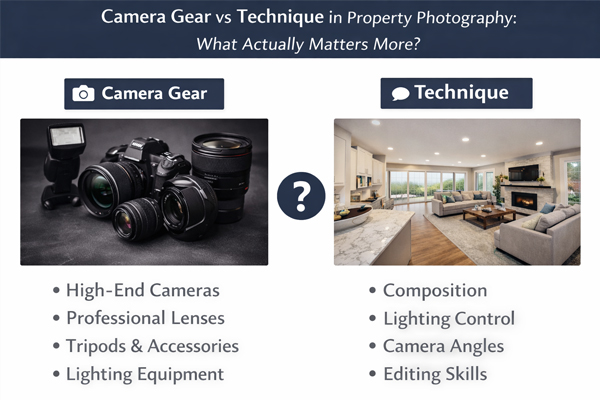
Camera Gear vs Technique in Property Photography: What Actually Matters More?
Property photography is one of the few marketing disciplines where the tools are highly visible but the impact is judged almost entirely on outcome. Sellers, estate agents, and even photographers themselves often assume that better cameras automatically produce better results. This assumption has driven years of gear upgrades, lens debates, and spec comparisons. Yet when buyers scroll through listings, they are not asking what camera was used. They are deciding whether a property feels credible, well presented, and worth further attention.
This article examines the relationship between camera gear and technique in property photography, separating common myths from practical realities. The focus is not on dismissing equipment, but on understanding where its influence ends and where technique becomes decisive. In residential markets such as Myburgh Park, Country Estate, Calypso Beach, and Long Acres, the difference between average and effective photography is rarely the camera body. It is almost always how the photographer uses light, space, and perspective.
The Persistent Myth of Expensive Cameras
One of the most widespread misconceptions in property photography is that expensive cameras produce professional results by default. This belief is reinforced by marketing, online reviews, and the visible complexity of modern gear.
The reality is more nuanced.
High-end cameras offer technical advantages such as dynamic range, resolution, and low-light performance. These advantages matter, but they do not compensate for poor technique. A poorly composed image taken on an expensive camera will still feel careless. A well-composed image taken on modest equipment can still feel polished and trustworthy.
Buyers do not perceive sensor size or megapixels. They perceive balance, clarity, and realism.
Why This Myth Persists
The gear myth persists because equipment is tangible and technique is not. Cameras can be purchased. Skill must be developed.
For sellers and agents, it is easier to believe that upgrading equipment solves quality issues than to recognise the importance of planning, experience, and execution. For photographers, it can be tempting to rely on gear as a proxy for professionalism.
In practice, gear only sets the ceiling. Technique determines whether that ceiling is ever reached.
What Buyers Actually Respond To
Buyers do not evaluate property photos technically. They respond psychologically.
They ask, often subconsciously:
Does this space feel accurate
Does the property look well cared for
Does the presentation feel honest
Can I imagine myself here
None of these questions are answered by camera specifications. They are answered by technique.
Technique as the Primary Driver of Outcomes
Technique governs how light is managed, how rooms are framed, how perspective is controlled, and how images flow as a set. These decisions shape the buyer’s experience far more than the brand of camera used.
A photographer with strong technique will consistently outperform someone with superior gear but weaker execution. This is observable across thousands of listings, regardless of price point.
Lenses Matter, But Only When Used Well
Lenses are often discussed as the most important piece of gear in property photography, and there is some truth to this. Focal length affects how space is rendered and how rooms feel.
However, the lens itself does not guarantee a good result.
A wide-angle lens used without restraint introduces distortion and misrepresentation. A moderate lens used with careful positioning and framing often produces more trustworthy images.
Technique determines whether a lens clarifies or exaggerates.
Composition Is a Skill, Not a Feature
Composition is where technique becomes visible.
Good composition balances verticals, manages negative space, and shows relationships between elements. Poor composition leaves rooms feeling skewed, cluttered, or confusing.
No camera feature can fix weak composition. Autofocus, dynamic range, and resolution do not decide where the camera is placed or what is included in the frame.
Buyers instinctively respond to composition because it affects how easily they can understand a space.
Light Control: The True Differentiator
Light is the most important variable in property photography, and it is also the least forgiving.
Gear can capture light, but technique controls it.
Understanding when to rely on natural light, when to supplement with flash, how to balance interior and exterior exposure, and how to avoid harsh contrast are all technique-driven decisions.
Two photographers using the same camera in the same room can produce dramatically different results based on how they manage light.
Why Cameras Do Not See Like Humans
One reason technique matters so much is that cameras do not see the way humans do. Human vision adapts dynamically to contrast and colour temperature. Cameras require deliberate control to replicate that experience.
Technique bridges this gap.
Exposure blending, careful flash placement, and colour balancing are all technique-based solutions to a technical limitation.
Without technique, even the best camera produces images that feel unnatural.
Perspective Control and Buyer Trust
Perspective errors are one of the fastest ways to undermine buyer trust.
Tilted verticals, stretched corners, and exaggerated depth make spaces feel unstable. Buyers may not consciously identify the cause, but they feel discomfort.
Perspective control is not a camera feature. It is a shooting discipline and a post-production skill.
Technique determines whether walls look solid or warped, whether ceilings feel believable or inflated.
Gear Helps Consistency, Technique Creates It
Professional property photography is not about producing one good image. It is about producing a consistent set of images that work together.
Gear can help maintain consistency through reliable colour and exposure, but technique determines whether that consistency is applied intelligently.
Consistency across rooms, lighting conditions, and viewpoints is what makes a listing feel professional.
Buyers interpret consistency as care.
Comparing Skill Versus Equipment Outcomes
When comparing outcomes, the pattern is clear.
A skilled photographer using mid-range equipment will usually produce results that outperform an unskilled photographer using premium gear.
This is because skill governs:
• Shot selection
• Camera placement
• Light timing
• Angle choice
• Post-production restraint
Equipment only supports these decisions. It does not replace them.
How Technique Multiplies Gear Effectiveness
This does not mean gear is irrelevant. It means gear amplifies technique.
Better cameras offer more latitude for correcting exposure, preserving detail, and maintaining quality under difficult conditions. However, these benefits only materialise when the photographer knows how to use them.
Technique multiplies the effectiveness of gear. Without technique, that multiplication factor is close to zero.
Buyers Perceive Results, Not Tools
Buyers never ask what camera was used. They ask whether the property feels right.
They respond to:
• Natural light balance
• Straight lines
• Realistic proportions
• Clear spatial relationships
All of these are outcomes of technique.
Gear is invisible to the buyer unless it fails catastrophically.
The Illusion of Gear as a Shortcut
One of the most damaging beliefs in property photography is that gear provides a shortcut to quality.
This belief leads to underinvestment in training, planning, and experience. It also leads to inconsistent results, because gear cannot compensate for situational complexity.
Every property is different. Technique adapts. Gear does not.
Professionalism Is a System, Not a Kit
True professionalism in property photography is systemic.
It includes:
• Pre-shoot planning
• Understanding of buyer psychology
• Consistent shooting workflow
• Controlled lighting approach
• Reliable post-production standards
Gear supports this system, but it does not define it.
A professional result comes from repeatable processes, not individual tools.
Why Buyers Trust Technique-Driven Photography
Technique-driven photography aligns expectations with reality.
When buyers arrive at a viewing and the property matches the photos, trust increases. When it does not, trust collapses.
This alignment is achieved through restraint, accuracy, and consistency, not through visual exaggeration.
Technique protects trust by prioritising realism over impact.
Context Matters More Than Specs
In residential areas such as Myburgh Park, Country Estate, Calypso Beach, and Long Acres, buyers are often comparing multiple similar properties.
Small differences in presentation influence decisions disproportionately.
Technique ensures that these differences reflect the property honestly rather than artificially.
The South African Context
In South Africa, property marketing spans a wide range of price points and buyer sophistication levels. However, across segments, the same principle holds.
Buyers reward clarity and punish inconsistency.
They may forgive modest equipment. They do not forgive misleading representation.
Technique is the common denominator that performs across markets.
Why Technique Ages Better Than Gear
Camera technology evolves rapidly. Techniques evolve slowly.
A photographer who relies primarily on gear will feel pressure to upgrade constantly. A photographer who relies on technique will remain effective across generations of equipment.
From a business perspective, technique offers more durable value.
When Gear Truly Matters
There are situations where gear makes a meaningful difference.
Low-light interiors
High-contrast scenes
Large-format print requirements
In these cases, better gear expands what is possible. But it still does not decide how those possibilities are used.
Gear matters most at the margins. Technique governs the core.
The Buyer Experience Is the Final Test
Ultimately, property photography succeeds or fails based on buyer experience.
If buyers feel informed, comfortable, and confident, the photography has done its job.
If buyers feel misled or uncertain, no amount of gear prestige can fix that.
Technique is what shapes experience.
Reframing the Debate
The question is not camera gear versus technique.
The correct framing is:
Technique first, gear second.
Gear should be selected to support technique, not replace it.
Implications for Sellers and Agents
For sellers and estate agents, this distinction matters.
Choosing a photographer based on equipment alone is a mistake. The better indicator is consistency of results across varied properties.
Professionalism shows up in repeatability, not in brand names.
Implications for Photographers
For photographers, the message is equally clear.
Investing in technique produces better returns than chasing gear upgrades. Training, experience, and critical evaluation of one’s own work deliver more improvement than a new camera body.
Gear should follow skill, not lead it.
The Role of Discipline and Restraint
Some of the most important techniques in property photography are about what not to do.
Not over-widen
Not over-light
Not over-edit
Not over-dramatise
Restraint is a learned skill, not a camera setting.
Why Technique Supports Long-Term Trust
Trust compounds.
Buyers who encounter accurate photography develop confidence in certain agents, brands, or styles. This confidence influences future decisions.
Technique-driven photography builds this trust quietly over time.
Closing Perspective
Camera gear and technique are not equal contributors to property photography outcomes. Gear provides potential. Technique determines reality.
In residential property marketing, buyers experience results, not tools. They respond to clarity, balance, and realism. These qualities come from technique, supported by appropriate gear.
Professionalism in property photography is not about owning the best equipment. It is about using whatever equipment is available with consistency, restraint, and understanding of buyer perception.
If the goal is to create images that build trust, support confident enquiries, and align expectations with reality, technique will always matter more than gear.
Gear may open the door. Technique decides what buyers see when they walk through it.


