
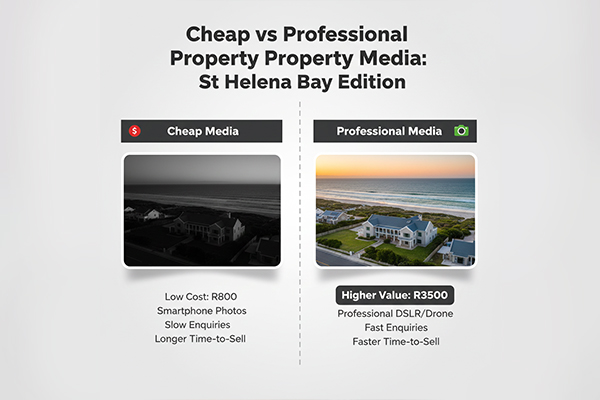
Cheap vs Professional Property Media: Pricing Trade-Offs in St Helena Bay
In property marketing, pricing decisions are often framed as cost control. Media is viewed as a line item to be minimised rather than a strategic lever to be managed. In coastal markets such as St Helena Bay, this framing can quietly undermine listing performance, brand credibility, and transaction outcomes.
The choice between cheap and professional property media is not simply a question of saving money versus spending more. It is a question of risk allocation. Cheap media shifts risk downstream to the listing, the agent, and the seller. Professional media absorbs risk upfront through planning, consistency, and execution.
This article analyses the pricing trade-offs between cheap and professional property media in St Helena Bay, focusing on risk exposure, brand impact, re-shoot costs, and why professional pricing functions primarily as risk reduction rather than visual indulgence.
The Problem: Media Is Treated as a Cost, Not a Risk Variable
Most pricing discussions around property media start with the wrong question.
The question is usually: How much does this cost.
The more useful question is: What risk does this introduce or remove.
In St Helena Bay, where buyer decisions are influenced by lifestyle alignment, trust, and visual clarity, media quality directly affects risk across the entire sales process. Yet this risk is rarely quantified.
Cheap media appears attractive because its risks are not immediately visible.
Why Cheap Property Media Exists
Low-cost property media exists because there is a market for speed and affordability.
Typical characteristics of cheap media providers include:
• Minimal pre-shoot planning
• High volume, low margin operations
• Limited post-production
• Generic shooting approaches
• Little integration with broader marketing strategy
In some markets, this model can function adequately. In coastal lifestyle markets, it often underperforms because buyer expectations are different.
The issue is not effort or intent. It is structural limitation.
The First Risk: Loss of Control Over First Impressions
First impressions in property marketing are fragile and time-bound.
The first two to three weeks of a listing’s life attract the highest attention. This is when platforms prioritise new listings and buyers are most receptive.
Cheap media introduces risk at this exact moment.
Poor lighting, inconsistent colour, awkward framing, or weak video pacing may not feel catastrophic, but they erode confidence immediately.
Once that first impression window passes, momentum is difficult to regain.
This risk cannot be reversed cheaply.
Buyer Perception and the Cost of Doubt
Buyers rarely articulate doubt directly.
Instead, doubt manifests as:
• Reduced engagement
• Hesitant enquiries
• Price-driven negotiation
• Requests for additional clarification
• Delayed decisions
Cheap media increases doubt by leaving unanswered questions.
Professional media reduces doubt by presenting information clearly and consistently.
The cost of doubt is not visible on an invoice, but it shows up in time on market and negotiation outcomes.
Brand and Listing Damage: The Silent Trade-Off
Property media does not only represent the property. It represents the agent.
In smaller markets such as St Helena Bay, buyers encounter the same agencies repeatedly. Patterns form quickly.
Listings with weak media do not exist in isolation. They contribute to cumulative brand perception.
Brand damage occurs when buyers subconsciously associate an agent or agency with:
• Inconsistent presentation
• Rushed marketing
• Lack of attention to detail
This damage is subtle but persistent.
Professional media protects brand equity by maintaining a consistent standard across listings.
Listing Damage Is Often Irreversible
One of the most underestimated risks of cheap media is listing fatigue.
When a listing underperforms early due to weak media, subsequent improvements are often less effective.
Buyers who saw the listing initially may have dismissed it. Even if media is replaced later, perception lingers.
In St Helena Bay, where buyer pools are smaller, this effect is amplified.
A poorly launched listing may never fully recover its initial potential.
The Real Cost of Re-Shoots
Cheap media frequently leads to re-shoots.
Agents realise performance is weak and commission new photography or video. The original saving disappears.
Re-shoot costs include:
• Additional media fees
• Time delays
• Marketing reset
• Loss of initial momentum
In many cases, the combined cost exceeds what professional media would have cost initially.
This is not an exception. It is a pattern.
Delays Carry Financial and Psychological Costs
Time on market has both financial and psychological consequences.
Financially, longer listings increase holding costs for sellers. Psychologically, they create pressure to reduce price.
Buyers interpret extended time on market as a signal, regardless of the reason.
Cheap media contributes to delays by failing to generate early traction.
Professional media is designed to perform during the critical early phase.
Professional Pricing as Risk Reduction
Professional property media pricing reflects a different intent.
Rather than optimising for low upfront cost, it optimises for:
• Predictable outcomes
• Consistent quality
• Buyer trust
• Brand protection
This makes professional pricing a form of insurance.
The premium is paid upfront to reduce the likelihood of downstream problems.
What Professional Media Pricing Typically Covers
Professional pricing usually includes:
• Pre-shoot planning
• Site-specific approach
• Consistent lighting and colour management
• Thoughtful composition
• Integrated photo and video workflows
• Quality-controlled post-production
These elements reduce variability.
Reduced variability reduces risk.
Buyer Trust Is Earned Visually
Trust is built before contact.
By the time a buyer enquires, they have already formed an opinion about:
• The property
• The agent
• The seriousness of the listing
Cheap media often undermines trust by feeling generic or careless.
Professional media earns trust by feeling intentional and calm.
In lifestyle-driven markets, trust precedes price acceptance.
Cheap Media and Negotiation Pressure
Buyers negotiate harder when they feel uncertain.
Weak media creates uncertainty around:
• True condition
• Space and layout
• Light and atmosphere
• Surroundings
To compensate for this uncertainty, buyers seek discounts.
Professional media reduces uncertainty, which supports firmer negotiation positions.
The pricing trade-off here is clear: save on media, pay in negotiation.
Video Quality Magnifies Risk
The difference between cheap and professional media is most visible in video.
Common issues with cheap video include:
• Jittery movement
• Inconsistent exposure
• Poor audio
• Abrupt pacing
These issues are more damaging than weak photos because video demands sustained attention.
In St Helena Bay, where many buyers are remote, video often replaces preliminary viewings.
Poor video increases risk significantly.
Cheap Media Often Optimises for Speed Over Fit
Low-cost providers are often incentivised to move quickly.
Speed is valuable, but not when it ignores context.
St Helena Bay properties vary widely in layout, light, and surroundings. A generic shooting approach fails to account for this variation.
Professional providers adapt their approach to each property.
Adaptation costs more, but it reduces mismatch risk.
Risk Exposure Extends Beyond the Listing
The risks of cheap media extend beyond individual listings.
They affect:
• Seller confidence
• Agent credibility
• Referral likelihood
• Repeat business
Sellers who feel their property was poorly represented are less likely to refer or relist with the same agent.
Professional media supports long-term relationships by demonstrating care.
The Coastal Buyer Mindset
Buyers in St Helena Bay are often:
• Lifestyle-oriented
• Environmentally sensitive
• Remote or semi-remote
• Emotionally invested
These buyers are particularly responsive to visual cues.
Cheap media that fails to communicate atmosphere and place struggles with this audience.
Professional media aligns better with buyer psychology.
The West Coast Context
Across the West Coast, property markets share certain traits:
• Strong lifestyle narratives
• High visual sensitivity
• Smaller buyer pools
• Repeat exposure to the same agents
These traits amplify both the upside of professional media and the downside of cheap media.
Risk compounds faster in smaller markets.
When Cheap Media Might Seem Acceptable
There are scenarios where cheap media appears acceptable:
• Very low-value listings
• Properties competing purely on price
• Short-term or distressed sales
Even in these cases, the decision should be explicit and informed.
Cheap media should be a strategic exception, not a default.
The Illusion of “Good Enough”
Cheap media often aims for “good enough.”
The problem is that buyers do not evaluate media in isolation. They compare.
When one listing uses professional media and another uses “good enough” media, the difference is stark.
“Good enough” is rarely competitive.
Platform Algorithms Reward Engagement
Property portals prioritise listings that generate engagement.
Professional media tends to increase:
• Click-through rates
• Time spent on listing
• Video views
These signals improve visibility.
Cheap media often underperforms algorithmically, compounding its disadvantage.
Risk Accumulation Over Time
Each listing carries risk.
Over time, agents who consistently choose cheap media accumulate more risk exposure than those who invest in professional standards.
This accumulation affects:
• Brand perception
• Market position
• Negotiation leverage
Professional media spreads risk management across the portfolio, not just individual listings.
Pricing Trade-Offs Summarised
Cheap property media trades:
• Lower upfront cost
for
• Higher downstream risk
Professional property media trades:
• Higher upfront investment
for
• Lower downstream uncertainty
This is the core pricing trade-off.
The Most Common Miscalculation
The most common mistake is evaluating media pricing in isolation from outcome.
Media should be evaluated alongside:
• Listing performance
• Time on market
• Negotiation outcomes
• Brand perception
When viewed holistically, professional media often delivers better ROI despite higher initial cost.
Professional Media as Preventative Strategy
Professional property media is preventative.
It prevents:
• Weak first impressions
• Buyer doubt
• Listing fatigue
• Re-shoots
• Brand erosion
Prevention is rarely celebrated, but it is highly effective.
Decision-Making for Agents and Sellers
For agents and sellers in St Helena Bay, the decision is not about spending more or less.
It is about deciding where risk should sit.
Cheap media pushes risk forward into the campaign. Professional media absorbs risk upfront.
In a market where trust, clarity, and lifestyle alignment drive demand, risk reduction matters.
Closing Perspective
The pricing trade-offs between cheap and professional property media in St Helena Bay are not primarily financial. They are strategic.
Cheap media offers short-term savings at the cost of increased uncertainty, weaker buyer trust, and higher downstream risk. Professional media requires greater upfront investment but reduces exposure across the entire sales process.
When viewed through a risk-and-reward lens, professional property media is less about aesthetics and more about control.
If you are marketing property in St Helena Bay and want listings to launch strong, protect brand credibility, and support confident pricing, the question is not whether professional media costs more.
The real question is whether absorbing risk later is truly cheaper than managing it upfront.


