
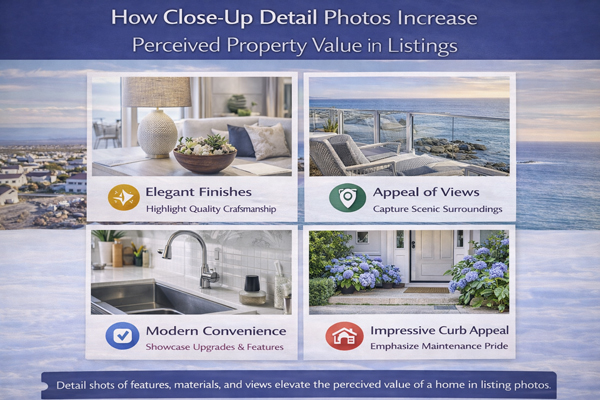
How Close-Up Detail Photos Increase Perceived Property Value in Listings
Property value is not judged only by size, location, or price per square metre. It is judged through perception. Long before a buyer calculates affordability or compares recent sales, they subconsciously assess quality. That assessment happens visually, quickly, and often without awareness.
Close-up detail photography plays a disproportionate role in this process. While wide-angle images establish space and layout, detail photos influence how buyers feel about quality, care, and value. In many listings, these images are missing, underestimated, or treated as decorative extras. In reality, they are one of the most effective tools for anchoring perceived value.
This article examines how close-up detail photos increase perceived property value by shaping buyer assumptions, reinforcing trust, and supporting stronger price positioning. The focus is not on aesthetics for their own sake, but on how visual evidence influences buyer psychology in real-world listing environments.
How Buyers Subconsciously Assess Quality Through Small Details
Buyers rarely articulate how they assess quality, but their brains are constantly doing it.
When viewing a property listing, buyers scan for signals. These signals help them answer a fundamental question: Is this property well cared for.
Small details carry significant weight in answering that question. Door handles, taps, cabinetry edges, tile alignment, light switches, finishes, and materials all act as indicators. Buyers use these cues as shortcuts to assess overall quality.
Close-up photos bring these cues into focus. They allow buyers to inspect materials and finishes without physically being present. Even when buyers do not consciously zoom in or analyse the image, the presence of clear, well-lit detail photos sends a signal that quality exists and is worth noticing.
In areas such as Myburgh Park or Calypso Beach, where many homes may be similar in size or layout, these small details often become the differentiating factor in perceived value.
Perceived Value Versus Actual Cost of Fixtures and Finishes
One of the most misunderstood aspects of property marketing is the relationship between cost and perceived value.
Many fixtures and finishes that buyers respond strongly to are not expensive in absolute terms. A brushed metal tap, a modern handle, or a well-finished light fitting may represent a small fraction of the total property cost. Yet visually, these elements carry disproportionate influence.
Buyers do not evaluate fixtures based on their invoice value. They evaluate them based on what they imply.
Close-up photos allow these implications to form clearly. A buyer seeing clean lines, consistent finishes, and thoughtful material choices assumes that similar care extends throughout the property. This assumption increases perceived value even when the actual cost of those elements is modest.
In contrast, when details are not shown, buyers often assume the opposite. Missing information is filled with conservative assumptions, which lowers perceived value regardless of reality.
Detail Shots as Proof of Care
One of the strongest psychological functions of close-up photography is proof.
Wide shots show what a property looks like. Detail shots show how it has been treated.
When a listing includes close-up images of finishes, edges, fittings, and materials, it communicates that the seller and agent are confident enough to show the finer points. This confidence signals care.
Care is a powerful concept in property sales. Buyers equate care with maintenance, longevity, and reduced risk. A well-cared-for property feels safer to buy.
Detail photos act as visual evidence of that care. They do not rely on claims or descriptions. They simply show it.
In Country Estate or Long Acres listings, where buyers may be comparing multiple properties with similar headline features, proof of care often tips the balance.
Why Listings With Only Wide Shots Underperform
Many property listings rely almost entirely on wide-angle images. These photos are important. They show layout, room size, and flow. But on their own, they leave gaps.
Wide shots answer the question how big is this space. They do not answer how good is this space.
When listings lack detail images, buyers are forced to infer quality from distance. This inference is risky, so buyers default to caution. They may still enquire, but with more scepticism. They may still view, but with sharper scrutiny.
Listings that include both wide shots and detail images perform better because they address both spatial and qualitative evaluation. Buyers understand the property more completely, which reduces uncertainty and increases confidence.
This difference becomes especially important in competitive areas where buyers are filtering aggressively.
The Role of Lighting in Making Details Feel Premium
Lighting is critical in detail photography. Poor lighting can neutralise the value of even high-quality finishes. Good lighting elevates them without exaggeration.
Close-up detail photos rely on controlled, soft lighting to show texture, material, and finish accurately. Harsh light creates glare and hides subtle qualities. Flat light removes depth and makes materials look cheap.
When lighting is handled correctly, details feel tactile and intentional. Metal looks solid rather than shiny. Wood looks natural rather than dull. Surfaces feel clean rather than sterile.
This lighting control is what transforms a detail photo from a snapshot into a value signal.
In premium coastal environments like Calypso Beach, where buyers expect a certain standard, poorly lit details can undermine perceived value quickly. Well-lit details reinforce it quietly.
Detail Photos and Price Anchoring
Price anchoring happens before buyers consciously consider numbers.
When buyers perceive a property as high quality, the asking price feels more reasonable. When quality feels uncertain, the same price feels inflated.
Close-up detail photos support price anchoring by visually justifying the asking price. They give buyers something concrete to associate with value. Instead of seeing only size and location, buyers see finish quality, material choice, and care.
This visual justification matters in negotiation.
Buyers who feel that quality has been demonstrated are less inclined to challenge price aggressively. They may still negotiate, but from a position of acceptance rather than scepticism.
Detail photos therefore do not just attract buyers. They protect price positioning.
Reducing Buyer Uncertainty and Objections
Many buyer objections are rooted in uncertainty rather than disagreement.
Buyers wonder whether finishes will look worn in person, whether materials are cheap substitutes, or whether corners have been cut. These concerns may not be voiced, but they influence behaviour.
Close-up detail photography reduces these uncertainties by showing reality clearly. Buyers can see the condition and quality of finishes. They are less likely to imagine problems that do not exist.
When uncertainty decreases, objections soften. Viewings become confirmations rather than investigations. Conversations shift from flaws to suitability.
This shift has a direct impact on how smoothly a sale progresses.
Why Detail Photos Matter More for Remote and Relocating Buyers
Not all buyers can easily attend multiple viewings.
Relocating buyers, semigrators, or investors often rely heavily on online information before committing time and resources. For these buyers, detail photos are especially important.
They provide reassurance that the property has been maintained and that the listing is transparent. Without detail images, remote buyers are forced to rely on descriptions, which feel less trustworthy.
In areas attracting lifestyle buyers, detail photography supports confidence across distance. It allows buyers to engage seriously before physical inspection.
Detail Photography as a Strategic Marketing Tool
Close-up photos should not be treated as decoration.
They are not added to make listings look artistic. They are added to communicate quality, care, and value efficiently.
Strategically chosen details focus on elements that buyers associate with durability and finish quality. Handles, taps, cabinetry, joinery, flooring transitions, and fittings are not random. They are selected because buyers subconsciously use them as quality markers.
When used intentionally, detail photography becomes part of a value-protection strategy rather than a visual flourish.
Supporting Firmer Negotiations
Negotiation outcomes are influenced long before offers are made.
When buyers feel confident in what they have seen, they negotiate with more respect for the asking price. When they feel uncertain, they negotiate defensively.
Detail photos support firmer negotiations by reducing doubt. Buyers who have seen evidence of care and quality are less inclined to assume that hidden issues exist. They focus negotiation on personal preference rather than perceived shortcomings.
This does not eliminate negotiation, but it improves its tone and outcome.
The Compounding Effect of Detail Photography
The impact of close-up photos compounds across the buyer journey.
They improve first impressions by signalling quality.
They increase confidence during evaluation.
They reduce objections at viewing stage.
They support price discussions during negotiation.
Each stage builds on the previous one. Small visual signals early create measurable advantages later.
This compounding effect is why detail photography consistently outperforms listings that rely only on wide shots.
Why Detail Photos Are Often Missing
Detail photos are often missing not because they are ineffective, but because they require intent.
They require time, controlled lighting, and an understanding of buyer psychology. They are not captured by accident.
Many listings default to efficiency over effectiveness. Wide shots are quicker. Detail shots require thought.
However, the absence of detail photography rarely saves time or money in the long run. It simply shifts cost into longer time on market, weaker offers, or price pressure.
Presentation as Value Protection
Property presentation does not create value out of nothing. It protects the value that already exists.
Close-up detail photos protect value by ensuring that quality is visible, not assumed. They prevent buyers from discounting the property mentally due to missing information.
In competitive markets, this protection can be the difference between achieving asking price and conceding unnecessary discounts.
Closing Perspective
Buyers assess quality through details long before they assess price through logic. Close-up detail photos speak directly to this process.
They show care, reinforce trust, reduce uncertainty, and support stronger value perception. When combined with wide-angle images, they complete the visual story buyers need to feel confident.
Close-up photography is not decoration. It is a strategic tool for value protection and positioning.
If you are preparing a property listing and want to ensure that its quality is clearly communicated and its value defended, close-up detail photography should be part of the strategy, not an afterthought. When presentation aligns with buyer psychology, outcomes improve not by chance, but by design.


