
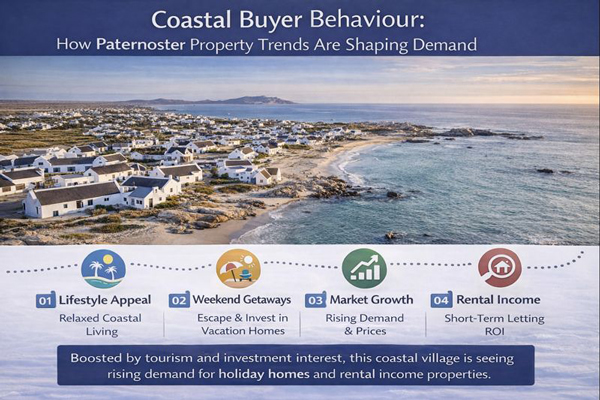
Coastal Buyer Behaviour: How Paternoster Property Trends Are Shaping Demand
Property demand in coastal towns rarely follows purely economic logic. In places like Paternoster, buyer behaviour is shaped by lifestyle aspiration, emotional alignment, and long-term personal narratives as much as by price or yield. Understanding these behavioural drivers has become essential for sellers, estate agents, and developers who want to position property effectively in a changing market.
This article examines how coastal buyer behaviour is shaping demand in Paternoster, with a focus on lifestyle-driven decisions, the rise of second-home and remote buyers, the balance between emotional and rational thinking, and what these trends mean for property marketing on the West Coast.
The Core Shift in Coastal Buyer Behaviour
For decades, coastal property markets were dominated by two primary buyer groups: retirees and holiday-home buyers. While these segments still exist, they no longer define demand on their own.
In Paternoster, buyer behaviour has diversified. Demand is increasingly driven by people seeking lifestyle repositioning rather than life-stage necessity. Buyers are not simply asking whether a property is affordable or practical. They are asking whether it aligns with how they want to live.
This shift changes everything, from how properties are evaluated to how they should be marketed.
Lifestyle-Driven Buying Decisions
Lifestyle has become the dominant motivator in coastal property purchases.
Buyers are choosing Paternoster not only for its location, but for what it represents: slower pace, visual calm, walkability, connection to nature, and psychological distance from urban pressure.
Lifestyle-driven buyers typically prioritise:
• Sense of place over floor area
• Environment over interior upgrades
• Feeling over specification
• Long-term satisfaction over short-term return
These priorities influence how properties are shortlisted and valued.
In this context, demand is less elastic than in purely investment-driven markets. Buyers are willing to wait for the right property rather than settle for the cheapest option.
The Emotional Pull of Coastal Living
Coastal towns activate emotion in a way inland markets rarely do.
Paternoster’s appeal is rooted in imagery, atmosphere, and identity. Buyers often describe wanting to “feel settled,” “breathe differently,” or “simplify life.” These are emotional cues, not rational ones.
Emotion does not replace logic, but it frames it.
Buyers first ask, does this feel right, and only then evaluate whether it makes sense financially.
This sequence matters because it reverses the traditional sales logic used in many property markets.
Second-Home Buyers Are No Longer Peripheral
Second-home buyers have always been part of the Paternoster market, but their behaviour has evolved.
Historically, second homes were primarily holiday properties used seasonally. Today, many second-home buyers view their coastal property as a flexible base rather than a fixed-use asset.
These buyers often intend to:
• Spend extended periods rather than short holidays
• Work remotely for part of the year
• Transition into full-time coastal living later
• Host family and friends regularly
This changes what they look for in a property.
Layout, light, internet reliability, and privacy matter as much as proximity to the beach.
The Rise of Remote Buyers
Remote work has fundamentally altered coastal demand.
Buyers no longer need to choose between career and location in the same way they once did. Paternoster benefits from this shift because it offers lifestyle appeal without complete isolation.
Remote buyers typically exhibit distinct behaviour:
• Longer research cycles
• Heavier reliance on visuals and online content
• Higher sensitivity to environment and noise
• Stronger preference for authenticity over polish
Because these buyers often purchase from a distance, perception plays an outsized role.
Marketing clarity becomes critical.
How Emotional and Rational Buying Interact
Coastal buying decisions are often described as emotional, but this can be misleading.
Buyers are not irrational. They are emotionally led and rationally justified.
The emotional decision initiates interest. Rational analysis then determines whether the purchase proceeds.
In Paternoster, emotional triggers include:
• Visual calm
• Light quality
• Sense of space
• Architectural harmony with surroundings
Rational considerations include:
• Price relative to comparable properties
• Maintenance requirements
• Rental flexibility
• Long-term resale potential
Effective marketing must speak to both layers without overemphasising one at the expense of the other.
Why Buyers Are More Selective Than Before
Despite strong interest in coastal property, buyers are more selective.
They are comparing more listings, asking better questions, and delaying decisions until alignment feels right.
This selectivity is driven by:
• Increased access to information
• Greater awareness of marketing tactics
• Higher emotional investment in lifestyle decisions
Buyers want reassurance, not persuasion.
This is a subtle but important distinction.
The Role of Perception in Demand Shaping
Perception plays a central role in how demand expresses itself.
Two similar properties can experience very different levels of interest based on how they are presented.
In lifestyle-driven markets, buyers interpret presentation quality as a proxy for care, authenticity, and alignment with local character.
Overly aggressive or generic marketing often underperforms in Paternoster because it clashes with buyer expectations of calm and simplicity.
Understated clarity tends to perform better.
Paternoster Versus Generic Coastal Towns
Not all coastal towns attract the same buyer mindset.
Paternoster differs from resort-heavy or high-density coastal areas in several ways:
• Strong village identity
• Limited overdevelopment
• Emphasis on community feel
• Architectural restraint
Buyers drawn to Paternoster are often actively avoiding highly commercialised coastal destinations.
This has direct implications for demand patterns and marketing tone.
Implications for Property Marketing
Understanding buyer behaviour is only useful if it informs action.
In Paternoster, effective property marketing increasingly needs to:
• Emphasise sense of place rather than features
• Show context, not just interiors
• Avoid overproduction or hype
• Communicate calm, honesty, and clarity
Buyers respond poorly to marketing that feels imported from urban or luxury markets without adaptation.
Local relevance matters.
Visual Strategy Matters More Than Ever
Because many buyers are remote or emotionally invested, visuals carry disproportionate weight.
Photography, video, and aerial imagery are not just promotional tools. They are decision-making aids.
Buyers use visuals to answer questions such as:
• Does this property fit the environment
• Will I feel comfortable here
• Does this align with my idea of coastal living
When visuals answer these questions clearly, demand becomes more focused and enquiries more meaningful.
Why Over-Marketing Can Suppress Demand
A counterintuitive trend in Paternoster is that excessive marketing can suppress demand.
Overly dramatic visuals, aggressive copy, or luxury tropes can alienate buyers seeking authenticity.
This does not mean marketing should be minimal. It means it should be proportionate.
Buyers want to feel invited, not sold to.
Demand Is Influenced by Buyer Confidence
Confidence is a key mediator between interest and action.
Buyers who feel confident about what they are seeing are more likely to enquire, view, and proceed.
Confidence comes from:
• Transparency
• Consistency
• Accurate representation
Marketing that reduces uncertainty supports demand more effectively than marketing that amplifies excitement.
The West Coast Context
Across the West Coast, similar behavioural patterns are emerging, but Paternoster remains distinctive in how strongly lifestyle and identity influence buying decisions.
This makes it both resilient and sensitive.
Resilient because demand is rooted in deep personal motivation. Sensitive because misalignment in presentation can quickly deter interest.
Pricing Confidence and Buyer Behaviour
Lifestyle-driven buyers often exhibit stronger pricing confidence once emotional alignment is achieved.
They may negotiate, but they are less likely to disengage over small differences if the property feels right.
Conversely, buyers who never achieve emotional alignment remain price-focused and hesitant.
Marketing that facilitates emotional alignment early tends to support firmer negotiations later.
Long-Term Demand Versus Short-Term Spikes
Paternoster demand is better understood as long-term rather than speculative.
Buyers are planning life changes, not quick flips.
This influences how properties should be positioned:
• As long-term lifestyle assets
• As part of a community
• As adaptable spaces
Marketing that reflects this long-term mindset resonates more strongly.
What Sellers Often Misunderstand
Many sellers assume buyers are primarily motivated by price or finishes.
In reality, buyers are often motivated by fit.
Fit includes:
• Environment
• Atmosphere
• Neighbourhood feel
• Alignment with personal values
Understanding this can prevent over-investment in the wrong upgrades and under-investment in presentation clarity.
Demand Is Shaped Before Enquiry
By the time a buyer makes contact, demand has already been shaped.
They have formed opinions, filtered options, and decided whether the property deserves attention.
Marketing that aligns with buyer behaviour shapes demand positively. Marketing that ignores it narrows the pool.
Strategic Takeaways for Property Stakeholders
For estate agents, developers, and sellers in Paternoster, the implications are clear:
• Buyer behaviour is lifestyle-led
• Emotional alignment precedes rational evaluation
• Remote and second-home buyers are significant
• Marketing clarity shapes demand quality
Understanding these dynamics allows for more intentional decision-making.
Closing Perspective
Coastal buyer behaviour in Paternoster is shaping demand in ways that reward clarity, authenticity, and emotional intelligence.
Buyers are not simply purchasing property. They are choosing a way of living, a rhythm, and an identity. This makes demand both powerful and discerning.
Property marketing that reflects these realities tends to attract better-aligned buyers, generate higher-quality enquiries, and support smoother transactions.
If you are involved in selling or marketing property in Paternoster, understanding buyer behaviour is no longer optional. It is the foundation of effective positioning, realistic pricing, and sustained demand.
Approach the market with empathy, insight, and restraint, and demand is far more likely to meet you halfway.


