
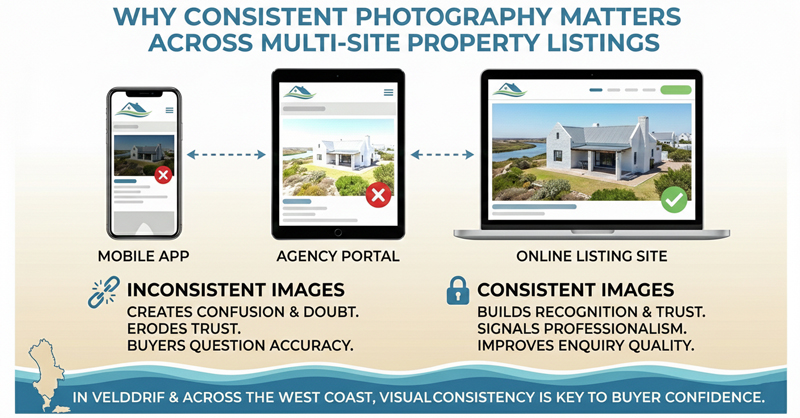
Why Consistent Photography Matters Across Multi-Site Property Listings
Property marketing no longer lives in a single place. A listing today exists across multiple property portals, agency websites, social platforms, messaging apps, and shared links between buyers, families, and advisers. Buyers rarely encounter a property once. They see it repeatedly, often in different formats, on different screens, and at different moments in their decision-making process.
In Velddrif and across the West Coast, this multi-site exposure has changed how trust is formed. Buyers build confidence gradually, through repetition and recognition. When a property appears visually consistent wherever it is seen, confidence grows. When it appears different from one platform to the next, confidence quietly erodes.
Consistent photography has become one of the most important and least discussed factors in how well a property performs across multiple listing sites. It influences trust, clarity, and ultimately the quality of enquiries a listing attracts.
How Buyers Actually Use Multiple Listing Sites
Most buyers do not stay loyal to one property platform. They move between sites depending on convenience, habit, and recommendations. A buyer might first discover a property on a large national portal. Later, they may search the same area on a local agency website. The same property might then be shared with them via a messaging app or appear again on a different platform with slightly different presentation.
From the buyer’s perspective, this feels seamless. From a marketing perspective, it is fragmented.
Buyers do not consciously analyse where they saw a property first. What they register instead is familiarity. They expect the property to look the same each time they encounter it. When it does, recognition is instant. When it does not, uncertainty creeps in.
In Velddrif, where buyers often compare several similar properties across different platforms before committing to viewings, this repeated exposure plays a major role in shaping perception.
The Subtle Problem Created by Inconsistent Images
Inconsistent photography rarely feels dramatic. It often shows up as small differences. A brighter image on one site. A warmer colour tone on another. A different sequence of rooms. Additional photos added later that do not match the original set.
To a buyer, these differences create a sense of instability.
They may not consciously think something is wrong, but they begin to wonder which version is accurate. They question whether the property has been edited differently to suit different platforms or audiences. This uncertainty weakens trust.
Even when all images are technically good, inconsistency creates friction. Buyers are forced to re-evaluate the property each time they see it. That extra mental effort works against engagement.
Why Inconsistent Photography Reduces Trust
Trust in property marketing is built visually before it is built through conversation.
When images change across platforms, buyers may assume that presentation is being manipulated. They may suspect that certain angles are being emphasised or avoided depending on where the listing appears. This suspicion often exists below conscious awareness, but it still influences behaviour.
Inconsistent lighting, colour balance, and image quality suggest a lack of control. Buyers interpret this as a lack of professionalism, even if the property itself is well presented.
In the West Coast market, where buyers may travel specifically to view properties and rely heavily on online information beforehand, this erosion of trust can significantly affect enquiry quality.
Buyer Psychology and Visual Recognition
Buyers rely on visual recognition to manage complexity.
When browsing multiple sites, they look for cues that confirm they are seeing the same property again. Consistent photography allows the brain to recognise the listing instantly and pick up where it left off.
This recognition reduces cognitive load. Buyers do not have to start from scratch each time. Instead, they build on existing impressions.
When images differ noticeably, recognition is disrupted. Buyers pause, question, and sometimes disengage. The listing feels less familiar and less reliable.
Consistency supports memory. Memory supports confidence.
How Consistency Builds Reliability Over Time
Confidence rarely forms in a single moment. It accumulates.
Each time a buyer sees a property presented consistently, their confidence in the information grows. The listing feels stable. Predictable. Reliable.
This reliability extends beyond the images themselves. Buyers often assume that consistent presentation reflects consistent care. They infer that a property marketed thoughtfully is also likely to be managed thoughtfully.
In Velddrif, where buyers may take weeks or months to decide, this slow build of trust is especially important.
The Role of MLS Photography in Visual Consistency
MLS-style photography is designed for consistency rather than creativity.
It focuses on standardised exposure, colour balance, composition, and sequencing. The goal is not to create dramatic variation, but to ensure that every image fits together as part of a coherent whole.
This approach is particularly effective for multi-site listings because it holds up across different platforms, devices, and screen sizes. Images remain recognisable and consistent wherever they appear.
For buyers, this consistency reduces confusion. They are not distracted by stylistic differences or quality fluctuations. They can focus on evaluating the property itself.
Why Standardisation Works Across Platforms
Different listing sites display images differently. Cropping, compression, and layout vary.
MLS-style photography anticipates these variations. It produces images that remain balanced and readable even when resized or compressed.
When photography is inconsistent or highly stylised, these platform differences become more noticeable. Images that look acceptable on one site may look overly dark, warm, or flat on another.
Consistent photography minimises these risks. It ensures that the property presents predictably regardless of where it appears.
Consistency and Expectation Management
Many buyer objections arise because expectations were not aligned.
The property feels different from what I saw online
The space is darker than expected
The finishes do not look the same in person
These objections often trace back to inconsistent imagery.
When photography is consistent across platforms, expectations remain stable. Buyers arrive at viewings prepared for what they will see. Surprises are reduced.
This alignment creates a more relaxed viewing experience and more constructive conversations.
How Consistency Improves Enquiry Quality
Consistency does not necessarily increase the number of enquiries. It improves their quality.
Buyers who feel confident in what they are seeing are more likely to reach out with serious intent. Their questions are clearer. Their interest is more focused.
Inconsistent listings tend to attract enquiries driven by uncertainty. Buyers reach out to clarify basic information or confirm whether images are accurate.
Consistent listings attract enquiries from buyers who already understand the property and are exploring suitability rather than authenticity.
In Velddrif, where lifestyle and setting play a major role in buying decisions, this distinction matters.
Consistency Across Platforms Builds Brand Trust
Photography consistency also affects how buyers perceive the agent or agency.
When listings appear coherent across multiple sites, buyers experience a sense of brand reliability. They feel that the marketing is controlled and intentional.
This perception influences trust in communication, negotiation, and follow-through. Buyers are more comfortable engaging with agents who appear organised and consistent.
In contrast, fragmented presentation can undermine confidence before contact is ever made.
The Hidden Cost of Visual Fragmentation
Visual fragmentation creates mental noise.
Buyers may hold several slightly different images of the same property in their mind. Instead of building a clear picture, they build a collage.
This fragmentation makes decision-making harder. Buyers feel less certain, even if they cannot explain why.
In competitive markets, anything that increases uncertainty reduces momentum.
Consistency Supports Longer Decision Cycles
Many buyers revisit listings multiple times before acting.
Each revisit is an opportunity to strengthen or weaken trust. When images remain consistent, familiarity grows. The property feels dependable.
When images change, buyers may feel unsettled. They may question whether something has changed or whether the listing is being adjusted to maintain interest.
Consistent photography supports long decision cycles by reinforcing stability.
Why Consistency Matters More Than Image Volume
Adding more photos is not always the solution.
If new images do not match the existing set, they can dilute rather than enhance the listing. Buyers may notice differences in lighting or quality and question why.
Consistency matters more than quantity. A cohesive set of images is more effective than a larger, inconsistent collection.
MLS-style photography supports this discipline by prioritising coherence over excess.
Consistency Across Devices and Screens
Buyers view listings on phones, tablets, laptops, and desktops.
Consistent photography ensures that images remain readable and recognisable across these devices. Exposure, colour, and contrast stay predictable.
Inconsistent images can shift dramatically depending on screen size and brightness, amplifying doubt.
Professional consistency anticipates these variations and reduces their impact.
Consistency as a Signal of Systems and Process
Buyers are sensitive to signs of organisation.
Consistent photography suggests that there is a system behind the marketing. Images are planned, processed, and deployed intentionally.
This signal extends beyond marketing. Buyers often assume that a property marketed systematically will be sold systematically.
In Velddrif and across the West Coast, where buyers value straightforward transactions, this signal is powerful.
Consistency Reduces Perceived Risk
From a psychological perspective, consistency equals safety.
Humans associate stable patterns with reliability. In property marketing, reliability reduces perceived risk.
When buyers feel that what they are seeing is consistent and repeatable, they are more willing to engage and commit.
Inconsistent presentation introduces risk, even if the property itself is sound.
Why Consistency Is a Strategic Choice
Consistent photography does not happen accidentally.
It requires planning, coordination, and restraint. It means deciding how a property will be presented and maintaining that presentation across all platforms.
This strategic approach pays off in buyer confidence and enquiry quality.
Closing Perspective
Buyers do not experience property listings once. They experience them repeatedly, across multiple sites, over time.
Consistent photography matters across multi-site property listings because it builds recognition, trust, and reliability. It reduces confusion, aligns expectations, and supports higher-quality enquiries.
In Velddrif and across the West Coast, where buyers often rely on repeated online exposure before committing to viewings, consistency is not a cosmetic detail. It is a foundation.
If you are reviewing how your property is presented across multiple listing sites and would like advice on achieving consistent, professional photography that supports buyer confidence, you are welcome to get in touch for guidance or a quote. Thoughtful, consistent presentation can significantly improve how a property performs across the market.


