
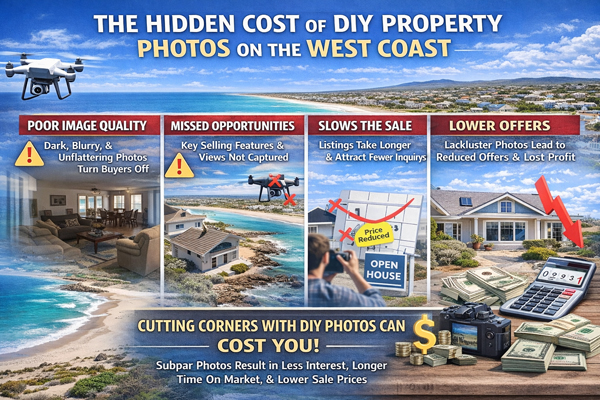
The Hidden Cost of DIY Property Photos on the West Coast
DIY property photos often feel like a sensible decision. A phone is already in your pocket. The house looks fine to you. Hiring a professional photographer feels optional, especially when you are already facing legal fees, agent commissions, and moving costs.
On the West Coast, this thinking is common. In places like Langebaan, Yzerfontein, and Velddrif, sellers regularly assume that because demand exists, presentation matters less. Properties will sell anyway, so why spend more upfront.
What this approach overlooks is that the real cost of DIY property photos is rarely visible on day one. It shows up later, quietly, through slower momentum, weaker enquiries, buyer hesitation, and compromised negotiating power. These costs are not listed on an invoice, but they often exceed the cost of professional photography many times over.
This article breaks down those hidden costs and explains why DIY photos are not a saving, but a risk.
The Illusion of Saving Money Upfront
DIY property photos feel free. That is the first and most dangerous assumption.
There is no invoice, no booking, and no line item in your budget. Because the cost is invisible, it feels like a gain. But property marketing does not work on visible costs alone. It works on outcomes.
The moment your listing goes live, buyers begin forming opinions. Those opinions determine how fast your property moves, how seriously it is taken, and how much leverage you retain as a seller. If presentation weakens those outcomes, the cost is real even if it never appears as a bill.
The West Coast market amplifies this effect because buyers often compare many similar homes. When everything else looks comparable, presentation becomes the deciding factor.
Opportunity Cost Is the First Hidden Loss
Opportunity cost is what you lose by choosing one option over another.
When you use DIY photos, the first opportunity cost is momentum. Properties attract the most attention when they first hit the market. This is when portals push them, buyers are alert, and agents actively promote them.
If your photos fail to make a strong first impression, you waste that window.
Buyers scroll past. Shortlists do not include your property. The listing does not generate urgency. Even if you improve photos later, the initial surge is gone.
In Langebaan and Yzerfontein especially, where lifestyle buyers often monitor new listings closely, missing that early attention can mean weeks of lost traction.
That lost time has a cost.
Buyer Doubt Begins With Weak Visuals
Buyers rarely say out loud that photos made them doubt a property. Instead, they simply hesitate.
DIY photos often introduce small signals that trigger that hesitation. Crooked lines. Dark rooms. Blown-out windows. Inconsistent colour. Poor angles. These may seem minor, but to buyers they suggest uncertainty.
Buyers ask themselves quiet questions.
Why does this room look smaller than the others
Why can’t I see what’s outside the windows
What isn’t being shown
These questions slow decision-making. Slowed decision-making reduces urgency. Reduced urgency weakens offers.
On the West Coast, where many buyers are relocating or buying lifestyle homes, confidence matters. Hesitation kills momentum long before price becomes the issue.
Hesitation Extends Time on Market
Time on market is not neutral.
The longer a property sits, the more buyers assume something is wrong. Even if the reason is simply weak presentation, the market does not care. Perception becomes reality.
DIY photos often lead to longer listing periods because they fail to convert interest into action. Buyers might view the listing but delay booking viewings. Others skip it entirely.
In Velddrif, where buyers often compare price per value carefully, a stale listing becomes a negotiating target. Buyers assume the seller is under pressure.
That pressure translates directly into lower offers.
The Compounding Cost of a Slower Sale
A slower sale creates secondary costs that are rarely considered upfront.
Ongoing bond repayments
Rates and taxes
Insurance
Maintenance
Utilities
Time and emotional energy
Each additional month on the market costs money. Even modest holding costs quickly exceed the price of professional photography.
Worse still, sellers often respond to slow momentum by reducing the price. That reduction is usually far greater than the cost of fixing the original presentation problem.
DIY photos feel cheap. Time is not.
DIY Photos Weaken Negotiation Position
Buyers negotiate based on leverage.
Strong presentation creates leverage for the seller. It signals demand, confidence, and competition. Weak presentation signals the opposite.
When buyers see DIY photos, they subconsciously assume that the seller is cutting corners. They infer that the listing may be struggling. This assumption emboldens negotiation.
Offers arrive lower. Conditions become stricter. Buyers push harder for concessions.
Even if the final selling price seems acceptable, it is often lower than what could have been achieved with stronger presentation from the start.
This is one of the most expensive hidden costs of DIY photography.
Why Buyers Equate Photo Quality With Property Quality
Buyers do not separate photography from the property.
When photos are poor, buyers assume the home is poorly maintained. When photos are professional, buyers assume care and pride of ownership.
This association is subconscious, but it is powerful.
DIY photos introduce doubt about upkeep, even when the property is immaculate. Buyers arrive at viewings prepared to find flaws. They scrutinise more. They become less forgiving.
Professional photos reverse this dynamic. Buyers arrive expecting quality and often interpret the same details more generously.
That difference changes outcomes.
DIY Photos Fail in Online Comparison Environments
Property is not viewed in isolation. It is viewed in feeds, grids, and comparison lists.
On property portals, your listing sits next to professionally photographed homes. Buyers compare instantly, not analytically.
DIY photos stand out, but not in a good way.
They look darker. Less balanced. Less intentional. Even a well-priced home can feel overpriced when placed visually next to stronger listings.
In markets like Langebaan and Yzerfontein, where agents increasingly invest in professional media, DIY photos fall further behind with each passing year.
This visual disadvantage costs attention, enquiries, and credibility.
The Risk of Misrepresentation Cuts Both Ways
DIY photos often misrepresent space, but not always in the way sellers expect.
Wide-angle phone lenses distort proportions. Rooms look larger in one photo and smaller in another. Lighting changes from room to room. Buyers struggle to form a clear mental model of the home.
This confusion creates risk.
Some buyers skip viewings because they cannot understand the layout. Others arrive and feel disappointed because reality does not match expectation.
Both outcomes are damaging.
Professional photography reduces this risk by presenting the property clearly and consistently, aligning expectation with reality.
DIY Photos Increase Emotional Cost for Sellers
Selling a property is already stressful.
DIY photos often extend that stress. Sellers watch listings stagnate. They second-guess pricing. They field low-quality enquiries. They wonder whether something is wrong with the house.
This emotional toll is real. It affects decision-making and often leads to reactive choices, such as premature price drops.
Professional media removes much of this uncertainty. Sellers can see that the property is being presented properly, which makes it easier to stay confident and patient.
Professional Media as Risk Reduction, Not Luxury
Professional photography is often framed as a marketing upgrade. In reality, it is risk management.
It reduces the risk of mispricing
It reduces the risk of slow momentum
It reduces the risk of weak negotiation
It reduces the risk of buyer mistrust
On the West Coast, where lifestyle perception plays a major role in value, reducing these risks matters.
Professional media does not guarantee a sale, but it dramatically improves the conditions under which a sale happens.
The ROI Is Not Just Price, It Is Process
Return on investment in property marketing is not only about final price. It is about the entire process.
How quickly viewings happen
How serious enquiries are
How confident buyers feel
How strong your negotiating position is
DIY photos often degrade every one of these factors. Professional photography improves them.
Even if the final price difference is modest, the improvement in speed, certainty, and stress reduction is significant.
Why West Coast Markets Amplify These Risks
West Coast buyers are often deliberate.
They compare carefully. They look for lifestyle alignment. Many are relocating, semigrating, or investing for the long term.
These buyers rely heavily on online presentation before committing to viewings. DIY photos undermine confidence early in the journey.
In areas like Velddrif, where value perception is closely tied to presentation and upkeep, this is especially risky.
The False Economy of Fixing It Later
Some sellers plan to start with DIY photos and upgrade later if needed.
This approach almost always backfires.
The initial listing period is the most valuable. Fixing photos later rarely recaptures lost momentum. Buyers who skipped the listing rarely return. Algorithms do not reset.
By the time photos are improved, the listing may already carry the stigma of time on market.
Fixing the problem early is cheaper than fixing it later.
Professional Photography Protects Your Asking Price
Price confidence comes from presentation.
When photos are strong, buyers assume the asking price is justified. When photos are weak, buyers assume there is room to negotiate.
Professional photography supports your price by aligning visual quality with value expectations.
DIY photography undermines that alignment from day one.
The Real Cost Is What You Never See
The most dangerous cost of DIY property photos is the one you never see.
You never see the buyers who scrolled past.
You never hear the conversations where your property was dismissed.
You never know how many offers were never made.
Those lost opportunities do not show up in spreadsheets, but they shape outcomes.
Closing Perspective
DIY property photos on the West Coast feel like a saving, but they carry hidden costs that compound over time.
They reduce momentum, increase buyer doubt, extend time on market, and weaken negotiation position. They shift risk onto the seller while offering no real upside beyond short-term convenience.
Professional photography is not about luxury or aesthetics. It is about reducing risk, protecting value, and creating the conditions for a confident, efficient sale.
If you are selling a property in Langebaan, Yzerfontein, Velddrif, or anywhere on the West Coast, investing in professional property media is one of the most effective ways to protect your outcome. If you would like advice or a quote on professional property photography, video, or drone media, you are welcome to get in touch to discuss the best approach for your listing.


