
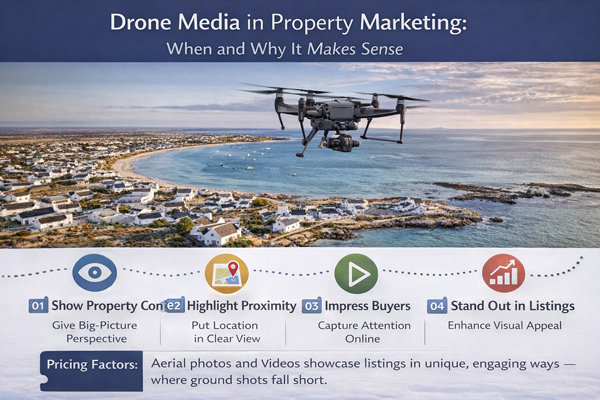
Drone Media in Property Marketing: When and Why It Makes Sense
Drone media has moved from novelty to normality in property marketing. What began as a visual extra has, in many markets, become an expected part of professional presentation. Yet expectation alone does not justify use. Not every property benefits equally from aerial photos or video, and not every campaign improves simply by adding drone footage.
The real question for estate agents, developers, and sellers is not should we use drone media, but when and why does it make strategic sense.
This article analyses drone media through a decision-making lens, using buyer psychology, campaign performance, and cost–value dynamics to explain when drone photos and videos add real marketing value and when they become unnecessary noise. The focus is on clarity, restraint, and strategic use rather than visual excess.
The Core Problem: Drone Media Is Often Used by Default, Not by Design
One of the biggest issues in modern property marketing is default behaviour.
Drone media is frequently added because competitors use it, because sellers expect it, or because it feels like a signal of professionalism. These reasons are understandable, but they are not strategic.
When drone media is used without a clear purpose, it often produces one of two outcomes:
• It adds little measurable value
• It distracts from more important information
In both cases, cost increases without proportional return.
Strategic use begins by understanding what drone media actually does differently from ground-based visuals.
What Drone Media Does That Other Media Cannot
Drone media’s primary strength is not drama. It is perspective.
Unlike ground photography or walkthrough video, drone imagery shows relationships rather than features. It explains how a property sits within its environment, how it connects to surroundings, and how space is distributed.
This relational information is often critical to buyer decision-making, but it is also highly situational.
Drone media makes sense when relationships matter.
Appropriate Use Cases for Drone Media
Drone media adds real value when at least one of the following is true:
• Location influences perceived value
• Surroundings are part of the selling proposition
• Orientation, spacing, or access matters
• Buyers are remote or unfamiliar with the area
• The property competes on lifestyle, not just price
In these cases, drone imagery answers questions buyers care about but cannot easily resolve from ground-level media.
In coastal and industrial-adjacent towns like Saldanha, these conditions are common. Proximity to water, infrastructure, open land, or development zones often plays a role in buyer evaluation.
When Drone Media Adds Clarity
Clarity is the most reliable indicator of whether drone media is justified.
Drone photos or video add clarity when they help buyers understand:
• Where the property is located relative to landmarks
• How close neighbours are
• How access routes work
• Whether the area feels open or dense
• How the property relates to its surroundings
If drone media answers these questions faster or more accurately than ground visuals, it is doing strategic work.
If it does not, it is likely decorative.
Drone Photos Versus Drone Video: Different Strategic Roles
Drone media is not a single format.
Drone photos and drone video perform different functions and should be evaluated separately.
Drone Photos Add Value When
• Buyers are scanning listings quickly
• Platforms prioritise image galleries
• Clear spatial reference is needed
• Mobile-first behaviour dominates
Drone photos are efficient. They communicate context instantly and without commitment.
Drone Video Adds Value When
• Buyers are already engaged
• Flow and movement add understanding
• Emotional reinforcement is needed
• The campaign includes social or website components
Drone video requires more attention and more editing discipline. It works best as a secondary asset rather than a lead one.
Strategic campaigns often use both, but with different intent.
Cost Versus Value: The Right Way to Evaluate Drone Media
The most common mistake in evaluating drone media is focusing on cost in isolation.
Drone media should not be judged by its price alone, but by what it contributes to:
• Buyer understanding
• Enquiry quality
• Pricing confidence
• Time on market
• Campaign coherence
Aerial imagery that improves one or more of these outcomes often justifies its cost, even if the impact is indirect.
Conversely, cheap drone media that adds confusion or inconsistency carries hidden costs.
When Drone Media Does Not Make Sense
Strategic use also means knowing when not to use drone media.
Drone imagery often adds little value when:
• The property is tightly enclosed
• Surroundings are visually neutral
• Buyers are primarily price-driven
• The listing competes on interiors alone
• Platforms used do not support aerial media well
In these scenarios, drone media may increase cost without improving outcomes.
Professional judgement includes recommending restraint.
Overuse Versus Strategic Use
Overuse is one of the fastest ways to reduce the effectiveness of drone media.
Common signs of overuse include:
• Excessive flyovers with no informational purpose
• Multiple aerial clips showing the same angle
• High-altitude shots that remove useful detail
• Cinematic effects that distract from context
Buyers quickly tune out media that feels repetitive or indulgent.
Strategic use focuses on just enough aerial information to remove doubt, not overwhelm.
Buyer Psychology: Why Less Often Converts Better
From a buyer psychology perspective, more media does not automatically mean more confidence.
Confidence comes from understanding, not volume.
Drone media that is precise, calm, and informative increases trust. Drone media that feels performative can reduce it.
Buyers are increasingly sensitive to overproduction. They respond better to visuals that feel neutral and honest.
Strategic restraint often converts better than maximal coverage.
Drone Media as a Filtering Tool
One of the most overlooked benefits of drone media is filtering.
By showing full context early, drone imagery helps buyers self-select.
Buyers who dislike density, proximity, or certain surroundings disengage early. Buyers who value those attributes engage more seriously.
This filtering improves enquiry quality.
High-quality enquiries reduce wasted viewings and shorten sales cycles.
Strategic Use in the West Coast Context
Across the West Coast, buyer behaviour shares common traits:
• High lifestyle sensitivity
• Strong interest in space and surroundings
• Frequent remote or semi-remote searches
• Comparisons across similar listings
Drone media aligns well with these traits when used purposefully.
In West Coast markets, aerial context often matters more than dramatic interiors.
Risk, Compliance, and Strategic Responsibility
Strategic use of drone media also includes understanding risk.
Drone operations involve:
• Safety considerations
• Legal compliance
• Insurance requirements
• Neighbour and public sensitivity
Using drone media irresponsibly undermines trust rather than building it.
Professional execution is part of strategic decision-making, not a separate concern.
Drone Media and Campaign Coherence
Drone media should never exist in isolation.
Its effectiveness depends on how well it integrates with:
• Interior photography
• Ground-level exteriors
• Video walkthroughs
• Copy and positioning
When aerial imagery aligns visually and conceptually with the rest of the campaign, it amplifies effectiveness.
When it clashes, it weakens perception.
Strategic use means thinking in systems, not assets.
When Drone Media Supports Premium Positioning
Drone media often makes sense for premium listings, but not because premium buyers want spectacle.
Premium positioning relies on:
• Confidence
• Transparency
• Calm presentation
• Complete information
Drone media supports this positioning when it shows context clearly and without exaggeration.
Overly cinematic drone footage can actually undermine premium perception by feeling sales-driven.
Measuring Whether Drone Media Is Working
While drone media impact is not always directly measurable, certain indicators suggest it is adding value:
• More informed buyer questions
• Fewer basic clarification requests
• Shorter decision timelines
• Stronger alignment at viewings
• Less aggressive price resistance
These signals indicate improved buyer confidence and perception.
The Strategic Question to Ask Before Using Drone Media
Before commissioning drone media, decision-makers should ask:
What buyer uncertainty does this remove.
If the answer is clear, drone media likely makes sense.
If the answer is vague or purely aesthetic, it likely does not.
This question reframes drone media from a feature to a function.
Avoiding the “Because Everyone Else Does” Trap
Competitive pressure is real, but imitation without strategy leads to mediocrity.
Drone media should not be used simply because competitors use it. It should be used because it communicates something competitors are not communicating well.
Strategic advantage comes from clarity, not conformity.
Drone Media as a Long-Term Expectation
As buyer expectations evolve, drone media is becoming a baseline in certain markets and segments.
Strategic use today helps position agents and developers ahead of expectation curves rather than reacting to them later.
However, baseline does not mean universal. It means contextual.
Strategic Bundling and Efficiency
Drone media often delivers best value when bundled with other services:
• Photography
• Video
• Editing and colour matching
• Campaign planning
Bundling improves coherence and reduces per-asset cost.
Strategic efficiency is about outcomes, not line items.
When Drone Media Becomes a Distraction
Drone media becomes counterproductive when it:
• Obscures rather than clarifies
• Competes with more important visuals
• Extends content unnecessarily
• Feels out of proportion to the property
In these cases, it should be scaled back or removed.
Strategic use includes knowing when to say no.
Decision-Making Framework Summary
Drone media makes sense when:
• Context matters
• Location influences value
• Buyers are remote or comparative
• Aerial clarity reduces uncertainty
• The campaign supports integration
It does not make sense when:
• Context adds little
• Interiors drive all decisions
• Budget would be better allocated elsewhere
• Aerials add noise, not clarity
This framework supports better decisions than blanket rules.
Closing Perspective
Drone media in property marketing is neither a universal solution nor an unnecessary indulgence.
It is a strategic tool that works when used with intention and restraint.
When drone photos or video remove buyer uncertainty, improve understanding, and support campaign coherence, they add real value. When they exist purely for visual impact, they often dilute effectiveness.
In markets like Saldanha and across the West Coast, where space, surroundings, and lifestyle influence buyer decisions, drone media often makes sense, but only when guided by strategy rather than habit.
If you are deciding whether to use drone media in a property campaign, the most important question is not can we include it, but what decision does it help the buyer make. When the answer is clear, drone media becomes an asset rather than an expense.


