
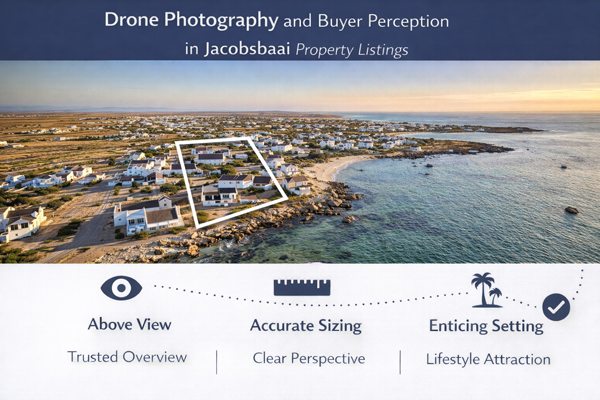
Drone Photography and Buyer Perception in Jacobsbaai Property Listings
Buyer perception is formed long before a viewing is booked and well before a price is debated. In coastal markets such as Jacobsbaai, perception is shaped almost entirely online, through visuals that either build confidence or quietly introduce doubt.
Drone photography has become one of the most influential factors in this process. Not because it is visually impressive, but because it changes how buyers interpret information, assess transparency, and emotionally connect with location. Aerial imagery affects how buyers think, not just what they see.
This article analyses how drone photography influences buyer perception in Jacobsbaai property listings, focusing on buyer psychology, trust signals, emotional interpretation, and the downstream effect on enquiry quality.
The Perception Gap in Property Listings
All property listings are selective. Buyers know this instinctively.
They understand that photographs show chosen angles, favourable light, and curated moments. As a result, buyers approach listings with a baseline level of caution. They are not distrustful, but they are alert.
In Jacobsbaai, this caution is heightened by similarity between listings. Many homes share comparable sizes, finishes, and layouts. When properties look alike, buyers rely more heavily on perception cues to decide which listings feel credible and worth pursuing.
Drone photography directly addresses this perception gap by expanding what is visible.
How Buyers Interpret Aerial Visuals
Buyers interpret aerial images differently from ground-level photos.
Ground photos are expected to be selective. Aerial photos are perceived as revealing.
From a psychological perspective, drone imagery signals a willingness to show the bigger picture. Buyers subconsciously interpret this as openness and confidence. Confidence is closely associated with honesty.
When buyers see aerial visuals in a Jacobsbaai listing, they often assume:
• The seller is not hiding context
• The agent is confident in the surroundings
• The listing is likely to align with reality
These assumptions form quickly and influence how buyers engage with the rest of the listing.
Aerial Perspective and Cognitive Ease
One of the most significant impacts of drone photography is reduced cognitive effort.
Without aerial imagery, buyers must mentally reconstruct context from fragments. They try to imagine how the property sits within the neighbourhood, how close neighbours are, and how the area feels as a whole.
This mental effort creates friction.
Drone photography removes much of this friction by providing a clear spatial overview. Buyers can form a mental map almost instantly.
From a buyer psychology standpoint, reduced cognitive load increases comfort. Comfort increases engagement. Engagement increases likelihood of enquiry.
Transparency as a Trust Signal
Transparency is one of the strongest drivers of positive buyer perception.
Listings that feel transparent are trusted more, even if the property itself is not perfect. Listings that feel selective or incomplete trigger caution.
Drone photography contributes to transparency by showing elements that are often omitted from ground-level imagery:
• Surrounding properties
• Road access
• Spacing and density
• Relationship to open land or coastline
When these elements are visible, buyers feel informed rather than managed.
In Jacobsbaai, where buyers often care deeply about openness and calm, this transparency is particularly influential.
Honesty Through Inclusion Rather Than Claims
Buyers rarely trust claims at face value.
Descriptions that state “well positioned” or “great location” are interpreted sceptically unless supported visually.
Drone photography replaces claims with inclusion.
Instead of asserting that a property is well located, it shows how and why. Buyers do not feel persuaded. They feel empowered to judge for themselves.
This sense of autonomy strengthens trust because buyers feel in control of their evaluation.
Emotional Response to Location Imagery
While trust and transparency are rational processes, emotion still plays a central role in buyer perception.
Location imagery triggers emotional responses related to:
• Calmness
• Openness
• Space
• Lifestyle aspiration
In Jacobsbaai, buyers are often seeking an emotional shift as much as a physical home. They are drawn to the idea of space, quiet, and connection to the environment.
Drone photography activates these emotions by showing the relationship between homes and surroundings.
Seeing space from above evokes a sense of freedom that interior photos cannot replicate.
Space as an Emotional Cue
Space is experienced emotionally before it is measured logically.
Drone imagery allows buyers to feel space rather than calculate it. This feeling influences perceived value and desirability.
A property that feels open and well positioned is often perceived as more valuable, even if its interior square meterage is similar to others.
In buyer psychology, perception of space frequently outweighs objective measurements.
Reducing Uncertainty Before Engagement
Uncertainty is one of the main reasons buyers delay enquiries.
They hesitate when they feel unsure about what they cannot see. Drone photography reduces this uncertainty by showing what lies beyond the property itself.
When buyers feel that fewer surprises await them, they are more willing to engage.
In Jacobsbaai listings, this often translates into enquiries that are more serious and better informed.
How Perception Influences Enquiry Quality
Not all enquiries are equal.
High-quality enquiries come from buyers who feel aligned and confident. Low-quality enquiries often come from buyers who are uncertain and exploratory.
Drone photography improves enquiry quality by filtering buyers early.
Those who like what they see in the aerial context proceed with confidence. Those who do not self-select out.
This filtering reduces wasted time and improves the efficiency of the sales process.
Buyer Confidence and Pre-Viewing Alignment
By the time a buyer books a viewing, their perception has already shaped expectations.
Listings that include drone imagery tend to produce viewings where buyers arrive informed rather than investigative.
They are not trying to uncover hidden context. They are confirming what they already understand.
This shift improves the tone of viewings and often leads to more productive discussions.
Credibility Through Completeness
Buyers associate completeness with professionalism.
Listings that include aerial imagery alongside interior and exterior photos feel more complete. This completeness influences credibility.
Incomplete listings feel provisional. Complete listings feel intentional.
Drone photography contributes to this sense of completeness by filling a critical informational gap.
Professionalism as a Perception Multiplier
Professional presentation amplifies positive perception.
Buyers often assume that if marketing is handled carefully, the transaction itself will be handled similarly.
Drone photography signals professionalism when it is executed cleanly and purposefully.
In Jacobsbaai, where buyers may be cautious and detail-oriented, this professionalism matters.
Avoiding the Pitfall of Overproduction
It is important to note that buyer perception can be damaged by misuse of drone imagery.
Overly dramatic angles, excessive altitude, or cinematic effects can reduce trust. Buyers may feel that imagery is being used to distract rather than inform.
Effective drone photography prioritises clarity over spectacle.
Calm, informative aerials tend to outperform dramatic flyovers in buyer perception studies and real-world behaviour.
Comparison Behaviour and Perceptual Advantage
Buyers rarely evaluate listings in isolation.
They compare.
Drone photography changes comparison dynamics by introducing new evaluation criteria.
Listings with aerial context feel more informative and transparent. Listings without it may feel incomplete by comparison.
This perceptual advantage influences which listings are shortlisted.
Perceived Value and Price Justification
Perceived value is shaped by how well a listing explains its price.
Drone photography helps justify value by showing what surrounds the property.
When buyers can see spacing, openness, and location, price feels more grounded.
Without this visual context, buyers may feel that pricing lacks support.
Transparency as a Buyer Filter
Transparency filters buyers.
Listings that show context attract buyers who value that context. Listings that hide context attract more speculative interest.
Filtered interest tends to convert better.
Drone photography contributes to this filtering effect by making context visible early.
Jacobsbaai Buyer Expectations
Buyers drawn to Jacobsbaai often prioritise environment as much as structure.
They are not only buying a home. They are buying a setting.
Drone photography aligns with this mindset by showing the setting clearly.
Listings that align with buyer priorities perform better.
The West Coast Context
Across the West Coast, buyer expectations are evolving.
Professional aerial imagery is increasingly associated with credible, serious listings. As this expectation grows, listings without aerial context may feel incomplete.
Perception shifts with exposure.
Long-Term Impact on Buyer Trust
Trust accumulates.
Buyers who repeatedly encounter transparent listings begin to trust certain marketing styles and agents more than others.
Drone photography, when used consistently and ethically, contributes to this long-term trust.
Measuring Perception Through Behaviour
While perception itself cannot be measured directly, its effects are visible.
Listings with drone imagery often experience:
• Longer engagement times
• More informed enquiries
• Fewer clarification questions
• Smoother viewings
These behaviours reflect improved buyer perception.
Drone Photography as a Psychological Tool
Drone photography is not simply a visual enhancement.
It is a psychological tool that shapes how buyers interpret information, assess honesty, and emotionally connect with location.
In Jacobsbaai property listings, its impact lies less in aesthetics and more in perception management.
Closing Perspective
Buyer perception determines property marketing outcomes long before offers are made.
Drone photography influences that perception by increasing transparency, reducing uncertainty, and activating emotional responses to space and location.
In Jacobsbaai, where buyers are selective and listings are often similar, aerial imagery helps properties feel credible, complete, and trustworthy.
When drone photography is used with intention and restraint, it does not oversell. It clarifies.
If you are marketing property in Jacobsbaai and want buyers to feel confident, informed, and aligned from their first interaction, drone photography should be viewed as a strategic buyer-perception tool rather than a visual add-on.


