
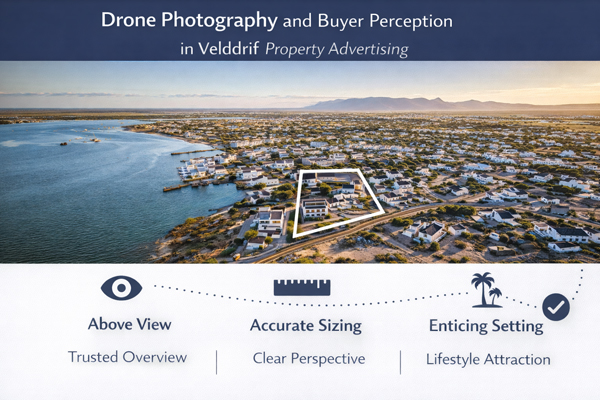
Drone Photography and Buyer Perception in Velddrif Property Advertising
Buyer perception sits at the centre of property advertising performance. Long before price negotiations, legal checks, or viewings take place, buyers form opinions about credibility, value, and suitability based almost entirely on what they see online. In Velddrif, where buyers are often comparing similar homes within a compact coastal market, these early perceptions carry disproportionate weight.
Drone photography has become one of the most influential tools shaping those perceptions. Not because it looks impressive, but because it changes how buyers interpret information. Aerial visuals affect trust, emotional response, and perceived transparency in ways that traditional ground-level photography cannot.
This article analyses how drone photography influences buyer perception in Velddrif property advertising, focusing on psychological interpretation, credibility signals, and emotional engagement rather than technical execution or visual novelty.
The Core Perception Problem in Property Advertising
Property advertising suffers from a structural limitation: it is selective by nature.
Listings show what fits within a frame. Buyers know this. They expect marketing to highlight strengths and minimise weaknesses. As a result, buyers approach listings with a baseline level of scepticism, even when they are interested.
In Velddrif, this scepticism is amplified by market familiarity. Many buyers already know the area or are comparing multiple nearby properties. They are alert to omissions and cautious about assumptions.
Drone photography alters this dynamic by expanding the frame.
When buyers see more context, they feel less managed and more informed. This shift from managed presentation to perceived openness is central to how aerial imagery changes buyer perception.
How Buyers Interpret Aerial Visuals
Buyers do not view aerial images as just another photo category. They interpret them differently.
Ground-level images are expected to be selective. Aerial images are expected to be revealing.
From a psychological perspective, aerial photography suggests a willingness to show the bigger picture. Buyers interpret this as confidence. Confidence, in turn, is associated with honesty.
In Velddrif listings, aerial visuals are often read as a signal that the seller or agent is comfortable revealing surroundings, spacing, and orientation. This interpretation occurs subconsciously but influences behaviour directly.
Buyers spend more time engaging with listings they perceive as open.
Aerial Perspective and Cognitive Processing
Aerial imagery changes how buyers process information.
Ground photos require mental reconstruction. Buyers must imagine how rooms connect, how the property sits on the land, and how neighbours are positioned.
Drone photography reduces this cognitive effort.
By presenting spatial relationships clearly, aerial visuals allow buyers to form a mental map quickly. Reduced cognitive load leads to increased comfort and engagement.
In buyer psychology, comfort is a precursor to trust.
Perceived Transparency and Honesty
Transparency is one of the strongest drivers of positive buyer perception.
Buyers are more likely to trust listings that appear to show everything rather than only what is flattering. Drone photography contributes to this perception by making context visible.
Aerial images show:
• Boundaries and spacing
• Adjacent properties
• Roads and access points
• Open land or development patterns
When these elements are visible, buyers feel informed rather than persuaded.
In Velddrif, where buyers may be concerned about density, access, or proximity, this transparency reduces hesitation.
Honesty Through What Is Included, Not Excluded
Perceived honesty in property advertising is rarely about what is said. It is about what is shown.
Listings that avoid showing surroundings raise questions. Listings that show them, even neutrally, build confidence.
Drone photography signals honesty not because it guarantees perfection, but because it demonstrates a willingness to include context.
Buyers interpret this inclusion as an ethical stance, even if it is simply a practical one.
How Drone Photos Elevate Listing Credibility
Credibility is built through consistency and completeness.
Listings that include aerial imagery alongside interior and exterior photos feel more complete. This completeness influences how buyers judge credibility.
Incomplete listings feel provisional. Complete listings feel considered.
Drone photography elevates credibility by filling informational gaps that ground-level photography leaves open.
In Velddrif property advertising, where buyers may be comparing multiple similar listings, credibility often determines which properties are shortlisted.
Visual Proof Versus Descriptive Claims
Descriptions can claim proximity, openness, or lifestyle appeal. Buyers treat these claims cautiously.
Drone photography replaces claims with proof.
When buyers can see proximity or spacing for themselves, they do not need to rely on interpretation. This autonomy strengthens trust.
Psychologically, people trust information more when they feel they discovered it themselves rather than being told.
Drone photography enables that discovery.
Emotional Responses to Location and Space
While trust and transparency are rational processes, emotion still plays a role.
Location visuals trigger emotional responses related to space, calm, and lifestyle aspiration.
In Velddrif, buyers are often drawn to the sense of openness and relationship to water and landscape. Aerial imagery makes these qualities visible and emotionally resonant.
Seeing space from above creates feelings of freedom and clarity. These feelings influence how buyers evaluate value and suitability.
Emotional responses do not replace rational evaluation. They frame it.
Space as an Emotional Signal
Space is not just a physical attribute. It is an emotional one.
Drone photography allows buyers to perceive space as something experienced, not measured.
This perception influences:
• How comfortable buyers feel
• How they imagine daily life
• How they judge long-term satisfaction
Listings that communicate space effectively feel less constrained and more appealing.
In coastal markets like Velddrif, this emotional response is a powerful differentiator.
Buyer Confidence and Reduced Uncertainty
Uncertainty is the enemy of action.
Buyers hesitate when they feel unsure about what they cannot see. Drone photography reduces uncertainty by showing what lies beyond the immediate property.
When uncertainty decreases, confidence increases.
Confident buyers enquire sooner, view with intent, and negotiate from a more positive position.
This behavioural shift is one of the most significant impacts of drone photography on buyer perception.
Trust Is Formed Before Contact
By the time a buyer contacts an agent, trust has already been partially formed.
Listings that feel transparent and credible generate warmer enquiries. Buyers approach conversations with openness rather than suspicion.
Drone photography contributes to this pre-contact trust by establishing credibility early.
In Velddrif property advertising, this can shorten the path from listing to viewing.
Professionalism as a Perception Multiplier
Drone photography also signals professionalism.
Buyers associate comprehensive marketing with competent representation. This association influences how they expect the transaction to unfold.
Professional presentation suggests:
• Attention to detail
• Process control
• Respect for buyer decision-making
These assumptions shape buyer behaviour throughout the sale process.
Drone photography amplifies professionalism when it is executed cleanly and purposefully.
Avoiding the Pitfall of Overproduction
It is important to note that buyer perception can be damaged by misuse.
Overly dramatic aerial imagery, extreme angles, or cinematic effects can reduce trust. Buyers may feel that visuals are being used to distract rather than inform.
Effective drone photography prioritises clarity over drama.
In Velddrif, buyers tend to respond better to calm, informative aerials than to visually aggressive ones.
Buyer Psychology and Comparison Behaviour
Buyers rarely evaluate listings in isolation.
They compare.
Drone photography influences comparison behaviour by introducing new criteria.
Instead of comparing only interiors and price, buyers compare positioning, spacing, and context.
Listings without aerial imagery often lose ground in these comparisons, even if interiors are strong.
This comparative disadvantage shapes buyer perception quietly but decisively.
Perception of Value and Justification
Perceived value is influenced by how well a listing explains its price.
Drone photography helps justify value by showing what surrounds the property.
When buyers see space, location, and context, price feels more grounded.
Without this visual justification, buyers may feel that pricing lacks support.
Drone imagery strengthens the link between asking price and perceived worth.
Filtering Buyers Through Transparency
Transparency acts as a filter.
Buyers who are not aligned with a property’s context self-select out early. Buyers who are aligned engage more seriously.
This filtering improves enquiry quality and reduces wasted effort.
From a perception standpoint, filtered engagement feels more purposeful.
Velddrif Buyer Expectations Are Evolving
Buyers in Velddrif and across the West Coast are increasingly accustomed to professional marketing.
Drone photography is becoming part of that expectation, especially for properties where surroundings matter.
Listings that omit aerial context may begin to feel incomplete rather than minimal.
Long-Term Impact on Market Perception
As drone photography becomes more common, it shapes broader market perception.
Buyers begin to expect transparency. Agents and sellers who provide it consistently build reputations for reliability.
This reputation influences how future listings are perceived before buyers even engage.
Drone photography contributes to this long-term trust capital.
Measuring Perception Through Behaviour
While perception itself is intangible, its effects are observable.
Listings with drone imagery often experience:
• Longer engagement times
• More informed enquiries
• Fewer clarification questions
• Smoother viewings
These behavioural indicators reflect improved buyer perception.
Drone Photography as a Psychological Tool
Drone photography is not just a visual upgrade.
It is a psychological tool that reshapes how buyers interpret information, assess trust, and experience space.
In Velddrif property advertising, its impact lies less in aesthetics and more in perception management.
Closing Perspective
Buyer perception determines property advertising success long before price negotiations begin.
Drone photography influences that perception by expanding context, increasing transparency, and triggering positive emotional responses to space and location.
In Velddrif, where buyers are discerning and comparisons are close, aerial imagery helps listings feel credible, complete, and trustworthy.
When drone photography is used with intention and restraint, it does not oversell. It clarifies.
If you are advertising property in Velddrif and want buyers to feel informed, confident, and aligned from the first interaction, drone photography should be considered a strategic perception tool rather than a visual extra.


