
Why Drone Photos Are a Core Part of Modern Property Marketing
Property marketing has changed quietly but fundamentally. Buyers are exposed to more listings, more images, and more platforms than ever before. As a result, attention has become the most valuable and most limited resource in real estate marketing.
In Saldanha Bay and across West Coast coastal towns, properties are no longer judged only on location and price. They are judged on how clearly, confidently, and professionally they are presented. Drone photos have moved from being a novelty to becoming a core part of modern property marketing because they align with how buyers look, scan, and make sense of information visually.
This shift is not about technology. It is about human behaviour.
The Core Problem Modern Property Marketing Faces
Most buyers are not actively searching when they first encounter a property listing. They are browsing. Scrolling through portals, social media, agency websites, or shared links. Their mindset is passive until something captures their attention.
The problem is that most property marketing still assumes buyers are patient and analytical. In reality, buyers make snap judgements and only slow down when something feels immediately clear or compelling.
Ground-level photos alone often fail to achieve this. They show details, but they lack orientation. They provide fragments, but not the whole picture. As a result, buyers struggle to understand how a property fits into its surroundings, and uncertainty causes disengagement.
In coastal towns like Saldanha Bay, where environment and setting are central to desirability, this gap becomes even more obvious.
Why Buyer Attention Has Become Harder to Hold
Modern buyers are visually trained. Every day they scroll through hundreds of images on their phones. This has changed how attention works.
Buyers no longer examine images carefully by default. They scan for patterns, clarity, and relevance. When something feels familiar or repetitive, their attention slips. When something provides new information quickly, they pause.
Property listings compete in this same visual environment. A sequence of interior photos, no matter how well shot, often blends into what buyers have already seen dozens of times.
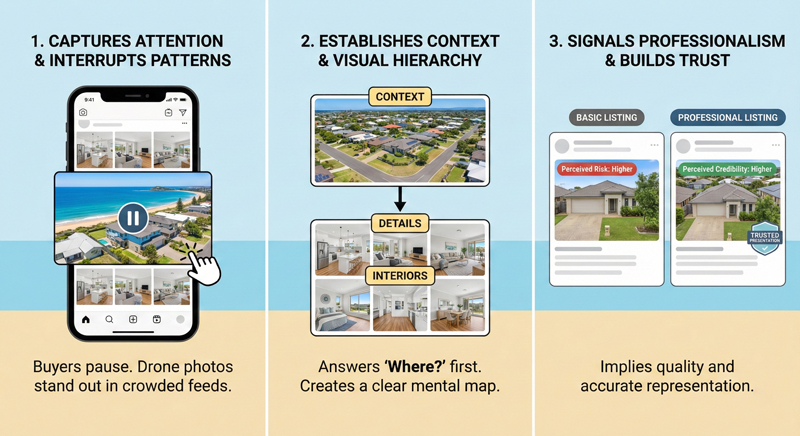
Drone photos interrupt this pattern. They show something buyers cannot see from the ground and cannot infer easily. That difference is what captures attention in a crowded visual landscape.
How Visual Hierarchy Shapes Buyer Perception
Visual hierarchy is the order in which the human eye processes information. In effective marketing, images are not equal. Some images orient the viewer. Others add detail. Others confirm quality.
In property marketing, visual hierarchy is often unintentionally reversed. Listings start with interior details before establishing context. Buyers are shown rooms before they understand where the home sits, how private it is, or how it relates to its surroundings.
Drone photos correct this.
Aerial images sit at the top of the visual hierarchy because they answer the biggest questions first. Where is this property? What surrounds it? How does it sit within the area?
Once these questions are answered, buyers are far more receptive to ground-level photos. They are no longer trying to piece together fragments. They are building on a clear mental map.
In West Coast coastal towns, where proximity to water, open space, and neighbouring properties strongly influences desirability, this hierarchy is especially important.
Top-Down Perspective Versus Ground-Level Perspective
Ground-level photos are immersive. They place the viewer inside the space. This is valuable, but it assumes the viewer already understands the broader context.
Top-down and elevated drone perspectives do the opposite. They pull the viewer out of the space and show the relationship between the property and everything around it.
This difference matters because buyers switch between two modes of thinking. Emotional immersion and logical evaluation.
Ground-level images support emotional immersion. Drone photos support logical understanding. Modern property marketing requires both.
When buyers can see the property from above, they understand plot size, boundaries, orientation, and spacing. When they then move to interior images, they interpret those spaces more positively because they already know how the home fits into the larger environment.
In Saldanha Bay, where coastal winds, views, and neighbouring structures influence how properties feel day to day, this combination is particularly powerful.
Why Drone Photos Increase Perceived Professionalism
Buyers subconsciously associate presentation quality with seller credibility.
A listing that includes well-executed drone photos signals preparation, intention, and confidence. It suggests that the property has been thoughtfully marketed rather than quickly uploaded.
This perceived professionalism extends beyond aesthetics. Buyers infer that a professionally marketed property is more likely to be accurately represented and properly maintained. That inference reduces perceived risk.
In contrast, listings that rely only on basic ground-level photos can feel incomplete, even if the images themselves are technically good. Buyers sense that something is missing, even if they cannot articulate it clearly.
Drone photos help close that gap. They communicate that the marketing effort matches the importance of the asset being sold.
How Perceived Professionalism Influences Value
Perceived professionalism affects how buyers think about price.
When marketing feels intentional and comprehensive, buyers are less likely to assume that the asking price is inflated. They are more inclined to believe that the price reflects real value.
In West Coast coastal towns, where properties can vary significantly in long-term appeal based on location and surroundings, this trust is critical. Buyers want reassurance that they are seeing the full picture before making decisions.
Drone photos provide that reassurance by showing what cannot be hidden or selectively framed.
Differentiation in Similar Markets
Many properties in Saldanha Bay and surrounding coastal towns share similar interior layouts and finishes. What differentiates them is often the plot, the positioning, and the immediate environment.
Ground-level photography struggles to communicate these differences clearly. Drone photos excel at it.
From above, buyers can see whether a home has open space on one side, how close neighbouring buildings are, how the property aligns with roads or coastal features, and how sunlight might interact with the space.
These details help buyers understand not just whether a property looks good, but whether it suits their lifestyle.
This differentiation is essential in modern property marketing because it moves the conversation away from generic comparison and toward personal fit.
Engagement Is a Byproduct of Clarity
Buyers engage longer with listings that make sense quickly.
Drone photos reduce the mental effort required to understand a property. Instead of guessing, buyers see. Instead of imagining, they know.
This clarity leads to longer engagement times, deeper exploration of listings, and more meaningful follow-up actions.
Buyers who feel informed are more likely to save listings, share them, and reach out with focused questions. Engagement becomes intentional rather than casual.
Why Drone Photos Are No Longer Optional
As buyer expectations evolve, what was once considered premium becomes standard.
Drone photos are now part of the visual language buyers expect in modern property marketing. Their absence can feel like a limitation rather than a choice.
This does not mean every property needs dramatic aerial shots. It means that buyers expect to understand context, setting, and spatial relationships visually. Drone photography is currently the most effective way to deliver that information.
In coastal towns along the West Coast, where environment is inseparable from value, this expectation is even stronger.
Closing Perspective
Modern property marketing is no longer about showing more images. It is about showing the right images in the right order.
Drone photos sit at the top of the visual hierarchy because they provide orientation, clarity, and confidence. They complement ground-level photography rather than replacing it, and together they create a complete visual narrative.
If you are planning a property marketing campaign in Saldanha Bay or elsewhere along the West Coast, aerial photography should be considered a foundational element, not an optional extra. If you would like guidance or a quote on property photography, drone photos, or aerial video as part of a broader marketing strategy, you are welcome to get in touch to discuss what would best suit your property.


