
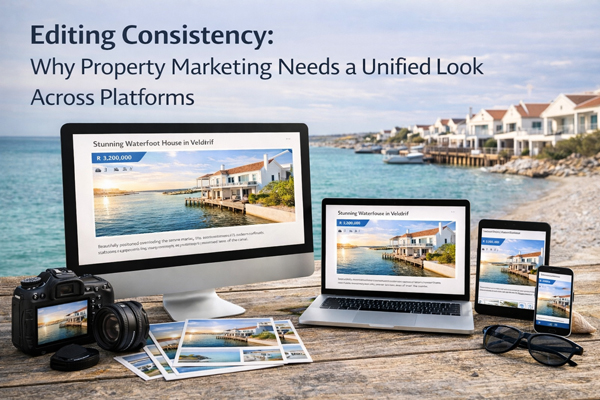
Editing Consistency: Why Property Marketing Needs a Unified Look Across Platforms
The Real Problem With Modern Property Marketing
Property marketing no longer happens in one place. A single listing in Velddrif can appear on property portals, agency websites, social media feeds, email campaigns, and messaging apps within hours. This is now standard practice in multi-platform property marketing.
The problem is that most listings are still edited as if they will only be seen once, on one screen.
Photos are adjusted individually. Videos are graded separately. Different platforms compress and reinterpret visuals in different ways. What looks acceptable on one portal can feel flat, dark, or inconsistent on another.
This is where property marketing consistency breaks down. And when consistency breaks down, trust follows.
Why Inconsistent Visuals Quietly Undermine Listings
Buyers rarely analyse images consciously. Instead, they react emotionally to visual cues. When a listing lacks real estate visual consistency, something feels off even if the buyer cannot explain why.
Common symptoms include:
Interior photos that look warm and bright while videos feel dull
Exterior images that shift in colour between platforms
Mixed contrast levels across rooms
Aerial visuals that do not match ground-level imagery
This is not a technical issue. It is a credibility issue.
When property listing photo consistency is missing, buyers begin to question accuracy. They wonder whether lighting is being used to hide flaws or whether the space will look different in person. That doubt reduces engagement and weakens enquiry confidence.
Editing Is a System, Not a Finishing Touch
Professional property marketing editing is not about making images look dramatic. It is about making them reliable.
A consistent editing system ensures that:
Whites remain neutral across platforms
Light feels natural and believable
Colour tone stays consistent from room to room
Photos and video feel like part of the same story
This requires a defined workflow, not isolated adjustments.
In real estate photo editing, this means working from a consistent colour profile, balancing exposure across the entire property, and editing with portal compression in mind. For video, it means grading footage to align with photography rather than treating video as a separate product.
This is the foundation of unified property marketing visuals.
Editing Property Photos for Portals and Social Media
Property portals and social platforms handle images very differently. Compression, cropping, and colour shifts are unavoidable.
When editing property photos for portals, the goal is stability. Images must survive platform processing without losing clarity or realism. This is why professional workflows focus on moderation rather than extremes.
Consistent property marketing visuals perform better because they:
Retain clarity after compression
Feel cohesive in grid layouts
Maintain visual balance across listings
This is especially important in high-competition areas like the West Coast, where buyers compare listings rapidly in grid views.
Video Editing and Listing Alignment
Video magnifies inconsistency faster than photography.
If real estate video editing for listings is not aligned with photo editing, buyers immediately notice the disconnect. Interiors feel darker. Colours shift. The flow between photos and video breaks.
Consistency between photo and video editing creates visual continuity. It reassures buyers that what they see in motion reflects what they saw in stills. This continuity strengthens property marketing visuals as a whole.
Why Consistency Strengthens Agent Branding
Branding in property marketing is rarely about logos. It is about repetition and reliability.
When buyers repeatedly see listings with:
Similar lighting balance
Consistent colour tone
Clear, honest presentation
they associate that look with professionalism.
This is how visual branding for estate agents is built organically. Over time, consistent editing becomes part of the agent’s identity. Listings feel familiar, dependable, and well managed before a word is read.
This effect is amplified when property marketing across platforms maintains the same visual language everywhere the listing appears.
Editing Consistency as a Performance Driver
Consistency is not cosmetic. It directly affects performance.
Listings with professional property photo editing and aligned video grading:
Hold buyer attention longer
Reduce uncertainty before enquiries
Support asking price confidence
Improve perceived transparency
This is why editing consistency in property marketing should be treated as a strategic decision, not a creative preference.
Why This Matters in Velddrif and the West Coast
Buyers in coastal markets respond strongly to light, openness, and atmosphere. Small visual inconsistencies are more noticeable because lifestyle expectations are higher.
In property marketing Velddrif and across the West Coast property marketing landscape, inconsistent visuals can:
Undermine lifestyle appeal
Make spaces feel smaller or darker
Reduce emotional connection
Consistent editing protects the mood that coastal property marketing relies on.
Photography and Editing as a Trust System
Trust in property marketing is built visually before it is built verbally.
When real estate branding through photography is consistent, buyers feel that the agent has control over the process. That control signals professionalism, accuracy, and care.
This is why many high-performing agencies rely on specialists who understand property photography editing South Africa standards and platform behaviour, rather than relying on ad-hoc edits.
Final Perspective
Modern property marketing is fragmented by default. Platforms, formats, and devices all pull visuals in different directions.
Consistency is what holds everything together.
When photo and video editing follow a unified system, listings feel trustworthy wherever they appear. That trust transfers to the agent, the brand, and ultimately the property itself.
If your listings are being marketed across multiple platforms, editing consistency is not optional.
It is the backbone of effective, professional property marketing.


