
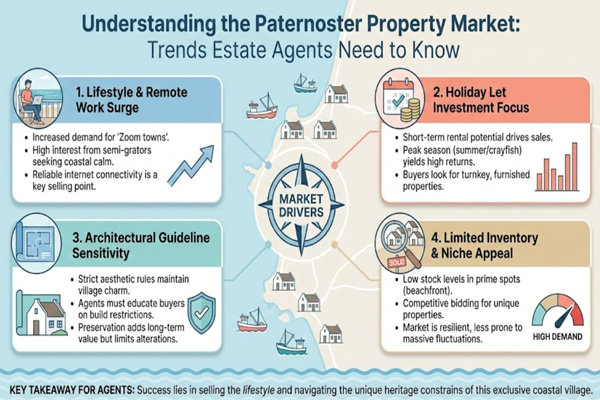
Understanding the Paternoster Property Market: Trends Estate Agents Need to Know
Why Market Awareness Now Separates Strong Agents From Average Ones
Property markets no longer move slowly or uniformly. They shift in response to buyer behaviour, economic signals, lifestyle preferences, and even subtle changes in perception. In smaller, high-demand coastal towns like Paternoster, these shifts are often felt earlier and more sharply than in larger metros.
For estate agents, relying on past performance or generalised regional data is no longer enough. Sellers expect agents to demonstrate current, localised market understanding. Buyers expect listings that reflect how they search, compare, and decide today, not how they did five years ago.
Understanding market trends is no longer an academic exercise. It directly influences pricing accuracy, marketing effectiveness, and mandate success.
The Risk of Operating on Outdated Assumptions
One of the most common mistakes agents make is assuming continuity. They expect buyer demand, pricing sensitivity, and listing performance to behave the same way year after year.
In Paternoster, this assumption is particularly risky. The market is shaped by a mix of permanent residents, lifestyle buyers, retirees, and investors. Each group responds differently to changes in interest rates, travel patterns, and lifestyle priorities.
Agents who do not actively track these shifts risk misaligning listings with buyer expectations. This misalignment often shows up as slower sales, increased price resistance, or repeated adjustments after launch.
Why Estate Agents Must Track Market Trends Continuously
Market trends provide context. They explain why certain listings outperform others and why similar properties can experience very different outcomes.
Tracking trends allows agents to anticipate buyer behaviour rather than react to it. This includes understanding which property types are in demand, how long buyers are willing to wait before negotiating, and what features or locations are currently commanding attention.
For agents, this knowledge translates into confidence. It supports clearer advice to sellers and more decisive positioning of listings.
Shifts in Buyer Demand in Paternoster
Buyer demand in Paternoster has evolved. While the town has long attracted holiday homeowners, recent years have seen increased interest from semi-permanent residents and remote workers seeking lifestyle changes.
This shift affects what buyers prioritise. Space for home offices, privacy, and proximity to amenities have become more important. Buyers are also more sensitive to how a property fits into the broader environment, not just what it offers internally.
Agents who recognise these changing priorities can tailor listings more effectively. Those who do not risk presenting properties in ways that feel outdated or incomplete.
Aligning Listings With Current Buyer Expectations
Successful listings feel aligned with buyer expectations from the first interaction. This alignment is not accidental. It comes from understanding what buyers are actively looking for and how they evaluate options.
In Paternoster, buyers often compare multiple properties across the town and even across the wider West Coast. Listings that clearly communicate location context, lifestyle fit, and long-term value tend to perform better.
Agents who align listing presentation, copy, and pricing with current buyer demand reduce friction. Buyers engage faster and with greater intent.
Pricing Strategy in a Nuanced Coastal Market
Pricing strategy in Paternoster requires precision. Overpricing can quickly stall momentum, while underpricing can undermine seller confidence and perceived value.
Market trends provide essential guidance here. Agents need to understand not just recent sale prices, but how long properties are taking to sell, how often prices are being adjusted, and where buyer resistance typically appears.
Pricing that reflects current conditions rather than historical highs builds credibility with buyers and sellers alike. It also reduces the likelihood of prolonged negotiations or repeated reductions.
The Relationship Between Trends and Time on Market
Time on market is one of the clearest indicators of alignment between pricing, presentation, and demand.
When trends are understood and applied correctly, listings tend to attract early engagement. When they are ignored, listings often require intervention later in the process.
Agents who track trends closely are better equipped to explain realistic timelines to sellers and adjust strategy proactively rather than reactively.
Market Trends and Marketing Decisions
Marketing decisions should never exist in isolation from market conditions. The way a property is marketed should reflect how buyers are behaving at that moment.
In periods of strong demand, marketing may focus on speed and clarity. In slower conditions, differentiation and storytelling become more important.
Understanding trends helps agents decide how much to invest in marketing, which channels to prioritise, and how to position listings competitively without overcommitting resources.
The Growing Importance of Market Education for Sellers
Sellers are increasingly informed. Many track listings online and form their own opinions about market conditions before speaking to an agent.
Agents who can contextualise this information and explain what it means in practice add significant value. Market insight becomes a service in its own right.
When sellers understand current trends, they are more likely to trust pricing advice, support marketing strategies, and remain patient during negotiations.
Using Trend Awareness to Win Mandates
Market intelligence is not only useful after a mandate is signed. It plays a critical role in winning mandates in the first place.
Agents who can speak clearly about current trends, buyer behaviour, and realistic outcomes differentiate themselves during presentations. Sellers feel reassured by agents who demonstrate awareness rather than optimism alone.
In competitive mandate situations, this credibility often becomes the deciding factor.
Why Localised Insight Matters More Than National Data
National property trends provide useful background, but they rarely capture the nuances of small coastal towns.
Paternoster behaves differently from larger urban markets. Demand is influenced by lifestyle appeal, scarcity, and emotional factors that do not always follow broader patterns.
Agents who rely too heavily on national data risk misreading local conditions. Those who focus on town-level insight deliver advice that feels relevant and trustworthy.
Turning Market Insight Into Strategic Advantage
Understanding trends is only valuable if it informs action. Agents who translate insight into pricing decisions, marketing adjustments, and seller guidance gain a measurable advantage.
Over time, this approach builds a reputation for accuracy and professionalism. Sellers seek out agents who are known for understanding the market rather than reacting to it.
This reputation compounds, leading to stronger mandates and more consistent performance.
A Confident Closing
The Paternoster property market continues to evolve, shaped by changing buyer priorities, economic conditions, and lifestyle trends. Estate agents who take the time to understand these shifts position themselves to perform more effectively and advise with confidence.
Market awareness influences every stage of the sales process, from winning mandates to setting prices and choosing marketing strategies. It reduces uncertainty, builds trust, and improves outcomes for both agents and clients.
Estate agents who want to remain competitive in Paternoster and across the West Coast must treat market intelligence as a core part of their professional toolkit. Those who do will not only keep pace with change, but use it to their advantage.


