
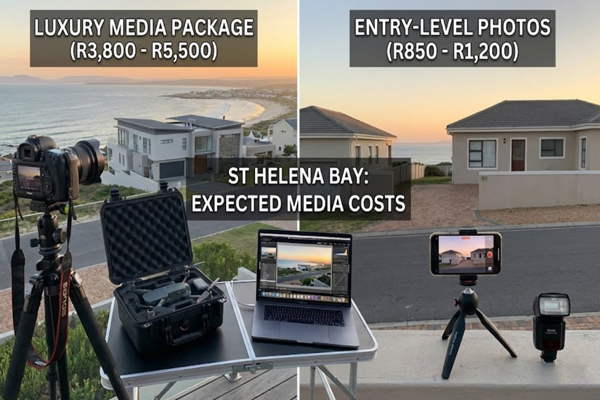
What Estate Agents Should Expect to Pay for Property Photos and Videos in St Helena Bay
Pricing Uncertainty Is a Common Source of Friction
For many estate agents, pricing for property photography and video feels inconsistent and opaque. Quotes vary widely. Services are bundled differently. Quality levels are not always obvious upfront. As a result, agents often struggle to understand what they should be paying, and why.
In St Helena Bay, this uncertainty is amplified by the nature of the market. Properties range from modest permanent residences to high-value lifestyle homes and coastal investments. Sellers are increasingly aware of presentation quality, yet agents still operate within defined marketing budgets.
Understanding how pricing works, what drives cost differences, and how to align spend with listing value is essential for agents who want predictable outcomes rather than trial and error.
Why Property Media Pricing Varies So Widely
Property media pricing is not based on a single factor. It reflects a combination of time, skill, equipment, post-production effort, and risk.
Two services that appear similar on paper can differ significantly in execution. One may involve basic capture with minimal editing. Another may include advanced lighting, colour correction, stabilisation, and multiple deliverables.
Without understanding these differences, agents may compare prices without comparing value.
In coastal markets like St Helena Bay, additional factors also influence pricing. Travel time, weather dependency, drone compliance, and scheduling constraints all affect cost structures.
Typical Pricing Tiers and Service Levels
While exact figures vary between providers, property media services generally fall into recognisable tiers.
At entry level, pricing covers basic photography or short video clips with minimal editing. These services are designed for speed and volume. They suit lower-value listings or situations where budget is the primary constraint.
Mid-range services include professional photography with balanced lighting, colour consistency, and a structured shooting approach. Video at this level typically includes smooth walkthroughs, basic aerial footage, and a polished edit suitable for listing platforms.
Premium services combine advanced photography, drone footage, and fully edited video storytelling. These packages focus on presentation, flow, and emotional impact. They require more time on site and significantly more post-production work.
Agents should expect pricing to increase as they move up these tiers, not arbitrarily, but because each level demands more resources and expertise.
Cost Versus Quality Trade-Offs
The most common mistake agents make is treating property media as a commodity rather than a performance tool.
Lower pricing usually reflects compromises somewhere in the process. Less time on site. Simpler lighting. Limited editing. Fewer revisions. These compromises may be acceptable for certain listings, but they become problematic when used indiscriminately.
Higher quality media tends to deliver stronger early engagement, better buyer perception, and smoother negotiations. While the upfront cost is higher, the downstream benefits often outweigh the savings made by choosing the cheapest option.
In practice, the trade-off is not cost versus quality, but cost versus outcome.
Bundled Pricing Versus Standalone Services
Many providers offer bundled packages that include photography, video, and drone media together. These bundles are usually priced more efficiently than booking each service separately.
Bundled pricing works well when agents plan campaigns holistically. A single shoot captures all required assets. Editing workflows are streamlined. Branding remains consistent across deliverables.
Standalone services make sense when agents already have certain assets or when a listing requires only one specific medium. However, repeated standalone bookings often result in higher total spend over time.
From an operational perspective, bundled services reduce coordination effort, scheduling complexity, and delivery delays.
Aligning Pricing With Listing Value
Not every listing requires the same level of investment. One of the most effective ways agents manage media costs is by aligning spend with listing value and strategy.
Higher-value properties justify higher media investment because presentation directly supports pricing confidence and buyer perception. Premium visuals reinforce premium positioning.
Lower-value or high-turnover listings may not require the same level of production, but still benefit from consistent baseline quality.
The key is intentional alignment rather than uniform spending across all listings.
Seller Expectations and Agent Responsibility
Sellers are increasingly exposed to high-quality property marketing through competing listings and social media. Many now expect professional visuals as a minimum standard.
When agents under-invest in media, sellers notice. They may not articulate it clearly, but confidence erodes when presentation feels basic or inconsistent with asking price.
Clear communication about media strategy and associated costs helps manage expectations. Sellers who understand why certain services are used are more likely to support the investment.
The Role of Location in Pricing
St Helena Bay presents specific logistical considerations. Travel distances, weather windows, and drone operating conditions can all influence pricing.
Providers servicing multiple towns across the West Coast often structure pricing to account for batching shoots and travel efficiency. Flexible scheduling can sometimes reduce costs, while urgent bookings may increase them.
Agents who understand these dynamics are better positioned to plan ahead and optimise spend.
Media Costs as Part of the Marketing Budget
Property media should not be viewed in isolation. It is part of the overall marketing budget alongside portals, advertising, and agent time.
Strong visuals improve the effectiveness of every other marketing channel. Listings perform better. Enquiries are stronger. Time on market is often reduced.
When viewed through this lens, media spend becomes an investment multiplier rather than a standalone cost.
Avoiding False Economy in Property Media
Choosing the cheapest option often leads to hidden costs. Poor visuals can result in weaker engagement, longer selling periods, and increased pressure to adjust pricing.
In contrast, well-executed media supports confidence throughout the sales process. Sellers are more patient. Buyers are more decisive. Negotiations are cleaner.
False economy in property marketing rarely saves money in the long run.
Setting Realistic Expectations as an Agent
Agents who understand pricing structures are better able to explain them to sellers and justify marketing decisions.
Clear expectations around what different price points deliver reduce friction and build trust. Sellers appreciate transparency, even when costs are higher than expected.
This clarity also protects the agent. Marketing outcomes are easier to defend when strategy and investment are aligned.
A Confident Closing
Property photography and video pricing in St Helena Bay reflects more than time behind a camera. It reflects skill, planning, editing, and the ability to present property in a way that supports buyer confidence and seller expectations.
Estate agents who understand pricing tiers, quality trade-offs, and alignment with listing value are better equipped to make informed decisions. They avoid over-spending where it is unnecessary and under-investing where it matters most.
When property media is treated as a strategic investment rather than a line item to minimise, it becomes a powerful support tool for faster sales, stronger mandates, and more consistent outcomes.
Agents who want predictable performance from their listings should expect to pay appropriately for the level of presentation their market demands and choose partners who deliver value, not just images.


