
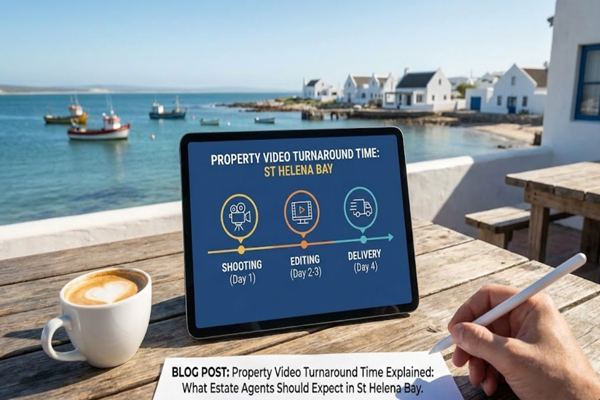
Property Video Turnaround Time Explained: What Estate Agents Should Expect in St Helena Bay
Turnaround Time Is a Workflow Issue, Not an Editing One
Property video has become a standard part of estate agent marketing in coastal towns. What continues to cause friction is not whether video should be used, but how long it takes to move from filming to a live listing.
In St Helena Bay, this question matters more than many agents expect. Buyer demand often comes from outside the immediate area. Listings are compared quickly. Early momentum plays a major role in how a property is perceived. When video delivery timelines are unclear or unrealistic, the entire listing launch becomes harder to manage.
Turnaround time is not a single step at the end of the process. It is the result of multiple coordinated actions between agent and videographer. Understanding those actions is what allows agents to plan confidently rather than react under pressure.
Why Misunderstanding Turnaround Time Creates Problems
Most frustration around video delivery comes from assumption. Agents often assume that once filming is complete, the video should follow shortly after. Videographers work within production workflows that include scheduling constraints, editing queues, quality control, and revisions.
When these realities are not discussed upfront, delays feel unexpected even when they are reasonable. Sellers become anxious. Agents feel the need to chase updates. Communication becomes reactive rather than structured.
In a close-knit market like St Helena Bay, where trust and reputation matter, this kind of friction quietly undermines confidence in the agent’s process.
What Property Video Turnaround Time Actually Includes
Turnaround time does not start when the camera is switched on and does not end when the edit is complete. It is a chain of dependent steps, each of which affects the next.
Before filming happens, there is coordination. Dates must align. Access must be arranged. The property must be ready. After filming, footage is backed up, reviewed, edited, colour balanced, stabilised, branded, and exported. Feedback may be requested. Revisions must be processed. Final approval is required before delivery.
If any one of these steps is delayed, everything that follows slows down. When agents understand this sequence, timelines become easier to manage and explain.
Coordination Between Agent and Videographer Sets the Pace
Efficient turnaround starts with coordination, not editing speed.
Videographers work fastest when they understand the objective of the video. Is it a short listing video, a lifestyle-focused edit, or a premium showcase? Each requires different decisions during filming and post-production.
Clear briefs save time. Property type, target buyer, preferred length, branding requirements, and platforms for use all influence how the video is structured. When this information is missing, decisions are delayed or revised later.
Agents who communicate clearly at the start reduce the likelihood of rework and speed up delivery without sacrificing quality.
Scheduling and Access Requirements Matter More Than Expected
In St Helena Bay, scheduling is rarely straightforward. Coastal conditions introduce variables that inland markets do not face.
Wind affects drone operations. Light changes quickly. Certain properties only look their best at specific times of day. Videographers often plan shoots around weather windows to avoid compromised footage.
Access is equally important. Properties that are not fully prepared or accessible at the scheduled time cause delays that ripple through post-production, especially when videographers are working across multiple towns on the West Coast.
Agents who build flexibility into scheduling often achieve faster overall turnaround than those who push for rigid dates under poor conditions.
Editing Queues and Production Capacity
One of the least understood aspects of turnaround time is the editing queue.
Videographers do not edit one project at a time in isolation. They manage multiple shoots, often across different towns, all requiring post-production. Editing is a skilled, time-intensive process that cannot be meaningfully rushed without consequence.
Queues exist to maintain quality and consistency. When agents understand this, delivery timelines feel intentional rather than slow.
Urgent delivery is sometimes possible, but it usually requires trade-offs or additional capacity. Treating urgency as the exception rather than the norm protects both quality and relationships.
Revisions and Feedback Shape Final Delivery Time
Editing itself is rarely the main cause of delay. Feedback is.
When feedback is vague, fragmented, or delayed, the process stalls. A video ready for review but waiting days for approval is effectively paused.
Clear, consolidated feedback allows revisions to be completed quickly. Knowing who reviews the video, how feedback is shared, and how quickly approval is given keeps momentum intact.
Agents who manage this internal process well consistently experience faster delivery.
Realistic Turnaround Timelines in St Helena Bay
With good coordination, estate agents can set realistic expectations.
Filming usually happens within a few days of booking, depending on weather and access. Initial edits are commonly delivered within several working days after filming. Final versions follow shortly after feedback is approved.
These timelines allow for quality control and professional execution. Attempts to compress them aggressively often result in compromised output or rework that ultimately slows the listing down.
Speed achieved through organisation is sustainable. Speed achieved through pressure is not.
Why Rushed Timelines Reduce Quality
Rushed production introduces subtle problems that buyers notice even if they cannot articulate them clearly.
Poor pacing, uneven colour, missed contextual shots, and technical inconsistencies all reduce the effectiveness of a video. In some cases, rushed work leads to reshoots or extensive revisions, delaying the listing further.
In coastal markets where presentation and perception play a large role in buyer confidence, these issues matter.
Agents who prioritise quality alongside speed protect the long-term performance of their listings.
Seller Confidence Is Tied to Visible Progress
From a seller’s perspective, turnaround time signals professionalism.
Smooth execution and clear communication build trust. Delays without explanation create uncertainty, even when the delay itself is reasonable.
Agents who explain the process upfront and provide realistic timelines rarely face pressure later. Sellers are far more patient when they understand what is happening and why.
This clarity turns turnaround time into a trust-building mechanism rather than a point of tension.
Integrating Video Timelines Into Marketing Planning
Video turnaround should be part of the broader marketing plan, not a separate task.
Agents who plan listing launches around realistic delivery timelines avoid partial releases and staggered updates. Photography, video, copy, and portals go live together, creating stronger first impressions.
This coordination also supports brand consistency across multiple listings, reinforcing professionalism over time.
Predictability Is More Valuable Than Raw Speed
While fast delivery is attractive, predictability is more important.
Sellers prefer knowing when something will be ready rather than hoping it will be ready quickly. Predictable timelines allow agents to communicate confidently and maintain control over the process.
In St Helena Bay, where reputation and repeat business matter, predictability becomes a competitive advantage.
Workflow Discipline Creates Sustainable Speed
The fastest agents are not the most demanding. They are the most organised.
Prepared properties, clear briefs, coordinated shoots, structured feedback, and timely approvals remove friction at every stage. Each small efficiency compounds into meaningful time savings.
Turnaround time becomes consistent rather than stressful.
A Confident Closing
Property video turnaround time is not an afterthought. It is a workflow outcome shaped by coordination, planning, and communication.
Estate agents in St Helena Bay who understand the production process, respect realistic timelines, and avoid rushed delivery achieve smoother launches and stronger seller confidence. They reduce friction, protect quality, and present listings professionally from day one.
Fast turnaround comes from preparation, not pressure. Agents who treat it as part of their operational strategy position themselves for more predictable results in a competitive coastal market.
If you want property video to support your listings rather than complicate them, understanding turnaround time is not optional. It is part of how professional campaigns are delivered.


