
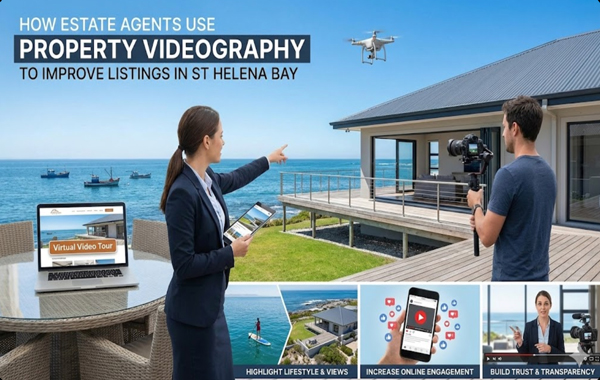
How Estate Agents Use Property Videography to Improve Listings in St Helena Bay
Property Listings Are Won or Lost on Clarity
Most property listings do not fail because they are overpriced or poorly located. They fail because buyers cannot understand them quickly enough.
In St Helena Bay, buyers compare listings at speed. Many are not local. Some are lifestyle buyers. Others are retirees or long-term investors scanning the market from a distance. Their first interaction with a property happens online, often in seconds.
If a listing does not explain itself clearly at that moment, it is filtered out. Property videography has become one of the most effective tools estate agents use to prevent this loss of attention and turn passive views into confident engagement.
Estate Agent Goals When Marketing a Listing
When estate agents market a property, they are trying to achieve more than visibility.
The real goals are to attract the right buyers, reduce friction in the decision process, support the asking price, and maintain seller confidence from launch through negotiation.
Property videography supports all of these objectives simultaneously. It does not replace photography, descriptions, or portals. It strengthens how they work together.
Agents who understand this use video strategically rather than decoratively.
The Limitation of Photo-Only Listings
Photography captures moments. Videography explains experience.
Photos show individual rooms but rarely communicate how those rooms connect. Buyers are left to imagine circulation, scale, and flow. This creates uncertainty, even when the property is appealing.
In St Helena Bay, where many homes share similar finishes and layouts within the same price bands, this uncertainty becomes a decision blocker. Buyers move on not because the property is wrong, but because understanding it requires effort.
Video removes that effort.
Why Video Increases Engagement on Property Portals
Property portals are designed for speed. Buyers scroll quickly, pausing only when something holds attention.
Video introduces movement, narrative, and orientation. Listings with video consistently keep buyers engaged longer because they answer questions faster.
Instead of jumping between photos and guessing layout, buyers watch and understand. Time on listing increases. Return visits become more common. Enquiry likelihood rises.
For estate agents, this means fewer wasted impressions and higher-quality engagement from the exposure they already receive.
How Videography Communicates Layout and Flow
Layout is one of the most important yet hardest elements to communicate through still images.
A well-produced property video guides the viewer naturally through the home. Entry points make sense. Living areas connect logically. Bedrooms feel placed rather than isolated. Outdoor spaces relate clearly to interior living.
This is especially important in St Helena Bay, where buyers often think long-term. They are evaluating how a home will function day to day, not just how it looks in isolation.
Videography shows livability, not just aesthetics.
Reducing Buyer Uncertainty Before Contact
Uncertainty delays action.
Buyers hesitate when they are unsure about layout, orientation, or how a home feels as a whole. Video reduces this hesitation by showing reality rather than implying it.
As a result, enquiries that follow video engagement are more confident. Buyers ask about availability, pricing, and process rather than basic clarification questions.
This improves efficiency for agents and shortens the path from first interest to serious discussion.
Videography as a Credibility Signal
Buyers read professionalism visually before they ever speak to an agent.
Listings with professional videography signal effort, care, and transparency. They suggest the agent and seller are confident enough to show the property openly rather than selectively.
In coastal markets like St Helena Bay, where many buyers are unfamiliar with the area and cautious about remote decision-making, this signal matters.
Videography builds trust before conversation begins.
Supporting Seller Confidence Through Video
Property videography is also a seller-facing tool.
Sellers want reassurance that their property is being marketed properly. When they see a professional video integrated into the listing, confidence increases. They feel supported rather than exposed.
This confidence often leads to better alignment on pricing strategy and greater patience during negotiations. Sellers trust the process because they can see it working.
Agents who use video well spend less time defending their marketing decisions and more time progressing deals.
How Video Pre-Qualifies Buyers
Not all engagement is equal.
Video acts as a natural filter. Buyers who invest time watching a property video are more serious than those who skim photos. They arrive at enquiries with clearer expectations and stronger intent.
Viewings become confirmation rather than exploration. Fewer viewings are needed to reach an offer. Cancellations and no-shows decrease.
For agents, this improves time management. For sellers, it reduces disruption.
Strengthening Portal Performance Without Extra Spend
Property videography does not require new platforms to be effective. It improves performance within existing ones.
Listings with video often stand out visually, feel more complete, and are remembered more easily. Even buyers who do not watch the full video are influenced by its presence.
In competitive searches across the West Coast, this distinction affects which listings are explored further and which are ignored.
Video increases the return on the exposure agents are already paying for.
Integrating Videography With Photography and Copy
Videography works best as part of a system.
Photography captures detail and stillness. Video explains flow and experience. Copy adds context and emphasis.
When these elements are aligned, buyers receive consistent signals about who the property is for and why it matters. Listings feel intentional rather than assembled.
Agents who plan video alongside photography and copy launch stronger, more coherent listings.
Why Videography Matters Specifically in St Helena Bay
St Helena Bay attracts buyers for lifestyle, setting, and long-term suitability.
Many are remote buyers comparing multiple towns and properties before committing to a visit. For them, videography is not a bonus. It is a decision-making tool.
Video helps buyers assess whether a property fits their needs before travel, saving time for both buyer and agent.
In this market, videography directly supports buyer confidence and seller satisfaction.
Long-Term Brand Impact for Estate Agents
Every listing contributes to an agent’s reputation.
Agents who consistently use professional videography position themselves as modern, transparent, and buyer-focused. Over time, this attracts better sellers and more realistic buyers.
In smaller coastal markets, reputation compounds quickly. Videography becomes part of how agents are recognised and recommended.
Avoiding Common Videography Mistakes
Not all video improves listings.
Rushed production, poor pacing, or unfocused storytelling can undermine credibility. Videography should prioritise clarity over spectacle.
Effective agents brief videographers clearly, plan shots intentionally, and ensure video aligns with the listing strategy rather than distracting from it.
When used with discipline, videography strengthens listings rather than overwhelming them.
A Confident Closing
Property videography improves listings in St Helena Bay by doing what photos alone cannot. It explains layout, demonstrates flow, reduces uncertainty, and builds trust before contact is made.
Estate agents who use videography strategically increase engagement on portals, attract better-qualified buyers, and maintain stronger alignment with sellers. They reduce friction throughout the sales process and improve overall listing performance.
In a market where buyers decide quickly and visually, videography is not about making listings look impressive. It is about making them understandable and trustworthy.
Agents who treat videography as a core listing strategy rather than an optional extra position themselves for stronger results, smoother negotiations, and long-term credibility across the West Coast.


