
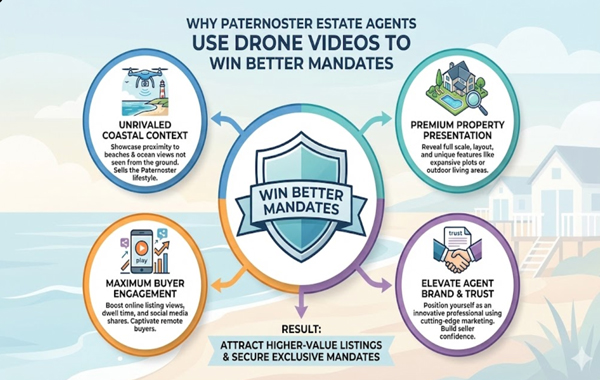
Why Estate Agents in Paternoster Use Drone Videos to Win Better Mandates
Mandates Are Won on Perception Before Performance
In competitive coastal markets, estate agents rarely lose mandates because of a lack of experience or effort. They lose them because sellers make early judgements about perceived marketing quality long before performance can be measured. This evaluation often happens during the first interaction, the listing presentation, or even before formal contact is made.
In Paternoster, where property value is closely tied to location, lifestyle, and scarcity, sellers are particularly sensitive to how their homes will be positioned in the market. Many are not motivated sellers. They are selective. They want confidence that their property will be represented in a way that reflects its setting and long-term value.
Drone video has emerged as one of the most effective ways agents influence this perception. Not as a technical feature, but as a signal of strategic intent.
The Core Problem: Agents Sound the Same to Sellers
Most listing presentations follow a familiar structure. Agents describe their experience, outline portal exposure, explain buyer databases, and promise professional photography. While these elements are important, they are also expected. Sellers hear similar language from multiple agents, making it difficult to distinguish genuine capability from routine practice.
This creates a subtle problem. When sellers cannot clearly see how one agent’s marketing differs from another’s, the decision becomes emotional or arbitrary. Comfort, familiarity, or convenience take precedence over strategic alignment.
In a market like Paternoster, where pricing precision and buyer targeting matter, this lack of differentiation undermines an agent’s ability to secure premium mandates.
Why Sellers Judge Marketing Quality Visually
Sellers may not understand marketing frameworks, but they understand presentation. Visual quality becomes a shortcut for competence. When sellers assess how their property will be marketed, they imagine how it will appear online, how it will be perceived by out-of-town buyers, and whether it will stand out among competing listings.
Static interior photography answers basic questions about layout and finish, but it does not explain context. It does not show proximity to the sea, elevation, neighbourhood density, or spatial relationships. In coastal markets, these factors heavily influence perceived value.
Drone video fills this gap. It transforms abstract location claims into visible reality. This shift has a direct impact on seller confidence.
Drone Video as a Mandate Differentiator
Drone video changes the mandate conversation by removing ambiguity. Instead of describing marketing quality, agents are able to demonstrate it. This demonstration carries weight because it requires no interpretation from the seller.
From a seller’s perspective, drone video suggests planning rather than habit. It implies that the agent has considered how buyers evaluate property and has chosen tools that support that behaviour. This distinction matters when multiple agents are competing for the same listing.
In practical terms, drone video allows agents to position themselves as specialists rather than generalists. It signals familiarity with the nuances of the area and an understanding of how location contributes to value.
Competitive Listings and Decision Friction
High-quality listings in Paternoster often attract multiple agents. Sellers compare presentations closely, even if they do not articulate their criteria explicitly. In these situations, small differences in perceived professionalism can have outsized effects.
Drone video reduces decision friction. It gives sellers a concrete reason to prefer one agent over another without relying on subjective impressions. The presence of aerial footage introduces contrast, and contrast simplifies choice.
This is particularly relevant in smaller markets, where reputations circulate quickly and visual consistency becomes part of an agent’s identity.
Seller Confidence and Price Alignment
Marketing quality influences more than mandate selection. It also affects how sellers engage with pricing strategy. Sellers who feel confident in their agent’s marketing approach are more receptive to realistic pricing guidance and less inclined to test inflated asking prices.
Drone video contributes to this confidence by reinforcing the idea that the property’s strengths are being fully communicated. Sellers are reassured that buyers will understand location benefits without requiring explanation during viewings.
This dynamic often leads to smoother negotiations and fewer pricing corrections later in the sales process.
Long-Term Brand Positioning for Estate Agents
Beyond individual listings, drone video plays a role in long-term brand perception. Agents who consistently incorporate aerial footage develop a recognisable visual style. Their listings share a common language that signals quality and attention to detail.
Over time, this consistency affects how sellers perceive the agent before any direct interaction occurs. It positions the agent as forward-thinking, visually competent, and aligned with modern buyer expectations.
In coastal regions like the West Coast, where many buyers search remotely, this form of visual credibility is especially influential.
Property Marketing ROI From an Agent Perspective
While drone video is often evaluated in terms of engagement metrics, its return for estate agents is broader and less immediate. The primary return is not clicks or views, but improved mandate quality and reduced resistance throughout the sales process.
Agents who use drone video strategically often experience fewer objections related to marketing effort, greater seller patience during listing periods, and stronger trust during negotiations. These outcomes are difficult to quantify but materially affect performance.
In this sense, drone video functions as a positioning tool rather than a transactional one.
Changing Expectations in Coastal Property Marketing
Buyer behaviour has evolved. Video is no longer supplementary; it is central to how properties are evaluated. Sellers observe this shift indirectly through listing platforms, social media, and competing properties in their area.
As expectations rise, agents who rely solely on traditional photography risk appearing misaligned with current market norms. This misalignment does not necessarily reflect service quality, but perception often overrides reality.
Drone video aligns agent presentation with how property is now consumed and compared.
A Quiet Shift in Mandate Standards
The growing use of drone video among estate agents in Paternoster reflects a broader change in how professionalism is judged. Sellers are no longer impressed by claims alone. They respond to visible evidence of marketing capability.
As more agents adopt aerial video, it transitions from a differentiator to a baseline expectation. Those who integrate it early establish credibility that compounds over time, while those who resist the shift face increasing difficulty standing out.
In Paternoster and similar coastal markets, drone video has become part of the unspoken standard against which estate agents are measured.


